
Tech
Crew 12 Launch
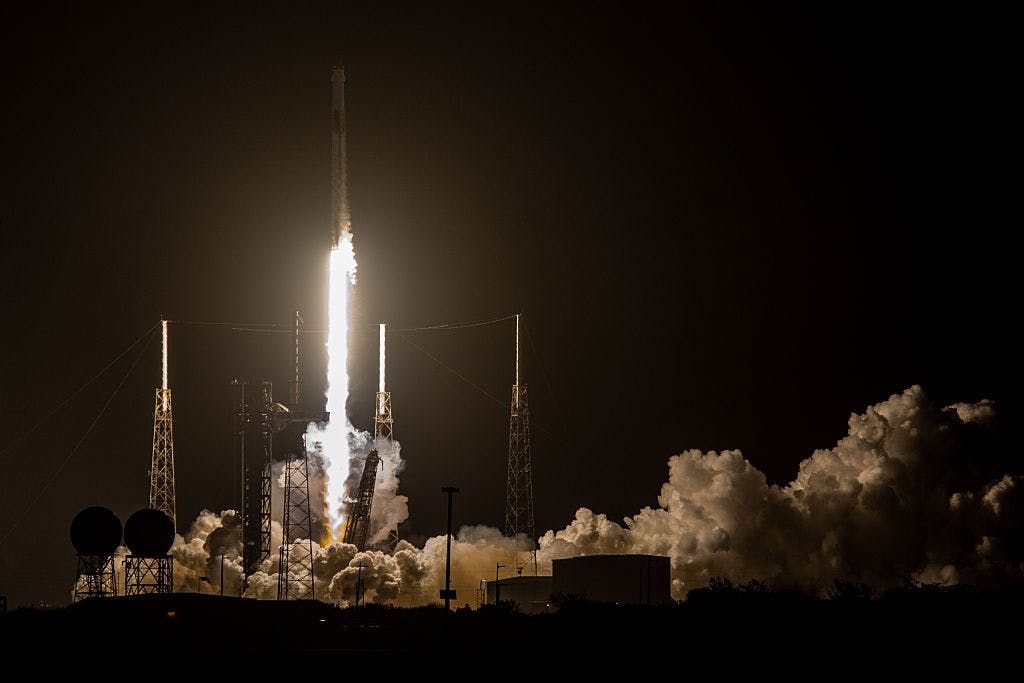
The Falcon 9 rocket launches with Crew 12 from Complex 40 at the Cape Canaveral Space Force Station (Manuel Mazzanti/Getty Images)

SpaceX to expand Starlink’s mobile coverage as it seeks $1.75 trillion IPO valuation

Starlink expects to connect 25 million monthly users by the end of the year on a service the company says will allow video calls and streaming.

Rani Molla

At the Mobile World Congress keynote Monday morning, SpaceX President Gwynne Shotwell and Starlink VP of Engineering Michael Nicolls said the company plans to offer broadband-level cellular service through its direct-to-cell product, now branded Starlink Mobile.

The company aims to grow from 10 million active monthly users today to 25 million by the end of 2026. The service is designed to give consumers access to high-speed internet, including video calls in remote areas using unmodified smartphones.

“ When your phone’s in your pocket, when you’re in your car and you’re connected to Starlink Mobile, it should look and feel like you’re connected to a high-performing 5G terrestrial network,” Nicolls said. “That kind of experience is what we’re shooting for.”

Still, SpaceX emphasized that satellite service is not meant to replace traditional cellular networks. “It cannot provide the data density that terrestrial networks have,” Nicolls said, while contending that it can augment coverage in areas where land-based networks don’t reach or when additional capacity is needed — a category that includes large portions of the US and much of the world.

For now, SpaceX is positioning Starlink Mobile as a complement to carriers like AT&T and Verizon rather than a direct competitor. The service is meant to fill coverage gaps in remote areas, at sea, and during emergencies when terrestrial networks go down. Shotwell noted that T-Mobile was SpaceX’s first — and remains its only — US carrier partner.

The mobile push comes as SpaceX expands its ambitions beyond launch services. Last month, the company announced it had acquired SpaceX CEO Elon Musk’s AI startup, xAI, creating a combined company that spans rockets, satellite broadband, mobile connectivity, and artificial intelligence. Bloomberg reported Friday that SpaceX is preparing to file IPO paperwork with the Securities and Exchange Commission as soon as March, targeting a valuation as high as $1.75 trillion. At the time of the merger, the combined company was valued at around $1.25 trillion. The higher valuation estimate suggests investors see businesses like Starlink’s internet service, and potentially Starlink Mobile, as key drivers of revenue beyond rocket launches.


More Tech

See all Tech
tech

Anthropic has surged past OpenAI in capturing business spending on generative-AI software

Last quarter, Anthropic attracted the lion’s share of trackable business spending on generative-AI software, according to new data from Ramp, a fintech company that provides corporate cards and expense management software for small firms and Fortune 500 companies alike.

The data showed that in the first quarter, Anthropic saw 37% of spending, its biggest share yet, versus 33% for OpenAI. Notably, the dataset doesn’t capture spending by Google or Microsoft.

OpenAI, which makes ChatGPT, still leads in overall adoption at 81% of AI buyers, but Anthropic is catching up, at nearly 63% in March. Overall, more than half of Ramp’s customers currently pay for AI, up from just 18% two years ago.

Anthropic’s enterprise tools, including Claude Code and Cowork, have been making waves among the business class, sending its revenue soaring.

Anthropic’s revenue share is even higher among companies spending on AI for the first time.

“Anthropic has definitely been on a tear,” Ara Kharazian, Ramp’s economist, told Sherwood News. “Its increase in adoption rates has been driven by its ability to sell to less technical users and smaller contracts than it typically has.”

It’s notable that midway through the first quarter, Anthropic had a falling-out with one of its biggest customers, the US government, which near the end of February decided to shun Anthropic’s products and lean into working with OpenAI.

tech

Report: Google ditches its objection to defense work, pitches Gemini to Pentagon

In 2018, Google employees protested against the company’s tech being used for the US military’s Project Maven — a drone targeting program — reminding the company of its “don’t be evil” motto.

After the controversy, the company declined to renew the contract with the Pentagon, drawing a bright line between Big Tech and the national security establishment.

What a difference a few years makes.

Google is now actively working to get its Gemini AI model to be used in classified national security settings, according to a new report from The Information. Seeking a similar deal to the one OpenAI hashed out with the Pentagon, Google reportedly wants a contract that allows use of Gemini in classified work, but with a prohibition on mass domestic surveillance and autonomous lethal weapons.

But Google is playing catch-up in a major way. Amazon and Microsoft both have been widely used for classified defense work, and contractors are already experienced in working with their cloud systems, while Google’s services have never been used in classified work.

What a difference a few years makes.

Google is now actively working to get its Gemini AI model to be used in classified national security settings, according to a new report from The Information. Seeking a similar deal to the one OpenAI hashed out with the Pentagon, Google reportedly wants a contract that allows use of Gemini in classified work, but with a prohibition on mass domestic surveillance and autonomous lethal weapons.

But Google is playing catch-up in a major way. Amazon and Microsoft both have been widely used for classified defense work, and contractors are already experienced in working with their cloud systems, while Google’s services have never been used in classified work.

1 in 5

We knew Tesla had been off-loading its struggling “apocalypse-proof” Cybertrucks onto CEO Elon Musk’s other companies, but now we know just how many.

The EV company sold about one in five Cybertrucks registered in the US in the fourth quarter to Musk’s other ventures, according to Bloomberg, citing data from S&P Global Mobility. The lion’s share went to SpaceX, which accounted for 1,279 of the 7,071 total registrations, while another 60 went to xAI (now part of SpaceX), Neuralink, and The Boring Company. All told, these inter-company sales represent roughly $100 million in value, and a vital lifeline for a vehicle that has failed to gain traction with the public, forcing Tesla to scale back production.

Musk’s companies have continued to scoop up the stainless steel behemoths this year, with another 158 Cybertruck purchases in January and 67 in February.

tech

TSMC CEO on Tesla and Intel’s Terafab: “There are no shortcuts”

Tesla CEO Elon Musk has reportedly asked the chip industry suppliers for his Terafab chipmaking project to move at “light speed” in an effort to help Tesla and SpaceX manufacture the AI chips they need.

On the company’s last earnings call, Musk said chip supply would be the “limiting factor” for Tesla’s growth in about three or four years. During a presentation for Terafab last month, Musk said, “We either build the Terafab or we don’t have the chips.” More established chipmaker Intel has since joined the effort.

Still, the world’s largest chipmaker isn’t convinced that “light speed” is physically possible. Speaking on an earnings call this morning, TSMC Chairman and CEO CC Wei offered a blunt assessment of Terafab’s ambitious timeline: “There are no shortcuts.” According to Wei, the physics of a modern foundry, which he says takes roughly five years to build and ramp, remains the ultimate speed limit, regardless of the customer’s urgency. “That’s a fundamental of the foundry industry,” he said.

Wei noted that Tesla remains a TSMC customer.

Latest Stories

Sherwood Media, LLC produces fresh and unique perspectives on topical financial news and is a fully owned subsidiary of Robinhood Markets, Inc., and any views expressed here do not necessarily reflect the views of any other Robinhood affiliate, including Robinhood Markets, Inc., Robinhood Financial LLC, Robinhood Securities, LLC, Robinhood Crypto, LLC, Robinhood Derivatives, LLC, or Robinhood Money, LLC. Futures and event contracts are offered through Robinhood Derivatives, LLC.
