

Tech
Chatbot speech bubbles
(Getty Images)
out of character

Teens are upset that they can’t speak to Character.AI chatbots anymore

The platform has restricted access for those under 18, as concerns around the tech’s impact grow.

Tom Jones

As far as execs at Character.AI are concerned, (role) playtime’s over for under-18s, as they start to ban teens from using the platform’s chatbots this week

The chatbot company, which clocks about 184 million website visits around the world each month — and millions more app sessions — per data from Similarweb, announced at the end of last month that it would be rolling back access to its open-ended chat feature for minors. Users who are under 18 have been limited to daily two-hour open-ended chats since the late October notice, and access started ramping down for most of those in the age range yesterday.

Indeed, a selection of young “power users,” as The Wall Street Journal termed them in a piece on the anguish some under-18 users are experiencing at being separated from the chatbots, are being given a weeks-long grace period where they can still access hour-long open-ended chats with the characters they’ve been interacting with, to “help minimize disruption” to the teen users.

Clearly, AI-generated conversations with popular characters like Yor Forger, “a loving mom who’s definitely not an assassin,” and Itoshi Rin, who “only loves soccer... and you,” have a lot of (mostly younger) users in the site’s full thrall.
Character.ai demographic chart
Sherwood News

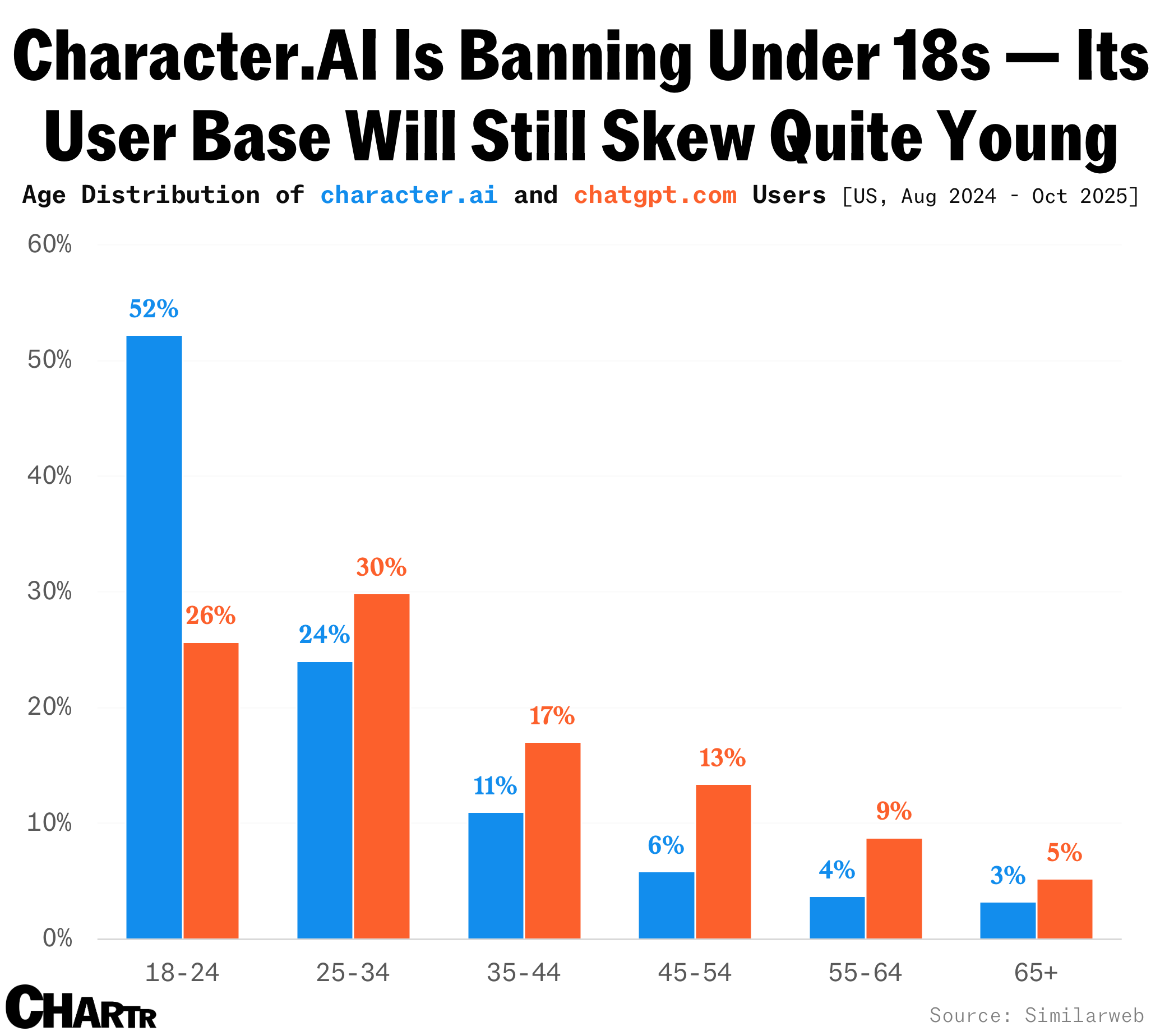
Though traffic-tracking site Similarweb doesn’t break out under-18s in its demographics data, the figures it does disclose already show that Character.AI tends to skew a lot younger than more general competitors like ChatGPT.

According to US-specific figures from Similarweb, of the 1.7 million monthly unique web visitors character.ai notched on average from August to October, some 52% were aged between 18 and 24, compared to a 26% share on chatgpt.com.

A lot to talk about

Character.AI’s younger users tend to be way more locked in, too: per the data, they visited 26 times each month on average and spent 18 minutes in a typical session using Character.AI — much higher than ChatGPT users, who visited the OpenAI chatbot 13 times on average across the month, spending around 6 minutes per visit.

Those sorts of numbers, paired with deaths linked to the platform and increasing concerns around the detrimental effects of chatbots on younger minds more generally, were likely factors in the move to pare back teen user access, which — at least according to Character.AI CEO Karandeep Anand — “wasn’t a very hard decision.”


More Tech

See all Tech
<10%

Despite a massive surge in corporate AI spending, the technology is broadly failing to deliver the massive cost reductions executives had anticipated, according to a new global survey from Bain & Co. shared with Bloomberg. The largest share of major companies measuring their AI returns — 40% — realized cost savings of 10% or less, with poor access to internal data cited as the primary roadblock. Most had expected higher returns. More concerningly, Bain warned that many companies are using their original, overly optimistic projections — rather than their actual savings — to justify funding their next wave of expensive AI investments, creating a “circular bet with a structural leak.”

tech

Anthropic confidentially files for IPO

Anthropic has filed confidentially with the Securities and Exchange Commission for its initial public offering. The IPO is expected to be one of the largest in US history, and will likely be joined by OpenAI, which is also expected to go public before the end of the year.

The company filed a draft S-1 form with the SEC, which does not indicate the price of the offering. The official public S-1, which will come later, will give potential shareholders a first look at the finances of Anthropic, which just last week announced that it raised $65 billion, reaching a valuation of $965 billion. This puts the company well ahead of archrival OpenAI, which is currently valued at $850 billion.

tech

Prosus may thwart Uber’s bid for Delivery Hero

Uber’s aggressive pursuit of Delivery Hero could hit a major roadblock. After the European food delivery giant rejected Uber’s initial $11.6 billion buyout offer, the American company pivoted, scooping up a 37% stake in the open market.

Now, Prosus, formerly Delivery Hero’s largest shareholder, is plotting a counteroffensive.

Thanks to an EU regulatory waiver Monday that temporarily pauses its mandatory stock sell-down, the Amsterdam-based investment firm is reportedly looking to either increase its stake or rally other shareholders against Uber. The goal: block the takeover entirely or force a significantly higher premium.

Prosus has warned about the loss of European tech relevance if a US giant swallows the company. Meanwhile, investors are loving the drama: the takeover tug-of-war, which also includes DoorDash, has sent Delivery Hero stock soaring over 75% in the past month.

Thanks to an EU regulatory waiver Monday that temporarily pauses its mandatory stock sell-down, the Amsterdam-based investment firm is reportedly looking to either increase its stake or rally other shareholders against Uber. The goal: block the takeover entirely or force a significantly higher premium.

Prosus has warned about the loss of European tech relevance if a US giant swallows the company. Meanwhile, investors are loving the drama: the takeover tug-of-war, which also includes DoorDash, has sent Delivery Hero stock soaring over 75% in the past month.

tech

Tesla sales surge in European markets in May

Tesla sales surged across Europe in May, Reuters reports, with sales jumping double and even triple digits in a number of early-reporting markets. Of course, 2025 was a very difficult year for Tesla sales in Europe, so the growth is coming off notably small denominators.

Interestingly, the resurgence is happening without EU approval for supervised Full Self-Driving, something CEO Elon Musk predicted would cause sales to “improve significantly” after blaming the absence of the tech for its weak sales.

The company has received approval for a version of its FSD tech in the Netherlands, as well as Lithuania and Estonia, and expects “EU-wide” permission in the second or third quarter.

Latest Stories

Sherwood Media, LLC and Chartr Limited produce fresh and unique perspectives on topical financial news and are fully owned subsidiaries of Robinhood Markets, Inc., and any views expressed here do not necessarily reflect the views of any other Robinhood affiliate, including Robinhood Markets, Inc., Robinhood Financial LLC, Robinhood Securities, LLC, Robinhood Crypto, LLC, Robinhood Money, LLC, Robinhood U.K. Ltd, Robinhood Derivatives, LLC, Robinhood Gold, LLC, Robinhood Asset Management, LLC, Robinhood Credit, Inc., Robinhood Ventures DE, LLC and, where applicable, its managed investment vehicles.
