
Tech
Self Driving Taxi Company Waymo Voluntarily Issues Software Recall Over Cars Not Stopping For School Buses
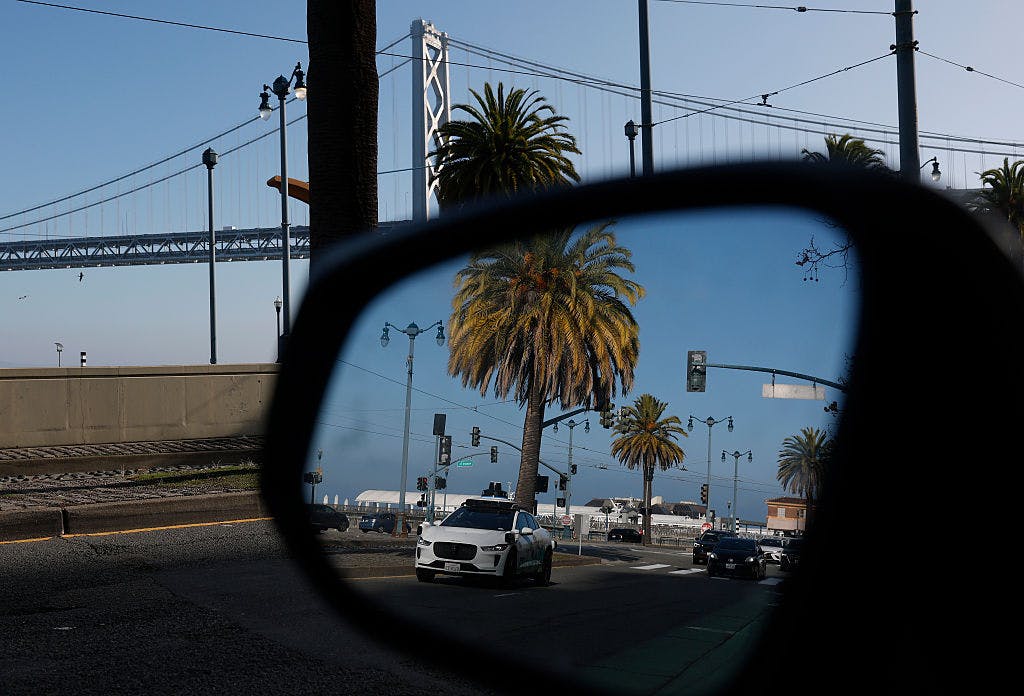
A Waymo robotaxi in a side-view mirror in San Francisco, California (Justin Sullivan/Getty Images)

Tesla’s Robotaxi is way cheaper than Uber, Lyft, or Waymo — but you’ll have to wait a lot longer for one

New data from ride-share comparison app Obi shows how much cheaper and less available Tesla’s autonomous ride-share service is.

The average price of a Tesla Robotaxi ride in the San Francisco Bay Area late last year was $8.17 — about half the cost of comparable routes with Lyft, Uber, or Google’s driverless Waymo, according to new data from ride-share comparison app Obi.

However, wait times for Tesla’s Robotaxis, which operate in the Bay Area with a driver, are roughly 3x to 5x longer than those of competing services. Tesla customers wait an average of nearly 16 minutes for their cheaper ride, compared to about three to six minutes for other services.

For this study, Obi analyzed more than 94,000 simulated ride requests from November and December across the four companies, using technical tools including APIs. The data came from a local database and includes hourly information on ride requests, prices, and estimated arrival times.

As was the case with Uber and Lyft in their early days, Tesla’s low prices appear aimed more at attracting customers than turning a profit. Robotaxi prices initially launched at an intentionally provocative $4.20 and rose to the equally tongue-in-cheek $6.90 before transitioning to industry-standard dynamic pricing. CEO Elon Musk has said Robotaxi rides would eventually cost about as much as a bus ticket.

 “Its a way to gather more data, and get more individuals in the cars and familiar with the brand,” Obi CEO Ashwini Anburajan told Sherwood News. “Theyre positioning themselves as a low-cost option in the market.”

Pricing is also central to Tesla’s broader narrative. By relying solely on cameras instead of costly lidar sensors used by competitors like Waymo, Tesla can afford to charge less.

While it remains unclear what Tesla Robotaxi rides will ultimately cost once the business matures, low prices are a powerful way to attract customers. Obi also surveyed consumers in markets where autonomous vehicles are available and found that pricing was their top pain point, with 45% calling it a major ride-share issue in 2026. That said, the next biggest problem was wait times, cited by 34% of respondents and an area where Tesla lags its rivals.

Tesla’s long wait times stem largely from its small fleet, which has ramped up far more slowly than the company promised. During the study period, just over 100 Tesla Robotaxis were in service in the Bay Area; today that number is closer to 170 — well short of Musk’s most recent promise to deploy 1,000 vehicles in the region by the end of 2025.

“Its not something that they can sustain if they want to be in the market competitively,” Anburajan said. “Ride-share is an impatient industry with consumers — wait times matter significantly.”

Waymo’s wait times outside peak demand have fallen since Obi first conducted its ride-share pricing and ETA study last spring, and are now often comparable to Uber and Lyft.

At the same time, the 30% to 40% price premium Waymo once commanded over traditional ride-hailers has narrowed significantly, nearly disappearing for longer trips. That shift reflects both Waymo lowering prices and Uber and Lyft raising theirs, per the report.

Competition in the Bay Area has also grown in that time.

Tesla expanded its service there in July, and Amazon’s Zoox entered the market in November, offering a free, limited-destination service to the public. Uber and Lucid have also begun testing their own robotaxi service, which is expected to become publicly available later this year.

The data points to a familiar trade-off in ride-hailing: riders care deeply about price, but only up to a point. Cheaper fares can lure customers in, but long wait times quickly erode that advantage. As competition intensifies across both autonomous and traditional services, success may hinge less on undercutting rivals and more on delivering a ride that’s both affordable and timely.

More Tech

See all Tech
tech

Georgia lawmakers introduce data center construction moratorium amid statewide pushback

More and more communities across the US are wrestling with the pros and cons of having a data center come to town. Georgia has become a hotspot of resistance to the data centers planned by Big Tech, according to a new report from The Guardian. The Atlanta metro area led the nation in data center construction in 2024.

Georgia state representatives introduced legislation that would place a one-year moratorium on data center construction in the state. Ten Georgia municipalities have already passed local bans on data centers.

Per the report, at least three other states have seen similar data center moratorium legislation introduced in the last week, including Maryland and Oklahoma.

Georgia state representatives introduced legislation that would place a one-year moratorium on data center construction in the state. Ten Georgia municipalities have already passed local bans on data centers.

Per the report, at least three other states have seen similar data center moratorium legislation introduced in the last week, including Maryland and Oklahoma.

tech

Corning soars after striking deal to sell up to $6 billion in optical infrastructure to Meta

Glass company Corning is soaring in early trading after announcing a $6 billion deal with Meta to provide its data centers with fiber-optic cable products. Thanks to a string of big tech deals — including partnerships with Broadcom and Apple — Corning’s stock is up about 100% over the past year.

A 175-year-old glass manufacturer, Corning is known for its Gorilla Glass, used in smartphone and laptop screens. It was known in the past for its iconic blue cornflower CorningWare ceramics, a consumer cookware business it spun off in the 1990s.

In an interview, Corning CEO Wendell Weeks told CNBC that he thinks “next year the hyperscalers will be our biggest customers,” amid demand from tech giants including Google and Microsoft.

tech

Wedbush’s Dan Ives predicts Tesla FSD penetration will rise from 12% to above 50%, but doesn’t say how

Ahead of earnings Wednesday, a new note on Tesla from Wedbush Securities analyst Dan Ives argues the company is on the cusp of a Robotaxi-driven transformation, with Full Self-Driving penetration rising above 50% and autonomy unlocking as much as $1 trillion in value — putting Tesla on a path to a $2 trillion to $3 trillion market cap over the coming year.

The issue isn’t the optimism; it’s the absence of mechanics. FSD penetration across Tesla’s global fleet currently sits in the low teens. The note doesn’t explain how Tesla bridges that gap — whether through pricing changes, bundling, or a behavioral shift among mass-market buyers. Tesla is ending the option to buy FSD outright in favor of subscriptions, but that alone isn’t going to push adoption from roughly 12% to 50%.

Ives treats Teslas Robotaxi progress as inevitable rather than conditional. The removal of safety drivers in Austin — which for now is isolated to two or three vehicles and involves using an extra car to follow the Robotaxi — is framed as a tipping point. But there’s little discussion of scaling risks, regulation, real-world performance data, or actual demand. Ives only says President Trump will likely issue an executive order on autonomous rules and regulatory hurdles will effectively disappear — with the implication that FSD adoption would accelerate rapidly.

Even near-term fundamentals are stretched to support the narrative. Tesla didn’t beat Q4 delivery expectations, though Ives says it did, having previously cited whisper numbers rather than the analyst consensus. That claim is then used to clear the runway for a valuation argument focused almost entirely on future autonomy.

In the end, this is less an earnings preview note than a statement of belief: autonomy works; adoption follows; Tesla wins at scale.

That story may eventually prove right — but for now, it’s an assertion that outstrips the evidence.

Latest Stories

Sherwood Media, LLC produces fresh and unique perspectives on topical financial news and is a fully owned subsidiary of Robinhood Markets, Inc., and any views expressed here do not necessarily reflect the views of any other Robinhood affiliate, including Robinhood Markets, Inc., Robinhood Financial LLC, Robinhood Securities, LLC, Robinhood Crypto, LLC, or Robinhood Money, LLC.