

PastLives
“Do civilizations rise and fall?”

The lost cities of the Amazon and the ex-VC trying to find them
Daniel Colson is on a quest to find fallen civilizations, fueled by a concern about what AI might do to ours.
At the mouth of the Nhamundá River, 300 miles east of Manaus, Brazil, an expedition pushed off in a boat and began heading upstream. For nearly 150 miles, the boat’s occupants — an international team of researchers, technicians, and guides, carrying gear and supplies for a two-week sojourn — barely saw another soul. The region of the northeastern Amazon basin they were traveling was known to be sparsely populated. A few Indigenous family homes dotted the banks; a single canoe crossed the river, disappearing back into the wetlands.
But Daniel Colson, the organizer of the expedition, knew the seeming emptiness of the area was an illusion of history. Hidden along the shore and beyond, deep in the jungle’s interior, was evidence of a vanished civilization that had cultivated the land for thousands of years before the arrival of Europeans devastated them with disease and warfare.
Remnants of its advanced agriculture, craftsmanship, governance, and religion could still be uncovered — easily, almost too easily, Colson was confident. “If you throw a dart behind your back at anywhere in the Amazon, you'll hit an Indigenous archeological site. You can't miss, basically,” he told me.
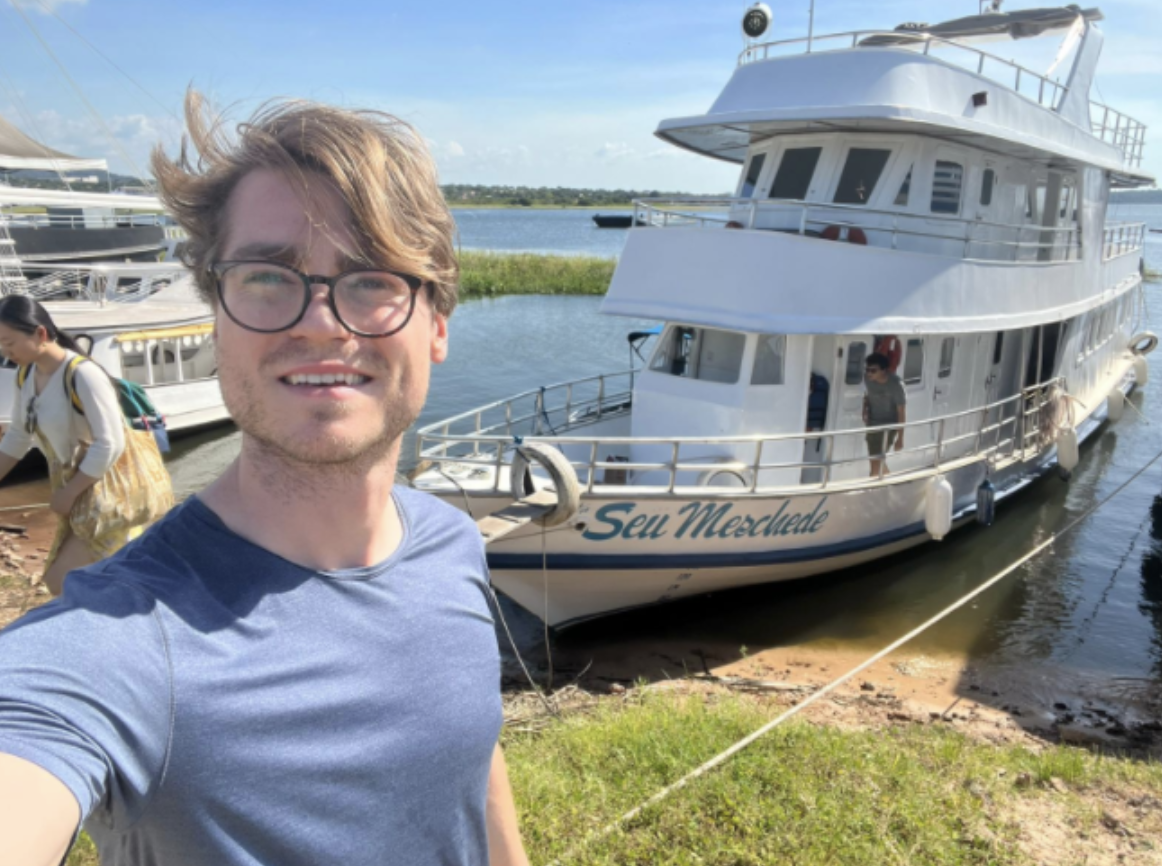
Colson, a former Silicon Valley tech executive, has no formal historical or archaeological training, but he’s long been intrigued by seeking out patterns and trends in world history, especially in pre-Columbian society. He’s interested in looking back in order to look forward.
Discussing the historical research that inspired his journey, he conjures the rise and fall of great civilizations as a result of invasions, pandemics, and technological change. “I've spent a lot of time thinking about cycles of civilization. Do civilizations rise and fall?” Colson said. “A lot of this is motivated by trying to understand what sort of response to threats from AI technology might work. Is there any human agency in the mix of the general trajectory of history? Or maybe it's just technological determinism, and so we don't have a choice?”
Colson is a friendly and enthusiastic tech-industry veteran in his early 30s. As a sociology researcher at Leverage Research, a Bay Area collective with close ties to Effective Altruism, Colson was among the inner circle laying the foundation for this decade’s AI- and crypto-dominated era. Tyler Alterman, who also worked at Leverage, met Colson around 2015. “He is a very confident and eloquent dude,” he said of Colson. Alterman later ended up bringing him on as a cofounder of Reserve, a cryptocurrency startup that began in Leverage’s incubator, Paradigm Academy. It was later spun off as an independent company with investments from OpenAI’s Sam Altman and Peter Thiel.
In 2019, Colson left Reserve to found a startup that aimed to employ Ivy League college students as virtual assistants to tech founders. After leaving this second startup, he took some time off to recoup, distancing himself from Effective Altruism. He felt the movement had been co-opted by technologists who were too gung ho about AI, and that those who did have ideas on containing AI were too focused on technological fixes and ignoring the possibility of government regulation.
Then came the pandemic. More or less on sabbatical, he was spending time at the home he’d recently purchased with his wife in Lake Tahoe with little to do other than read. He began to explore primary sources from the era of history that fascinated him, leading him to Gaspar de Carvajal’s “The Discovery of the Amazon,” which was not published until 1894, over 300 years after he went there, and not translated into English until the 1930s.
De Carvajal served as chaplain for Gonzalo Pizarro’s 1540 expedition to the Amazon, and extensively chronicled their encounter with what appeared to be a large and advanced civilization. But, as Colson said, “when people returned on subsequent expeditions, the things that Gaspar de Carvajal and Francisco de Orellana saw were basically gone. And so people thought they made it up.”
Rumors of vast, rich cities in the Amazon eventually transformed into legends of El Dorado and the Lost City of Z, sending Europeans on centuries of wild goose chases. By the 20th century, it was clear that if such civilizations ever existed at all, they were lost. The accepted orthodoxy among academics was that the majority of the Amazon region was untouched and sparsely settled throughout history. This belief that pre-contact Amazonian settlements were concentrated solely around the rivers and floodplains led to archaeological neglect of the region’s interior, away from the fertile riverbanks.
But a combination of deforestation and the development of new imaging technologies has led to a changing understanding of what the Amazon looked like before the arrival of Europeans. “The thing we're discovering is the entire Amazon was densely inhabited,” Colson said.
Since the 1990s, excavations and expeditions by researchers from around the world have increasingly discovered evidence for vast settlements, earthworks, and agricultural technology with the help of a tool known as lidar.
Lidar, short for light detection and ranging, sends out laser-light pulses to measure distances. Based on how quickly the light pulse returns to the sensor, the height of the identified object can be calculated with incredible accuracy.
For the past two decades, helped by improvements in GPS and drone technology, lidar has become an important part of the archaeological researcher’s arsenal, allowing them to limit the amount of time they spend doing exhaustive on-the-ground searches and instead head straight to valuable sites by identifying them from above. Lidar findings have included ancient Mayan complexes in Mexico, lost urban settlements in Bolivia, and forgotten Roman roads in England.
In 2018, a team led by archaeologists from the University of Exeter found hundreds of pre-Columbian villages in the Brazilian state of Mato Grosso, in an area previously thought to be untouched. A 2022 expedition used lidar to scan parts of the Amazon from above and found thousands of undiscovered earthworks. The density of these earthworks (human-made, large-scale structures made by artificially placing soil), which might have been settlements, geoglyphs, or religious sites, allowed the researchers to estimate there are 10,000 of them scattered across the Amazon, indicating a population of between 8 million and 10 million.
This population, Colson said, was destroyed by pandemics that wreaked havoc on the continent following the Europeans’ arrival. There was a civilization and then it was gone, in the blink of a century’s eye. This larger historical question — how could this have happened? How could we have forgotten it? How can we stop it from happening again? — has become the center of Colson’s work, both as an AI-safety advocate and as an amateur archaeologist.
Big problems require big, out-of-the-box solutions, like undertaking independent archaeological research in the Amazon. Colson doesn’t present himself as an interloper, citing collaboration with Brazilian academics and local residents as part of his methodology. A team of 19 people accompanied Colson up the Nhamundá in 2022, including Brazilian archaeologist Márcio Amaral, an independent academic sociologist, a videography team, and a local ground-operations team that included translators and Indigenous guides. Colson funded the entire expedition — he declined to tell me how much it cost — out of his own pocket.
As he became increasingly interested in the history of the Amazon and where it fit into big questions about humanity’s future, lidar technology emerged as a specific point of fascination. Its ability to deliver big results appealed to his tech-industry-honed project-management priorities.
“Lidar scanning is probably 1,000x’s, maybe 10,000x’s, the efficiency of rainforest archeological-site prospecting,” Colson said.
The centerpiece of the expedition was a lidar scanner mounted to a DJI Matrice 600 Pro, a commercial-grade drone with a six-foot wingspan. Rental and operation of scanners like this can run up thousands of dollars a day, not including additional costs for the software to process and output the scanner’s data.
The major find from the first round of scans was the discovery of what’s known as a “crowned mountain” settlement which has been found in surveys of the Amazon across Guiana and northern parts of South America. “The top of the mountain is leveled into a perfectly flat foundation, and then there's sort of an access ramp that goes down the back,” Colson said, describing what he saw in the lidar data. It’s the largest type of common settlement found in these kinds of scans of the Amazon, indicating a population between 10,000 and 20,000 people and status as a notable religious site.
Colson is hoping to return to the Amazon soon. He wants to use lidar in a manned plane instead of a drone to capture a larger area. The way he puts it, the 2022 trip was a proof of concept, and the next one is going to be the real thing, complete with documentary crew.
For now, Colson is occupied by his political work. In 2023, he founded the Artificial Intelligence Policy Institute, a think tank “dedicated to seeking political solutions to potential catastrophic risks from emerging AI technology.” AIPI conducts extensive polling, looking at what the general public thinks about AI regulation and its level of trust in tech executives to guide AI development effectively and safely. Its first poll, released last year, found that 72% of Americans support measures to slow down AI development and usage. Its latest,released last month, shows that 80% of voters polled were in favor of government oversight and certification of new AI models. AIPI is also engaged in congressional-engagement efforts, meeting with staffers and members of Congress to advise on policies and discuss the potential for AI regulation.
His interest in the Amazon dovetails with this work. Investigating the area, he said, can inform us about the potential large-scale changes coming for our society. Seeing the scale of what was lost when the Amazonian civilization fell makes the threat from AI “seem really real, because it wouldn't be the first time that civilizations were destroyed in a dozen years,” he said.
As a lidar evangelist, Colson is working on getting his peers as excited and invested as he is in the idea of finding something in the Amazon. He hopes to do his part to help the tech space better understand how encounters with advanced technology have impacted past cultures. “Technology is really the core and the basis of power and the way that power expands,” he said. “These things operate on cycles that are so much bigger and larger than a single human life or lifespan.”
Whether his explorations actually do have the potential to discover something new — “a special secret that we could find,” as he described it — or will merely add to the larger store of knowledge about the region is something only time will tell. But hidden deep in the Amazon, Colson believes, are the keys to our future.
Allegra Rosenberg is a journalist in New York.




