Tech
Vr Ecosystem
Meta Ray-Ban glasses (Getty Images)

Will Meta’s latest collab with Ray-Ban finally bring smart glasses into the mainstream?

No — because they will cost at least $1,000.

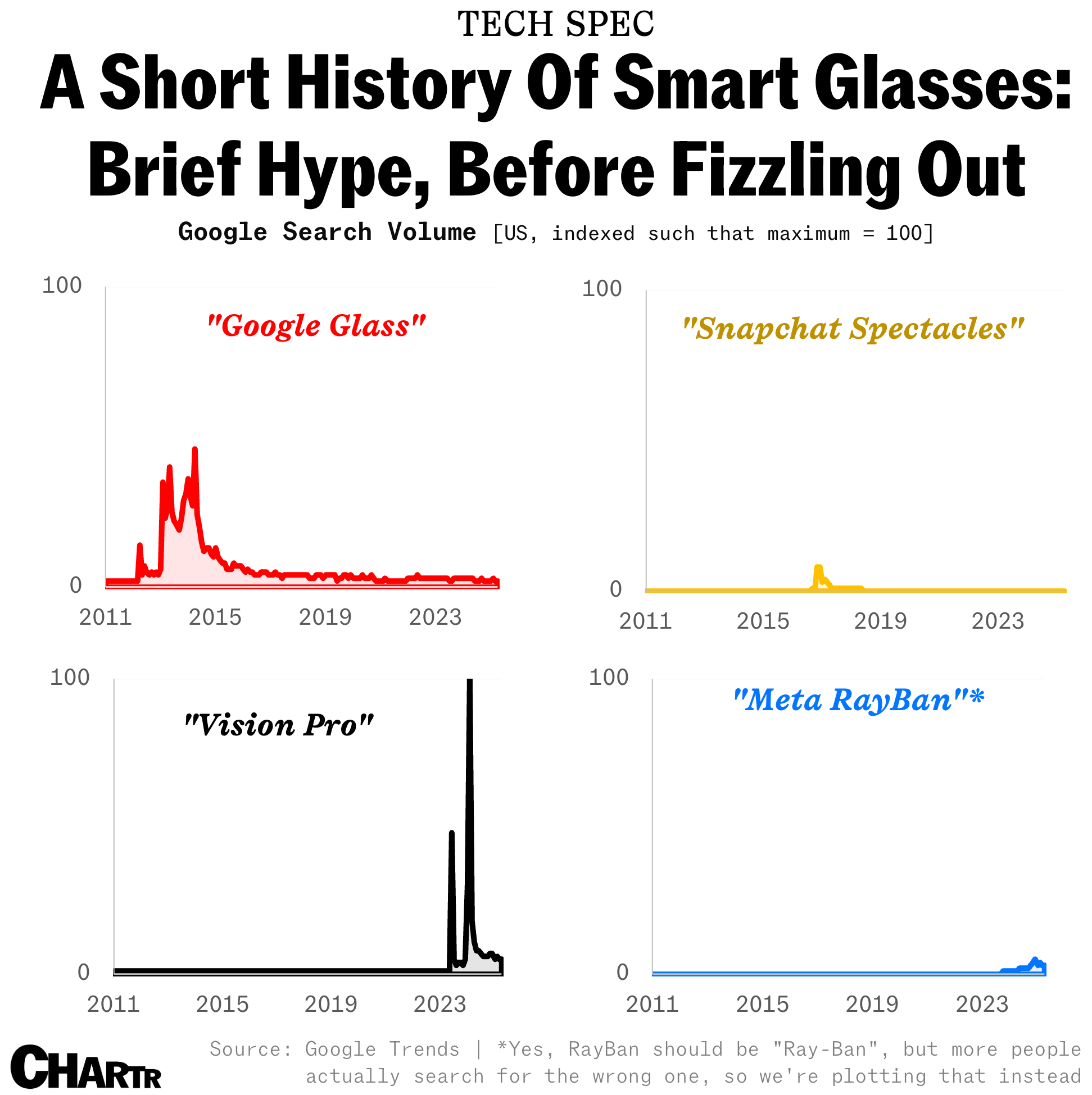
For years, tech companies have been trying to sell us on the idea of putting technology into stuff to put on our face. But historically, the hype for products like smart glasses has been short-lived.

First came Google, with its “Glass” product proving all the way back in 2012 that people mostly wanted glasses to help them see. Then came the small spark of Snapchat’s Spectacles, a product whose first iteration ended up costing the company millions but since evolved into one that a tech reviewer called “amazing. And extremely goofy.” More recently, we’ve had efforts from Apple and Meta.
Smart glasses history
Sherwood News

Apple’s take on the concept has been more about full immersion. But demand for its bulky VR/AR $3,500 Vision Pro has been disappointing, with unconfirmed reports in January that the company may not have just slowed but actually entirely ceased production of its headset.

Despite a litany of cautionary tales before it, Meta’s boss, Mark Zuckerberg, isn’t giving up on the category just yet, with the social media giant on track to introduce a deluxe version of its popular Ray-Ban Meta Glasses, per Bloomberg. With a price point expected to be north of $1,000 and the ability to run apps, display photos, and control the device using hand gestures, the glasses are designed to build on the modest success of Meta’s cheaper Ray-Ban glasses, which reportedly sold over a million units last year.

For now, Meta’s glasses business is still a cash drain for the company, with the company’s total losses from its VR and AR business topping more than $60 billion since 2020.


More Tech

See all Tech
tech

Report: US Treasury wants to get a look at Anthropic’s Mythos model

Anthropic’s relationship with the US government is complicated — and the Treasury Department is reportedly looking to make it even more so.

The Pentagon has officially deemed the startup a national security supply chain risk after it refused to allow its Claude AI to be used for any and all national security applications, including domestic surveillance and autonomous killing.

But since Anthropic’s unusual announcement of its next model, Mythos, other parts of the US government want to get their hands on it.

Bloomberg reports that the US Treasury is interested in getting access to Mythos for its own security testing. Last week, Treasury Secretary Scott Bessent summoned top Wall Street CEOs to Washington to discuss the cybersecurity implications of the new model.

Mythos has not yet been released to the public, as Anthropic has deemed its potential offensive cybersecurity capabilities to be too dangerous for wide release, and has opted to share the powerful new model only with a group of leading tech companies.

Anthropic wants these early access partners to test out the model, hoping to secure any major vulnerabilities before a public release. OpenAI also shared a forthcoming AI-powered cybersecurity tool with a select group of partners to shore up defenses in light of advances in detecting vulnerabilities.

European regulators were apparently left out of the loop from the Mythos announcement, and are also eager to test the new model.

But since Anthropic’s unusual announcement of its next model, Mythos, other parts of the US government want to get their hands on it.

Bloomberg reports that the US Treasury is interested in getting access to Mythos for its own security testing. Last week, Treasury Secretary Scott Bessent summoned top Wall Street CEOs to Washington to discuss the cybersecurity implications of the new model.

Mythos has not yet been released to the public, as Anthropic has deemed its potential offensive cybersecurity capabilities to be too dangerous for wide release, and has opted to share the powerful new model only with a group of leading tech companies.

Anthropic wants these early access partners to test out the model, hoping to secure any major vulnerabilities before a public release. OpenAI also shared a forthcoming AI-powered cybersecurity tool with a select group of partners to shore up defenses in light of advances in detecting vulnerabilities.

European regulators were apparently left out of the loop from the Mythos announcement, and are also eager to test the new model.

tech

Report: SpaceX’s satellite internet business is propping up its rocket and AI businesses

Ahead of SpaceX’s highly anticipated IPO in June, new reporting from The Information reveals just how dependent the rocket and AI company is on its internet business.

According to the report, in 2025, Starlink generated $11.4 billion in revenue and $7.2 billion in adjusted EBITDA — a striking 63% margin — making it SpaceX’s only meaningful source of profit.

By contrast, the company’s core rocket launch business and its recently acquired AI unit, xAI, lagged far behind financially. The space launch business generated $4.1 billion in revenue and about $700 million in adjusted EBITDA, while the AI segment brought in $3.2 billion in revenue but lost roughly $1.2 billion on an EBITDA basis.

In other words, Starlink accounted for most of SpaceX’s revenue — and more than all of its adjusted profit.

Starlink’s profitability is already attracting rivals. Amazon on Tuesday agreed to acquire satellite company Globalstar in an effort to more directly compete with Starlink.

tech
Rani Molla

Meta will surpass Google in ad revenue this year, new industry data shows

In a world supported by digital ad dollars, Meta may soon be king. The Instagram owner’s net digital ad revenues are expected to hit $243.5 billion in 2026, surpassing Google’s projected $239.5 billion, according to new data from eMarketer.

The shift is happening as Big Tech companies, including Meta and Google, are increasing their spending on AI in hopes that AI will grow their top and bottom lines.

On the company’s last earnings call, Meta CFO Susan Li credited AI with driving performance gains, and said that growth will continue: “We expect the set of investments we’re making in 2026 will enable us to drive further gains as we continue to integrate AI across all layers of the marketing and customer engagement funnel.”

“In surpassing Google, Meta has essentially had many of its core strategies validated,” said Max Willens, principal analyst at eMarketer. “Meta has long understood that scale, network effects, and habits are more important than anything else in digital media. It has carefully built and defended the advantages it has in all three areas.”

Latest Stories

Sherwood Media, LLC produces fresh and unique perspectives on topical financial news and is a fully owned subsidiary of Robinhood Markets, Inc., and any views expressed here do not necessarily reflect the views of any other Robinhood affiliate, including Robinhood Markets, Inc., Robinhood Financial LLC, Robinhood Securities, LLC, Robinhood Crypto, LLC, Robinhood Derivatives, LLC, or Robinhood Money, LLC. Futures and event contracts are offered through Robinhood Derivatives, LLC.