
Tech
Internet access

With the ACP at risk of ending, lower-income families could lose internet access

Staying connected

A last-ditch bipartisan effort to save the Affordable Connectivity Program (ACP) — a government initiative that subsidizes home broadband for more than 20 million low-income households — could soon hit Congress, according to the WSJ, just as funding for the scheme looks set to run dry.

The proposal to pump a further $7B into the program would extend the stipends, issued as $30-75 vouchers towards monthly home Wi-Fi bills, until the end of the year. The scheme has been praised for keeping seniors, minorities, and veterans (almost 50% of households that benefit are military families) online across the US.

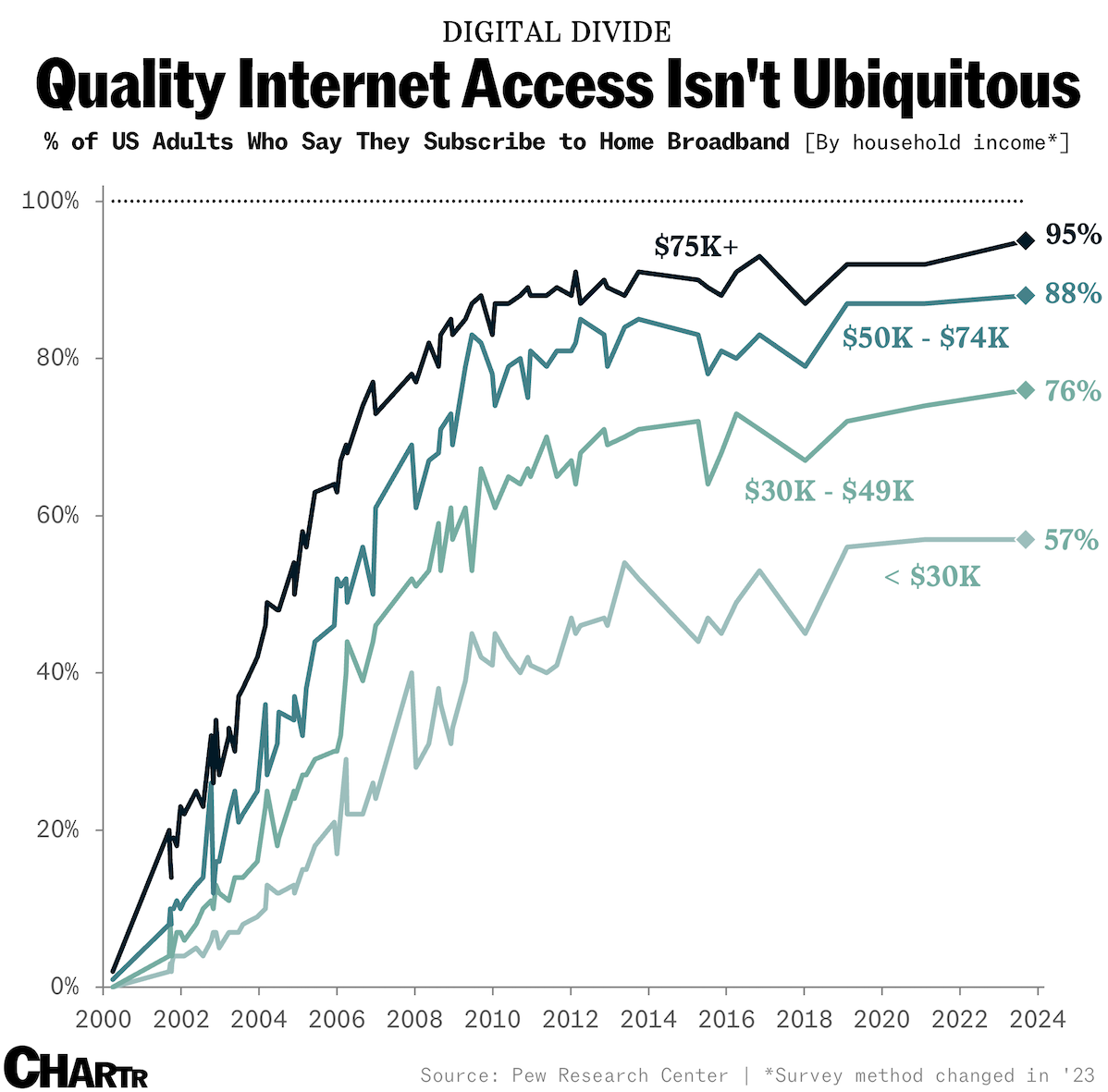
Given how essential the internet now is to modern life, America remains worryingly uneven in its adoption of home broadband. According to a set of surveys that Pew Research Center has been running for the last 23 years, just 1% of American adults had a home broadband subscription in 2000; last year, 80% said the same. However, that growth hasn’t been mirrored across all income groups, with only 57% of adults in households where annual income is below $30K reporting a subscription to broadband at home late last year… and that was with the ACP in place.

Despite a reasonable amount of cross-aisle support, injecting more cash into the ACP has proven difficult. While Congress enacted the ~$14B ACP as part of Biden’s Bipartisan Infrastructure Law in 2021, the president’s request for a supplementary $6B to extend the scheme last October hasn’t gone anywhere. If the same fate befalls this latest bid, millions of Americans could lose access to the internet at home, or be forced to cut spending elsewhere.


More Tech

See all Tech
tech

Corning surges after multibillion-dollar fiber-optic deal with Amazon

On Monday, Amazon announced a multiyear, multibillion-dollar deal to buy optical fiber from 175-year-old glassmaker Corning to power and connect its rapidly expanding US artificial intelligence data centers. Shares of Corning popped more than 9% on the news.

Corning said the investments would create 1,000 new, highly skilled jobs at Corning's manufacturing facilities in North Carolina.

This isn’t Corning’s first Big Tech rodeo. Last month the stock jumped when Nvidia invested $500 million in Corning warrants, and the stock ripped in January following a deal with Meta to provide fiber-optic cable connections for its AI data centers.

tech

London’s robotaxi war is “months” away as Uber opens waitlist to battle Alphabet’s Waymo

Starting today, Uber users in London can join an in-app waitlist to be matched with a self-driving vehicle, with a commercial launch planned for the coming months. Riders who opt in could be picked up by a Ford Mustang Mach-E powered by UK-based AI startup Wayve. The rides will initially operate with a human safety driver and will cost the same as an UberX, Uber Electric, or Uber Comfort ride.

The move turns London into the next ground zero for a robotaxi showdown, pitting Uber against its US partner, Alphabets Waymo. While the two companies cooperate stateside — allowing users to hail Waymo rides via the Uber app in Phoenix, Austin, and Atlanta — they are locked in a turf war abroad. Uber is hedging its bets to own the future of ride-hailing, with more than 30 AV partnerships around the world and plans to roll out Wayve-powered robotaxis across 10 global markets.

Waymo, which is available in 11 US markets, is also aggressively pushing its own international expansion and has already deployed about 100 autonomous Jaguars for testing on London streets ahead of a planned commercial launch this year. With the UK fast-tracking its autonomous vehicle regulations, London is set to be the ultimate proving ground to see if Uber’s strategy of funding Waymos rivals can beat Alphabets in-house tech.

tech

FT: Meta considering “tens of billions” in new capital to fund AI

Just days after Google announced a monster $85 billion upsized equity raise, the extremely profitable Meta is seeking to sell “tens of billions of dollars” in stock, according to a new report from the Financial Times.

Meta is planning on spending between $125 billion and $145 billion on AI capital expenditure this year alone.

Shares dropped more than 5% on the news.

Latest Stories

Sherwood Media, LLC and Chartr Limited produce fresh and unique perspectives on topical financial news and are fully owned subsidiaries of Robinhood Markets, Inc., and any views expressed here do not necessarily reflect the views of any other Robinhood affiliate, including Robinhood Markets, Inc., Robinhood Financial LLC, Robinhood Securities, LLC, Robinhood Crypto, LLC, Robinhood Money, LLC, Robinhood U.K. Ltd, Robinhood Derivatives, LLC, Robinhood Gold, LLC, Robinhood Asset Management, LLC, Robinhood Credit, Inc., Robinhood Ventures DE, LLC and, where applicable, its managed investment vehicles.
