
Tech
Xiaomi 2025 Q2 Revenue Growth
A Xiaomi electric vehicle is displayed in a Xiaomi Smart Home store in Shanghai, China (Costfoto/Getty Images)
On the shoulders of giants

Xiaomi is speedrunning building an electric vehicle business

Apple decided pivoting from phones to EVs was too hard. Xiaomi is finding it a piece of cake.

Going first is hard, and scary. You have to forge a path, fixing problems no one else has ever faced, without the ability to ask anyone for help. There’s a reason Google wasn’t the very first search engine and Facebook wasn’t the OG social media platform. It’s almost always easier to build on existing work — and no company is proving that better than Chinese tech giant Xiaomi with its new electric vehicle business.

Su got a fast car

In 2021, no one at Xiaomi knew how to make cars. Indeed, going from smartphones to EVs isn’t exactly a logical or easy next step — just ask Apple, which finally gave up on its moon shot car project after a decade.

But facing a fresh round of US trade sanctions in 2021, execs at Xiaomi ran a scary thought experiment — what would happen to the company if the sanctions killed off its phone business? Xiaomi Auto was founded in September of that year, and now, less than four years on, the company thinks it can deliver 350,000 electric vehicles like its SU7 this fiscal year. That’s a milestone that took Tesla more than a decade, and domestic rival BYD even longer.
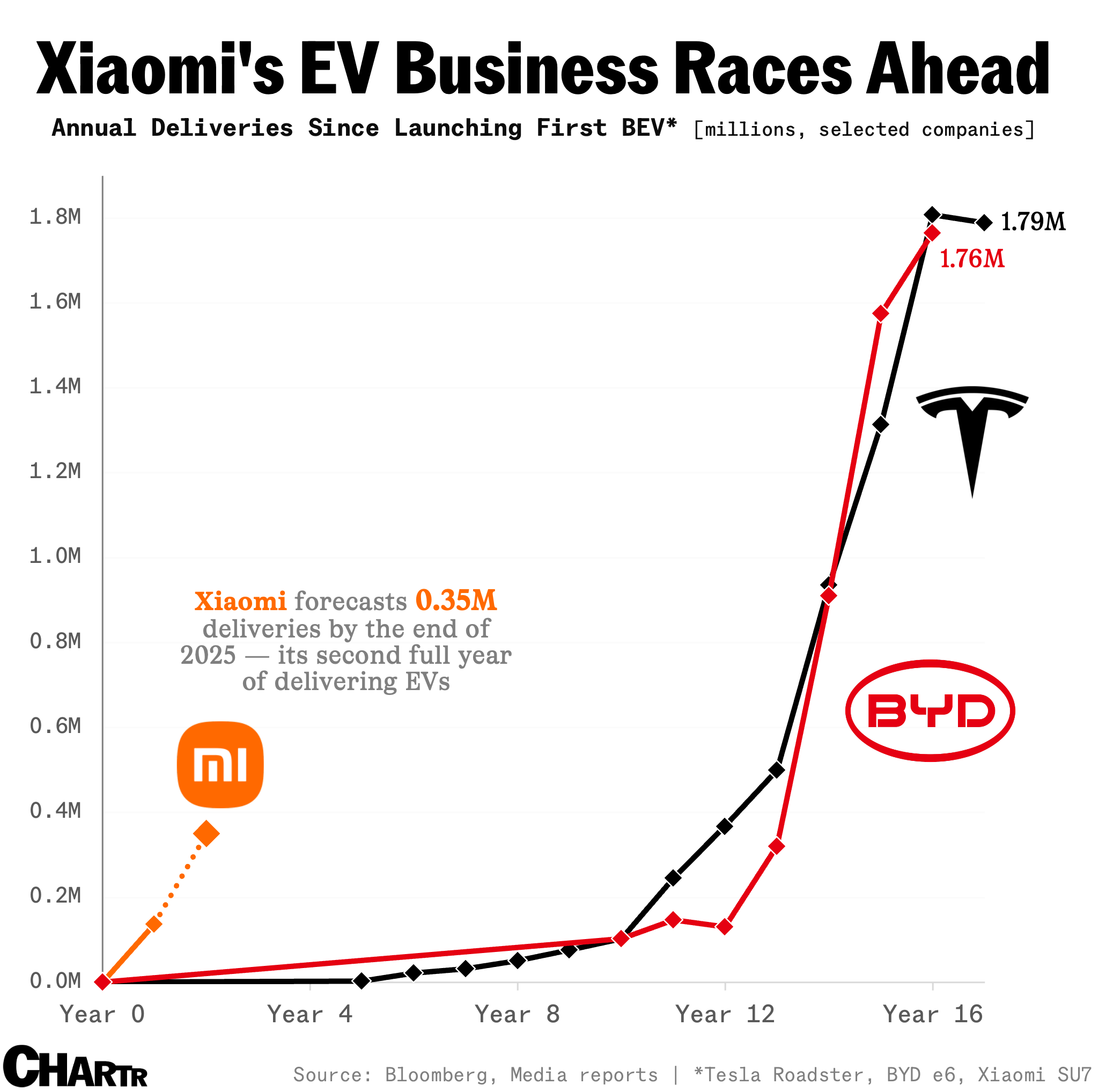
Xiaomi's EV business
Sherwood News

Phone down, car up

As yesterday’s earnings report revealed, cars are speeding up to become Xiaomi’s future, as the company — which has a ~15% share of the smartphone market — noted that the global smartphone industry itself is likely to experience near to zero collective growth this year, while intense price wars continue to chip away at profitability.

Meanwhile, Xiaomi’s smart EVs, AI, and new initiatives segment reached some $3 billion (RMB 21.3 billion) in revenue — finding a swath of middle- to high-income consumers that already love Xiaomi and aren’t swayed by rival BYD’s cheaper EV alternatives. The company is now looking to expand into Europe by 2027.

Being first is nice, but being second (or more like 50th in Xiaomi’s case) clearly doesn't prevent you from catching up quick.


More Tech

See all Tech
tech
Rani Molla

Microsoft is reportedly building a super app to tame product sprawl — and finally crack mobile

Super apps are very 2010s, but they might be the future for Microsoft. The enterprise giant is working on combining its sprawling and often confusing product suite into a single super app expected by late summer, Fortune reports.

By unifying the tools, Microsoft is hoping that the massive popularity of some of its offerings — particularly GitHub Copilot — will rub off on its other, slower-growing products.

The tool will merge its coding assistant GitHub Copilot, its chat function Copilot, its Copilot Cowork tool, and a new agentic workflow called Autopilot. The move, known internally as “Delivering one Copilot,” will have the dual purpose of simplifying Microsoft’s fragmented desktop AI offerings and finally helping the office software giant gain a foothold on mobile, where competing tools have dominated.

Microsoft is taking a page from frenemy OpenAI’s playbook. In March, OpenAI announced plans for its own desktop super app to combine ChatGPT, Codex, and its Atlas browser into one central workstation.

The tool will merge its coding assistant GitHub Copilot, its chat function Copilot, its Copilot Cowork tool, and a new agentic workflow called Autopilot. The move, known internally as “Delivering one Copilot,” will have the dual purpose of simplifying Microsoft’s fragmented desktop AI offerings and finally helping the office software giant gain a foothold on mobile, where competing tools have dominated.

Microsoft is taking a page from frenemy OpenAI’s playbook. In March, OpenAI announced plans for its own desktop super app to combine ChatGPT, Codex, and its Atlas browser into one central workstation.

42
Rani Molla

Forty-two is the answer to life, the universe, and everything in Douglas Adams’ classic “The Hitchhiker’s Guide to the Galaxy.” It’s also the number of unsupervised Robotaxis Tesla has on the road in Texas, the only state where it’s operating autonomous service, according to records from a newly required government database in the state.

That’s much lower than CEO Elon Musk had hoped, as the company struggles to ready its camera-only autonomous vehicles for commercial scale. In 2025, Musk said that the service would be available to “half the population of the US by the end of the year.”

Even smaller competition has more: Avride has 317 and Nuro has 47. Meanwhile, Tesla’s chief rival, Alphabet subsidiary Waymo, has 577 in operation in the state. Nationwide, Waymo’s fleet currently numbers more than 3,000.

Unfortunately for Tesla, figuring out how to actually scale its robotaxi fleet remains the ultimate question.

INDIA-TECHNOLOGY-AI-DIPLOMACY

Anthropic raises $65 billion at a $965 billion valuation, releases a more “honest” Claude Opus 4.8

Anthropic’s monster $965 billion valuation puts it firmly ahead of OpenAI’s $850 billion valuation as the rivals head toward expected IPOs later this year.

Jon Keegan5/28/26
tech
Jon Keegan

Report: Microsoft tries to get back in the AI coding game with new model

Microsoft wants to fight its way back into the AI coding field by releasing a new model next week at its annual Microsoft Build developer conference, The Information reports.

The company is expected to announce a new family of models as Microsoft AI CEO Mustafa Suleyman seeks to shore up the company’s own AI offerings and gradually wean it off OpenAI’s technology over the remainder of their $13 billion partnership.

Microsoft was initially well positioned to meet software developers with AI-enhanced tools. It owns GitHub, the most popular platform for hosting and sharing code, and GitHub’s Copilot AI-powered coding tool was released months before OpenAI’s ChatGPT debuted in 2022.

But it fumbled one of the biggest first-mover advantages in history as Anthropic’s Claude Code, OpenAI’s Codex, and Cursor rolled out coding tools that developers loved.

Microsoft was initially well positioned to meet software developers with AI-enhanced tools. It owns GitHub, the most popular platform for hosting and sharing code, and GitHub’s Copilot AI-powered coding tool was released months before OpenAI’s ChatGPT debuted in 2022.

But it fumbled one of the biggest first-mover advantages in history as Anthropic’s Claude Code, OpenAI’s Codex, and Cursor rolled out coding tools that developers loved.

Ojai outside

Waymo to launch free robotaxi rides in its new Ojai vans

The new vehicles are less expensive — which is important for the service to really scale.

Rani Molla5/28/26

Latest Stories

Sherwood Media, LLC and Chartr Limited produce fresh and unique perspectives on topical financial news and are fully owned subsidiaries of Robinhood Markets, Inc., and any views expressed here do not necessarily reflect the views of any other Robinhood affiliate, including Robinhood Markets, Inc., Robinhood Financial LLC, Robinhood Securities, LLC, Robinhood Crypto, LLC, Robinhood Money, LLC, Robinhood U.K. Ltd, Robinhood Derivatives, LLC, Robinhood Gold, LLC, Robinhood Asset Management, LLC, Robinhood Credit, Inc., Robinhood Ventures DE, LLC and, where applicable, its managed investment vehicles.
