

Tech
Yahoo Advertises New Search Technology
Yahoo has tried a lot of promotional ideas over the years (Chris Hondros/Getty Images)
OLD DOG, NEW TRICKS

Yahoo is still one of the most visited websites on the planet

Now the internet OG is introducing new features to help users tackle inbox overload. Yes, AI is in the first sentence of the press release.

David Crowther

Internet brands don’t tend to live very long.

Myspace, Vine, Flickr, BuzzFeed, Napster, Bebo, Vice, Tumblr, and many more have exploded onto the scene before either fading into obsolescence, obscurity, or imploding altogether — and those are just a few of the ones you’ve heard of. Thousands more never made it beyond a domain registration and a traffic-less website.

It’s remarkable, then, that Yahoo — one of the earliest mainstream internet brands — is still alive and kicking at the ripe old age of 31, with the private-equity-owned brand this week announcing a new “catch up” feature to its email service, Yahoo Mail.

In terms of features, it’s not exactly revolutionary stuff: AI-powered summaries of your emails that give you the option to delete or keep the messages hardly represent an innovative breakthrough in digital communications. Even the marketing, which includes a collaboration with a streetwear brand to create a range of “Anti Email Email Club” tees and sweatshirts, feels very 2010s.

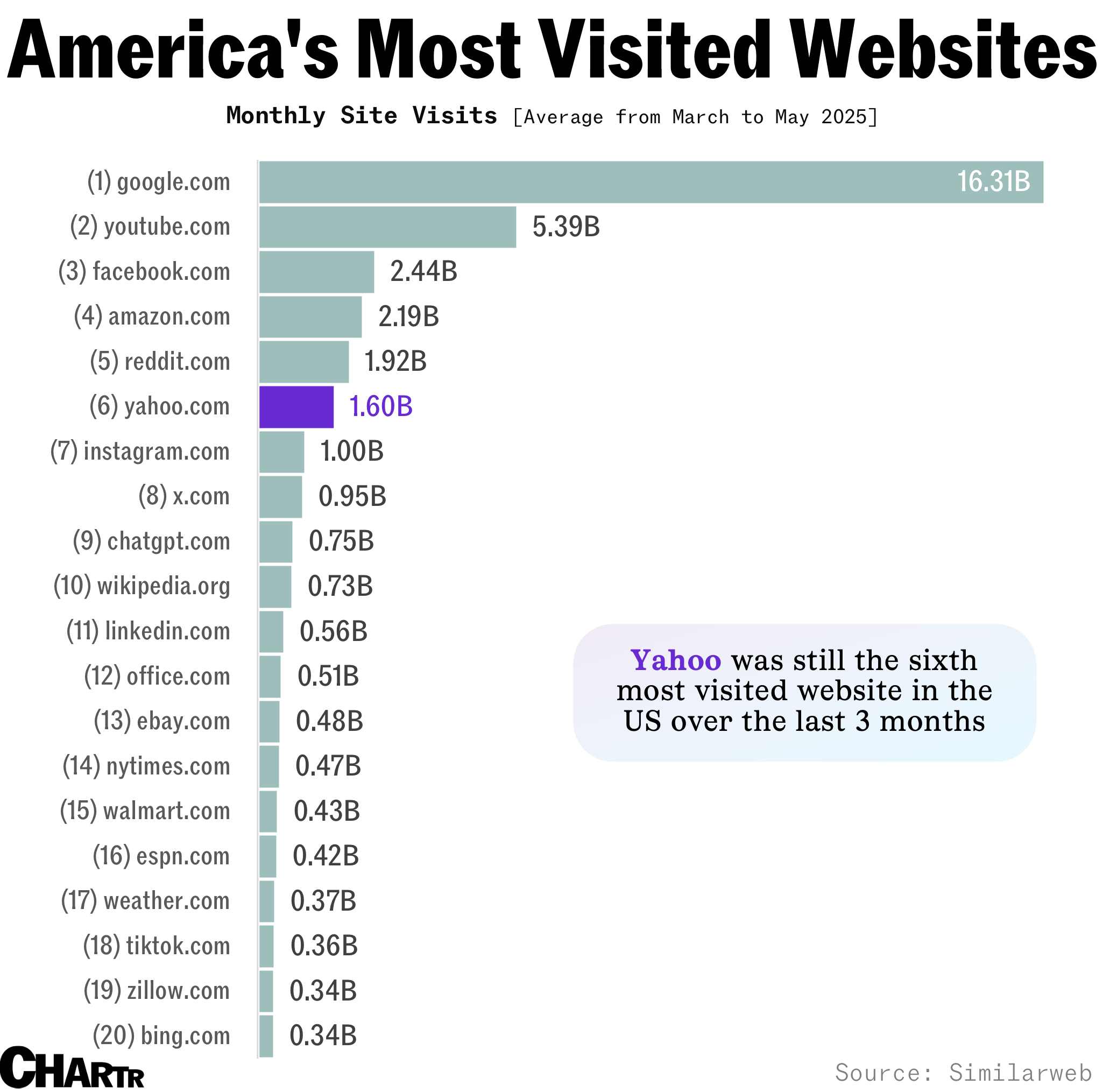
But, for all the criticisms you could throw at an internet dinosaur like Yahoo, it’s hard to deny its continued longevity. Its email service reportedly still has over 200 million users, and data from Similarweb finds that Yahoo.com is still the sixth-most-visited website in America.
Yahoo visits
Sherwood News

Racking up an average of more than 1.6 billion page views from March to May, Yahoo is pulling in more site visits than ChatGPT, Wikipedia, X, LinkedIn, The New York Times, ESPN, and many other household names.

Interestingly, though, we’ve started to notice a small decline in Yahoo’s traffic, per Similarweb data. The site notched 351 million visits in the week ending May 23. That was the lowest since at least April 2024, down 13% on the average weekly figure of the past 12 months. Can Yahoo still be relevant at 40 years old? What about when it hits half a century? Only time will tell.

Related reading: ChatGPT is soaring up this leaderboard — last month Americans visited the website of the AI chatbot more than Wikipedia.


More Tech

See all Tech
tech

Alphabet to tap international bond markets again as AI spending surges

Alphabet is tapping European debt markets again as its AI spending ramps up.

The Google parent is selling at least €3 billion ($3.5 billion) in bonds across six tranches, according to Bloomberg. The filing says that it’s for “general corporate purposes,” and the timing aligns with its plans to spend up to $190 billion this year on data centers and other AI infrastructure. In a separate filing released today, Alphabet also said it’s issuing Canadian dollar-denominated bonds, colloquially referred to as a maple bonds,” but no values were available.

These are the latest in a broader funding push as the company increases its already high capex expectations. Earlier this year, Alphabet raised about $20 billion in a heavily oversubscribed US bond sale and also tapped sterling and Swiss franc markets as part of a roughly $32 billion deal.

These are the latest in a broader funding push as the company increases its already high capex expectations. Earlier this year, Alphabet raised about $20 billion in a heavily oversubscribed US bond sale and also tapped sterling and Swiss franc markets as part of a roughly $32 billion deal.

tech

Tesla told European regulators it expects “EU-wide” FSD approval in second or third quarter

Weeks after Dutch regulators became the first in the EU to approve Tesla’s Full Self-Driving (Supervised) system, internal emails viewed by Reuters show the concerns the company still faces across the bloc. That includes regulator questions about speeding, performance on icy roads, and whether calling a system that requires constant driver attention “Full Self-Driving” is misleading.

CEO Elon Musk has blamed Tesla’s weak European sales on the lack of FSD and is betting that wider approval could help turn things around.

That rollout may take longer than hoped: while Musk had pointed to earlier approval, a presentation in the correspondence reviewed by Reuters says Tesla now expects “EU-wide” clearance in the second or third quarter of 2026.

European vehicle regulators are meeting in Brussels today to discuss the matter, but the earliest possible vote would be in July.

CEO Elon Musk has blamed Tesla’s weak European sales on the lack of FSD and is betting that wider approval could help turn things around.

That rollout may take longer than hoped: while Musk had pointed to earlier approval, a presentation in the correspondence reviewed by Reuters says Tesla now expects “EU-wide” clearance in the second or third quarter of 2026.

European vehicle regulators are meeting in Brussels today to discuss the matter, but the earliest possible vote would be in July.

US-AI-TECH-TRIAL-COMPUTERS

OpenAI President Greg Brockman wanted a billion dollars — now his stake is worth $30 billion

A dispatch from the Musk v. Altman trial, as unflattering details from Brockman’s personal journal emerge.

tech

Meta pushes deeper into AI robots with acquisition

Meta just bought robotics AI startup Assured Robot Intelligence, Bloomberg reports, doubling down on its push into humanoid tech. The team will join Meta’s Superintelligence Labs to build models that let robots “understand, predict and adapt to human behaviors in complex environments.”

The goal, Bloomberg says, is to be the Android of robots: building the software and hardware foundation others can use.


The move comes right after China forced Meta to let go of its acquisition of agentic AI startup Manus.

CEO Mark Zuckerberg joins Tesla’s Elon Musk and Amazon’s Jeff Bezos in racing into AI-powered robots.

CEO Mark Zuckerberg joins Tesla’s Elon Musk and Amazon’s Jeff Bezos in racing into AI-powered robots.

tech

Apple’s capital spending is heading the opposite direction of Big Tech

The big story in Big Tech has been just how much they’re spending on capex to furnish their AI futures. Not only are Alphabet, Amazon, Meta, and Microsoft spending more than ever, they’re also spending more than they said they would just a quarter earlier. In total, their 2026 capital expenditure bill is now slated to surge beyond $700 billion.

Apple, by contrast, continues to take a different approach. The company has lagged peers in developing its own frontier AI models and has leaned more on partnerships. The strategy certainly doesn’t seem to be hurting Apple yet. The company posted record revenue in the March quarter that beat analysts’ expectations this week, even without a robust AI offering.

Apple’s capex actually fell in the March quarter. Its payments for acquisition of property, plant, and equipment totaled about $1.9 billion in its fiscal second quarter, down 36% from roughly $3 billion a year earlier. So on a year-over-year basis, Apple’s capex declined while everyone else’s jumped sharply.

Latest Stories

Sherwood Media, LLC produces fresh and unique perspectives on topical financial news and is a fully owned subsidiary of Robinhood Markets, Inc., and any views expressed here do not necessarily reflect the views of any other Robinhood affiliate, including Robinhood Markets, Inc., Robinhood Financial LLC, Robinhood Securities, LLC, Robinhood Crypto, LLC, Robinhood Derivatives, LLC, or Robinhood Money, LLC. Futures and event contracts are offered through Robinhood Derivatives, LLC.
