World
Canada Battles US Tariffs And Prepares For Economic Impact
(Artur Widak/Getty Images)
whiskey sours

American booze is getting pulled off the shelves in Canada. How bad could that be?

The US exported more than $768 million worth of alcohol to Canada in 2024.

J. Edward Moreno

American booze is now off the shelves in most of Canada, threatening to put a $768 million dent in the US economy.

Canadian provinces — including Ontario, Quebec, and British Columbia — have announced that they will halt or restrict US liquor sales in response to the 25% tariffs the US imposed on Canada and Mexico. Canadian provinces have more authority over the alcohol business than US states, with some provincial governments having full or partial monopolies on retail alcohol sales.

While booze makes up a smaller chunk of the economy than other goods, an outright ban on sales packs a more direct punch than tariffs, which are taxes on imports.

“That’s worse than a tariff because it’s literally taking your sales away,” Lawson Whiting, CEO of Jack Daniel’s maker Brown-Forman, told analysts on Wednesday. “It’s disappointing that some of our consumers aren’t going to be able to get our bottles of Jack Daniel’s up there, because it’s a big brand in Canada.”

Whiting also said that Canada makes up about 1% of its sales.

The US alcohol industry is concentrated in certain pockets of the country.

The majority of whiskey exported from the US, for example, comes from Kentucky and Tennessee. That includes Brown-Forman’s crown jewel, Jack Daniel’s, as well as some brands owned by Diageo like Bulleit Bourbon and George Dickel. (Diageo also sells Crown Royal whiskey from Canada and Don Julio tequila from Mexico, so its taking punches from all sides of this trade war.)

Most wine produced and exported from America comes from California. Brands like Robert Mondavi are sold by Constellation Brands, though its biggest trade war liability is Modelo, which it imports from Mexico and is the most-sold beer in the US.


More World

See all World
world
Tom Jones

The UAE’s OPEC exit will hit the group in the barrels

After just shy of 60 years in OPEC, its membership even predating its status as a nation-state, the United Arab Emirates yesterday announced its shocking departure from the oil production group, effective May 1, as the knock-on effects of the Iran war continue to play out across the Middle East and the energy landscape.

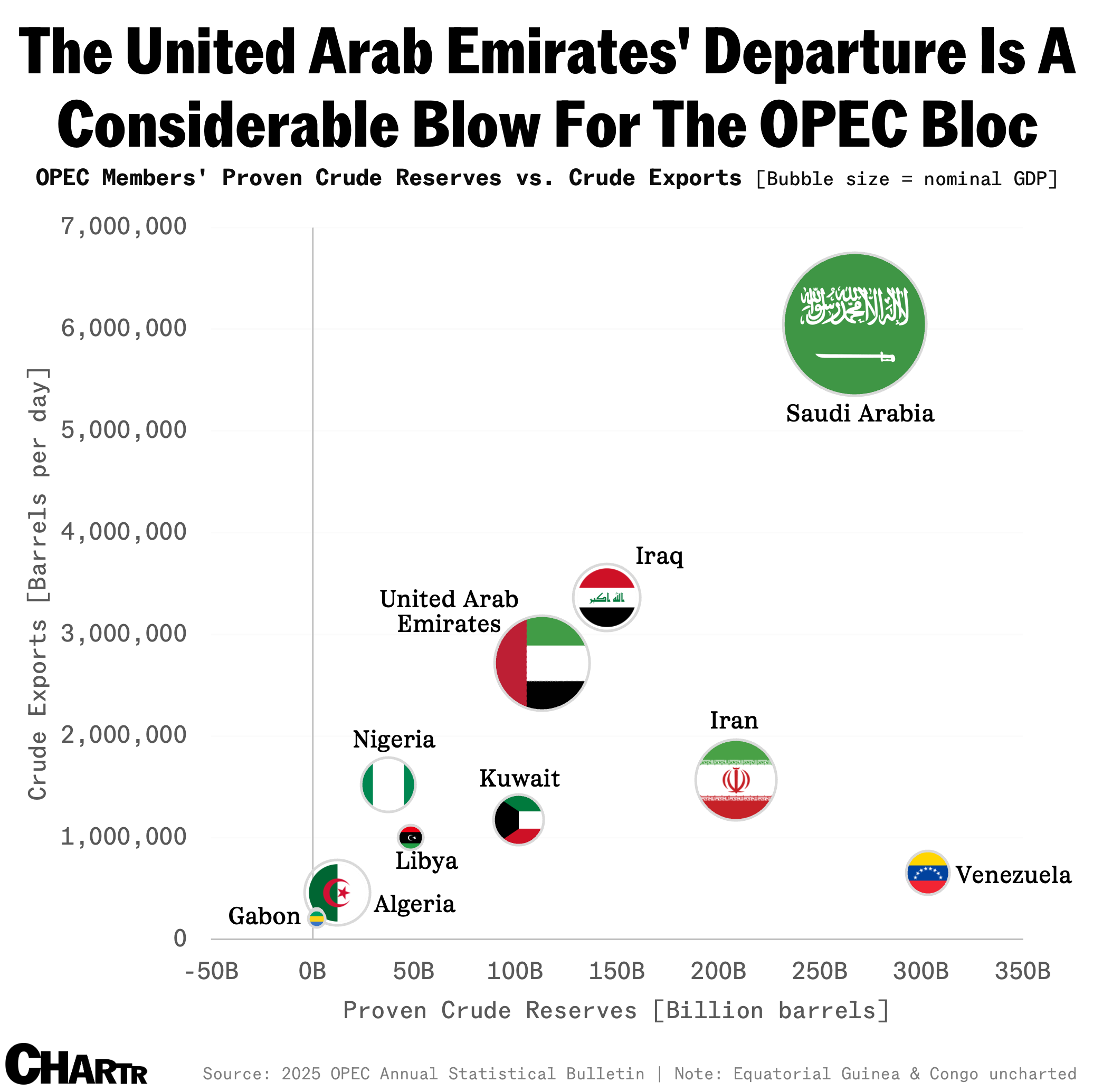
For context, the UAE produces the third-highest amount of oil in the group, per April data and OPEC’s latest set of annual statistics.

According to the cartel’s 2025 Annual Statistical Bulletin, the OPEC group was collectively exporting some 19 million barrels of crude oil a day last year, with the United Arab Emirates accounting for some 14% of that daily output.

UAExit means UAExit

The nation, whose energy minister told Reuters yesterday that the decision was taken “after a careful look at current and future policies related to level of production” and wasn’t made following discussions with any other country, made up a healthy share of the group’s total confirmed crude oil reserves, as well.

OPEC exports chart
Sherwood News

Of the 12 nations in the core group, which was founded by just five oil superpowers back in September 1960, only two (Iraq and Saudi Arabia) exported more barrels of crude oil daily, pumping out 3.36 million and 6.05 million barrels, respectively, each day to nations around the world.

For its part, the UAE said it will “continue its responsible role by gradually and thoughtfully increasing production, in line with demand and market conditions,” per the official state news agency. Clearly, the nation now wants a little more control of just how much oil it can pump around the world, with the UAE having to eat a large proportion of lost revenues due to its healthy abundance and OPEC restrictions.

According to the cartel’s 2025 Annual Statistical Bulletin, the OPEC group was collectively exporting some 19 million barrels of crude oil a day last year, with the United Arab Emirates accounting for some 14% of that daily output.

UAExit means UAExit

The nation, whose energy minister told Reuters yesterday that the decision was taken “after a careful look at current and future policies related to level of production” and wasn’t made following discussions with any other country, made up a healthy share of the group’s total confirmed crude oil reserves, as well.

OPEC exports chart
Sherwood News

Of the 12 nations in the core group, which was founded by just five oil superpowers back in September 1960, only two (Iraq and Saudi Arabia) exported more barrels of crude oil daily, pumping out 3.36 million and 6.05 million barrels, respectively, each day to nations around the world.

For its part, the UAE said it will “continue its responsible role by gradually and thoughtfully increasing production, in line with demand and market conditions,” per the official state news agency. Clearly, the nation now wants a little more control of just how much oil it can pump around the world, with the UAE having to eat a large proportion of lost revenues due to its healthy abundance and OPEC restrictions.

Latest Stories

Sherwood Media, LLC and Chartr Limited produce fresh and unique perspectives on topical financial news and are fully owned subsidiaries of Robinhood Markets, Inc., and any views expressed here do not necessarily reflect the views of any other Robinhood affiliate, including Robinhood Markets, Inc., Robinhood Financial LLC, Robinhood Securities, LLC, Robinhood Crypto, LLC, Robinhood Money, LLC, Robinhood U.K. Ltd, Robinhood Derivatives, LLC, Robinhood Gold, LLC, Robinhood Asset Management, LLC, Robinhood Credit, Inc., Robinhood Ventures DE, LLC and, where applicable, its managed investment vehicles.