
World
Knot yet: The decline in marriage rates in America

Knot yet: The decline in marriage rates in America

Knot yet

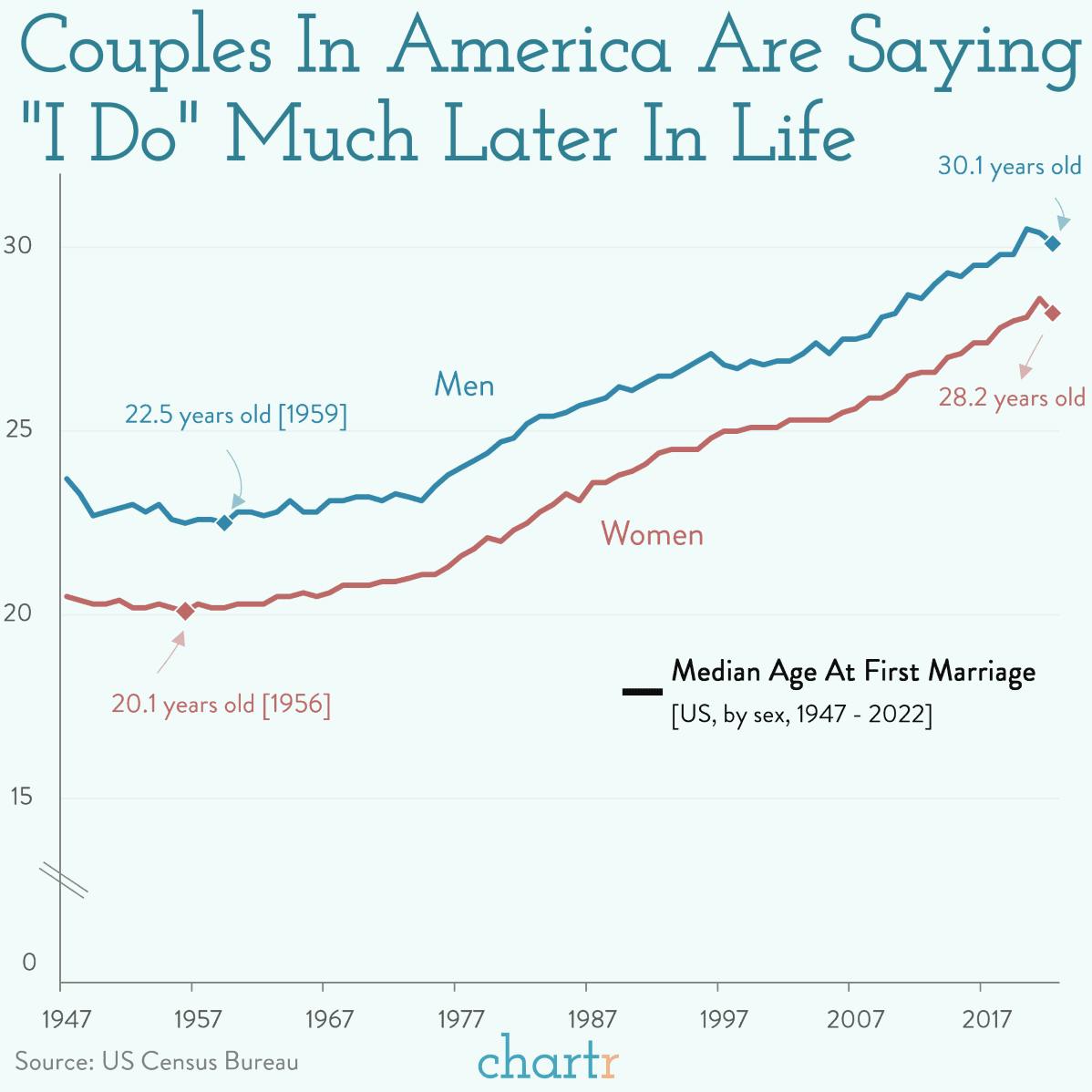
The latest data from Pew Research out this week reveals that an astonishing 25% of 40 year olds in the US have never been married, marking a record high share. In 2010, the corresponding figure was 20%, and if we go back to 1980, just 6% of 40 year olds had yet to tie the knot.

The data fits with the longer term trend in marriage — people have been getting married at a lower rate and generally later in their lives. Indeed, the typical age for men to say "I do" was just over 30, while women typically married a few months after their 28th birthday, according to the US Census Bureau. Both these ages have increased by around 5 years since the turn of the century. In 2000 the median age for men and women to get married was 26.8 and 25.1, respectively, and if you go back to the 1950s, women were typically getting married just after they turned 20.

Emerging adult

Exploring why marriage is increasingly put off is a complicated social question, but access to higher education has certainly played its part. With more people studying, the percentage of 21 year olds with full-time jobs has dwindled from 64% in 1980 to 39% in 2021, according to Pew Research.

Another explanation is that a new life stage "emerging adulthood" — when individuals are studying, leaving home for the first time, exploring their identity, travelling or just embarking on their careers — has gotten longer.

Shifting cultural norms around living with partners, increased economic independence for women, changing work patterns, a rise in the number of people who consider themselves "religiously unaffiliated" and an increase in the number of people living alone have also all contributed to the trend.

More World

See all World
world
Tom Jones

The UAE’s OPEC exit will hit the group in the barrels

After just shy of 60 years in OPEC, its membership even predating its status as a nation-state, the United Arab Emirates yesterday announced its shocking departure from the oil production group, effective May 1, as the knock-on effects of the Iran war continue to play out across the Middle East and the energy landscape.

For context, the UAE produces the third-highest amount of oil in the group, per April data and OPEC’s latest set of annual statistics.

According to the cartel’s 2025 Annual Statistical Bulletin, the OPEC group was collectively exporting some 19 million barrels of crude oil a day last year, with the United Arab Emirates accounting for some 14% of that daily output.

UAExit means UAExit

The nation, whose energy minister told Reuters yesterday that the decision was taken “after a careful look at current and future policies related to level of production” and wasn’t made following discussions with any other country, made up a healthy share of the group’s total confirmed crude oil reserves, as well.

OPEC exports chart
Sherwood News

Of the 12 nations in the core group, which was founded by just five oil superpowers back in September 1960, only two (Iraq and Saudi Arabia) exported more barrels of crude oil daily, pumping out 3.36 million and 6.05 million barrels, respectively, each day to nations around the world.

For its part, the UAE said it will “continue its responsible role by gradually and thoughtfully increasing production, in line with demand and market conditions,” per the official state news agency. Clearly, the nation now wants a little more control of just how much oil it can pump around the world, with the UAE having to eat a large proportion of lost revenues due to its healthy abundance and OPEC restrictions.

According to the cartel’s 2025 Annual Statistical Bulletin, the OPEC group was collectively exporting some 19 million barrels of crude oil a day last year, with the United Arab Emirates accounting for some 14% of that daily output.

UAExit means UAExit

The nation, whose energy minister told Reuters yesterday that the decision was taken “after a careful look at current and future policies related to level of production” and wasn’t made following discussions with any other country, made up a healthy share of the group’s total confirmed crude oil reserves, as well.

OPEC exports chart
Sherwood News

Of the 12 nations in the core group, which was founded by just five oil superpowers back in September 1960, only two (Iraq and Saudi Arabia) exported more barrels of crude oil daily, pumping out 3.36 million and 6.05 million barrels, respectively, each day to nations around the world.

For its part, the UAE said it will “continue its responsible role by gradually and thoughtfully increasing production, in line with demand and market conditions,” per the official state news agency. Clearly, the nation now wants a little more control of just how much oil it can pump around the world, with the UAE having to eat a large proportion of lost revenues due to its healthy abundance and OPEC restrictions.

Latest Stories

Sherwood Media, LLC and Chartr Limited produce fresh and unique perspectives on topical financial news and are fully owned subsidiaries of Robinhood Markets, Inc., and any views expressed here do not necessarily reflect the views of any other Robinhood affiliate, including Robinhood Markets, Inc., Robinhood Financial LLC, Robinhood Securities, LLC, Robinhood Crypto, LLC, Robinhood Money, LLC, Robinhood U.K. Ltd, Robinhood Derivatives, LLC, Robinhood Gold, LLC, Robinhood Asset Management, LLC, Robinhood Credit, Inc., Robinhood Ventures DE, LLC and, where applicable, its managed investment vehicles.