
World
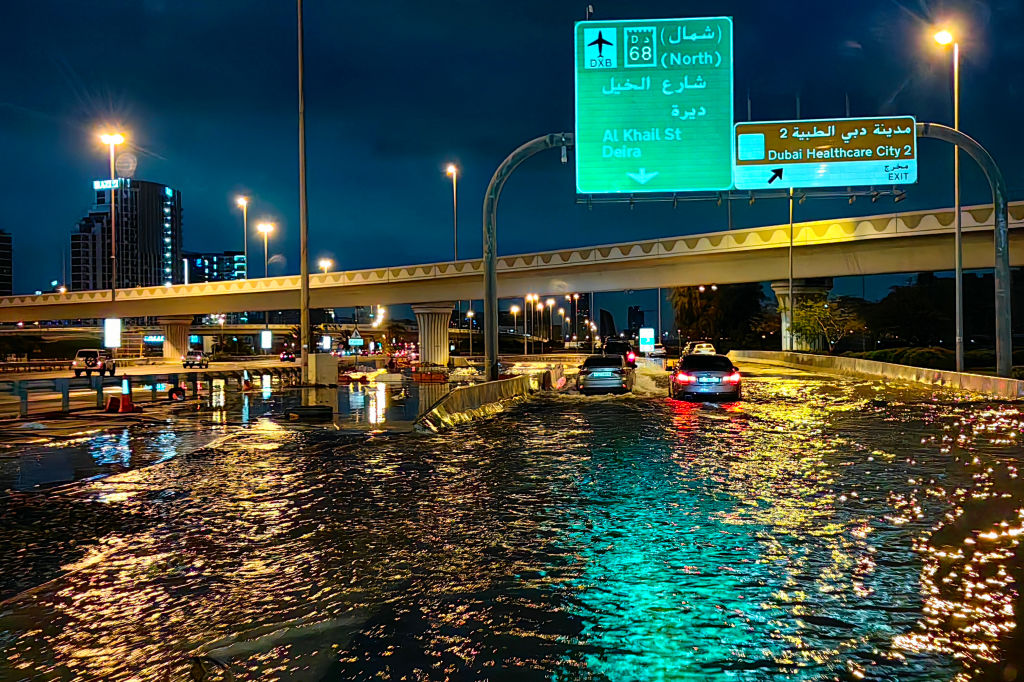
TOPSHOT-UAE-BAHRAIN-OMAN-WEATHER-FLOOD
(Photo by GIUSEPPE CACACE/AFP via Getty Images)

Dubai just got more than a year’s worth of rain in a single day

Climate change, cloud seeding, or just plain bad weather?

Out of the blue sky

Heavy thunderstorms sent the typically arid United Arab Emirates into chaos yesterday, with Dubai recording more than 5.59 inches (142 mm) of rain in just 24 hours since Monday night — the most in 75 years and equivalent to 1.5x the total seen in a typical year.
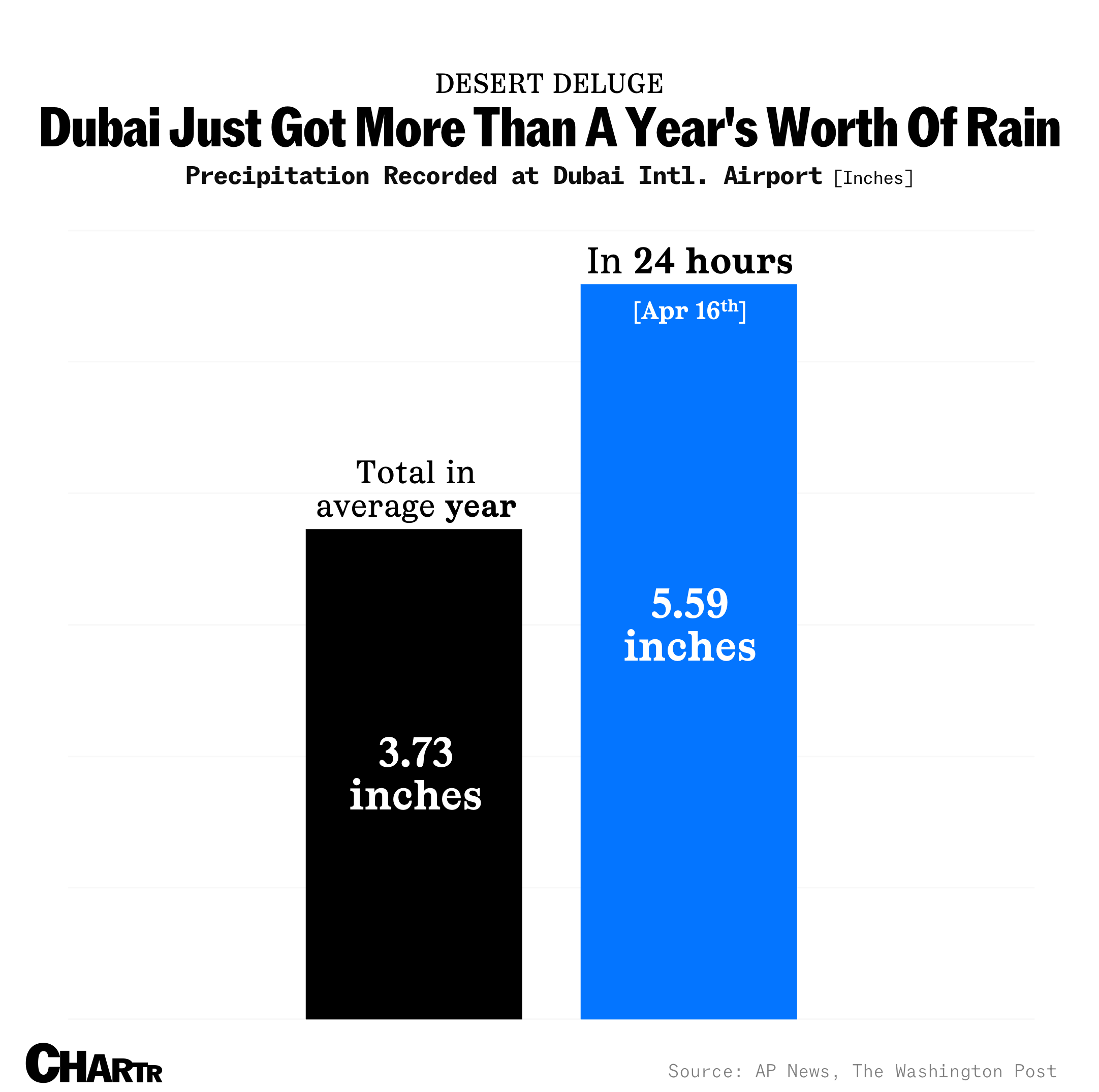
Dubai just got more than a year’s worth of rain in a day

The “historic weather event” caused flash flooding and wreaked havoc across Dubai’s motorways, metro stations, and malls, with hundreds of flights at Dubai International Airport temporarily grounded.

Scientists have laid some of the blame on climate change, the usual suspect for unusual weather, as the driving force behind the unprecedented storm: per NASA, for every 1°C rise in average temperature, the atmosphere can hold ~7% more moisture, leading to heavier rainfall in shorter periods, over smaller areas.

However, several news outlets have also pointed towards cloud seeding — an operation that sees aircraft spray metal salt particles into clouds, inducing precipitation — as a culprit, which the UAE has been carrying out since the 1990s to improve water security and boost agriculture.

While there is debate about whether seeding could have an impact of this magnitude (the government is denying that the practice occurred in days preceding), the severity of flooding in the Gulf nation’s most populous city may be most strongly attributed to its lack of drainage and incapacity to deal with much rain at all — let alone a year’s worth in 24 hours.

More World

See all World
world
Tom Jones

The UAE’s OPEC exit will hit the group in the barrels

After just shy of 60 years in OPEC, its membership even predating its status as a nation-state, the United Arab Emirates yesterday announced its shocking departure from the oil production group, effective May 1, as the knock-on effects of the Iran war continue to play out across the Middle East and the energy landscape.

For context, the UAE produces the third-highest amount of oil in the group, per April data and OPEC’s latest set of annual statistics.

According to the cartel’s 2025 Annual Statistical Bulletin, the OPEC group was collectively exporting some 19 million barrels of crude oil a day last year, with the United Arab Emirates accounting for some 14% of that daily output.

UAExit means UAExit

The nation, whose energy minister told Reuters yesterday that the decision was taken “after a careful look at current and future policies related to level of production” and wasn’t made following discussions with any other country, made up a healthy share of the group’s total confirmed crude oil reserves, as well.

OPEC exports chart
Sherwood News

Of the 12 nations in the core group, which was founded by just five oil superpowers back in September 1960, only two (Iraq and Saudi Arabia) exported more barrels of crude oil daily, pumping out 3.36 million and 6.05 million barrels, respectively, each day to nations around the world.

For its part, the UAE said it will “continue its responsible role by gradually and thoughtfully increasing production, in line with demand and market conditions,” per the official state news agency. Clearly, the nation now wants a little more control of just how much oil it can pump around the world, with the UAE having to eat a large proportion of lost revenues due to its healthy abundance and OPEC restrictions.

According to the cartel’s 2025 Annual Statistical Bulletin, the OPEC group was collectively exporting some 19 million barrels of crude oil a day last year, with the United Arab Emirates accounting for some 14% of that daily output.

UAExit means UAExit

The nation, whose energy minister told Reuters yesterday that the decision was taken “after a careful look at current and future policies related to level of production” and wasn’t made following discussions with any other country, made up a healthy share of the group’s total confirmed crude oil reserves, as well.

OPEC exports chart
Sherwood News

Of the 12 nations in the core group, which was founded by just five oil superpowers back in September 1960, only two (Iraq and Saudi Arabia) exported more barrels of crude oil daily, pumping out 3.36 million and 6.05 million barrels, respectively, each day to nations around the world.

For its part, the UAE said it will “continue its responsible role by gradually and thoughtfully increasing production, in line with demand and market conditions,” per the official state news agency. Clearly, the nation now wants a little more control of just how much oil it can pump around the world, with the UAE having to eat a large proportion of lost revenues due to its healthy abundance and OPEC restrictions.

Latest Stories

Sherwood Media, LLC produces fresh and unique perspectives on topical financial news and is a fully owned subsidiary of Robinhood Markets, Inc., and any views expressed here do not necessarily reflect the views of any other Robinhood affiliate, including Robinhood Markets, Inc., Robinhood Financial LLC, Robinhood Securities, LLC, Robinhood Crypto, LLC, Robinhood Derivatives, LLC, or Robinhood Money, LLC. Futures and event contracts are offered through Robinhood Derivatives, LLC.