World
Protests Against Mass Tourism Take Place In Spain And Portugal
An antitourist protest in Lisbon, Portugal (Horacio Villalobos/Getty Images)

Europeans hit back against overtourism

Last summer, record numbers of tourists visited Europe’s top attractions. Now, many residents have had enough.

On Sunday, a string of planned overtourism protests took place across some of Europe’s most beloved tourist destinations — with locals in popular southern European cities and islands rallying against the swaths of summer travelers that descend on their neighborhoods.

As reported by The New York Times, residents in Barcelona sprayed tourists with water guns; protestors in Lisbon carried an effigy of the city’s patron saint to the planned site of a new hotel; people in Genoa rolled suitcases through the streets in what they called a noisy stroll.” One day later, staff at the Louvre, which sees ~20,000 people visit just the room where the Mona Lisa is kept every single day, went on an impromptu strike against overcrowding.

DEL-EU-GE

The protesters might have a point.

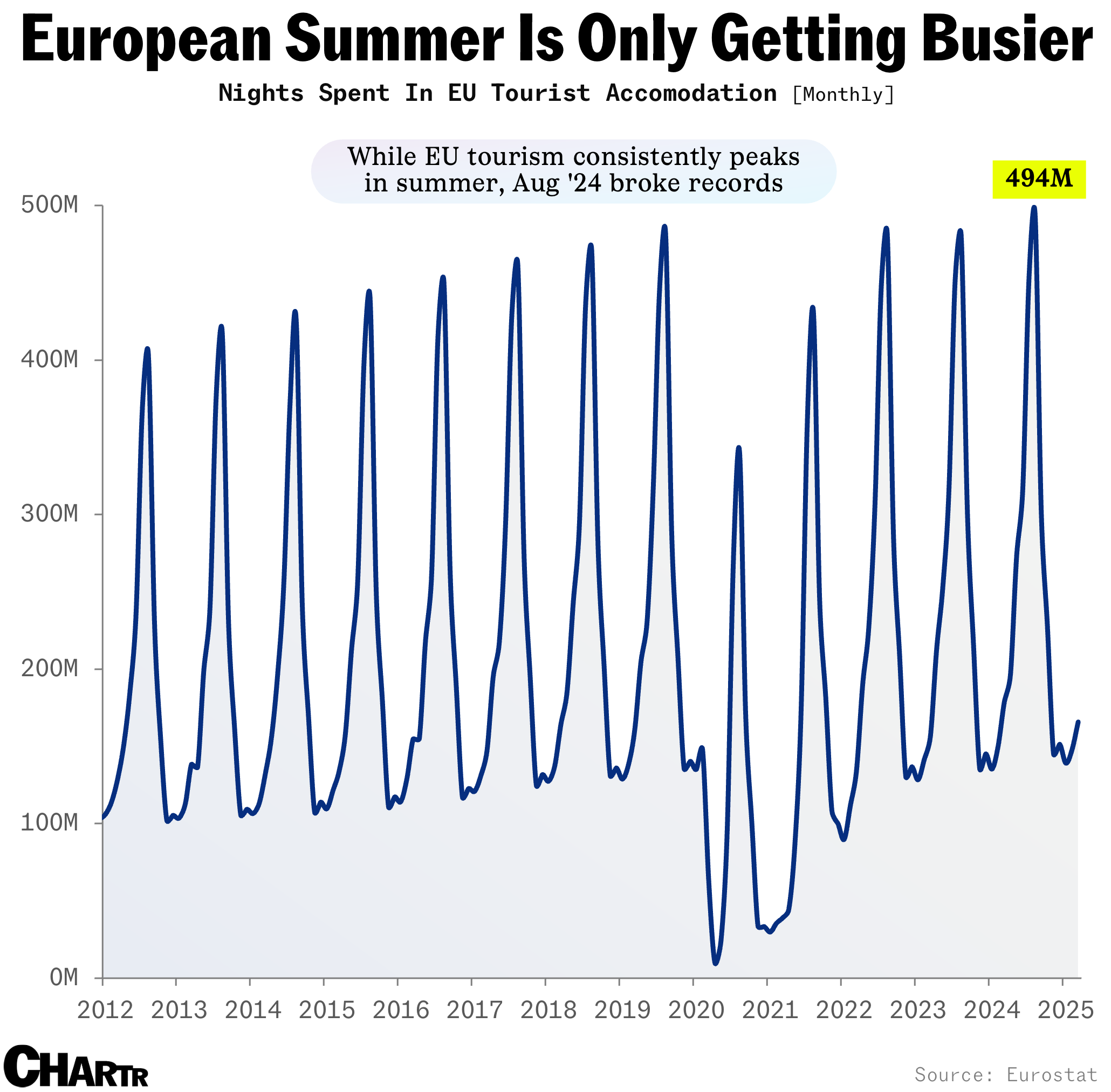
Indeed, Europe recorded ~747 million international tourist arrivals in 2024, per the UN, while data from Eurostat shows that last year was the biggest tourism summer on record for the EU, with August alone recording 494 million tourism nights, up 16% from the same month a decade prior. The countries that saw the highest number of nights spent in EU tourist accommodation were Spain (~500 million), Italy (~458 million), and France (~451 million).
European visitors
Sherwood News

In some of the most popular destinations, authorities are taking heed. Daytrippers to Venice now face higher tourism taxes, Greece is limiting visitor numbers to the Acropolis, and Spain continues to clamp down on unlicensed short-term accommodation rentals — much to Airbnb’s chagrin.

But will the protests be enough to deter Europhiles from visiting? Unlikely. Summer travel from the US to Europe is forecast to increase 10% this year.

More World

See all World
world
Tom Jones

The UAE’s OPEC exit will hit the group in the barrels

After just shy of 60 years in OPEC, its membership even predating its status as a nation-state, the United Arab Emirates yesterday announced its shocking departure from the oil production group, effective May 1, as the knock-on effects of the Iran war continue to play out across the Middle East and the energy landscape.

For context, the UAE produces the third-highest amount of oil in the group, per April data and OPEC’s latest set of annual statistics.

According to the cartel’s 2025 Annual Statistical Bulletin, the OPEC group was collectively exporting some 19 million barrels of crude oil a day last year, with the United Arab Emirates accounting for some 14% of that daily output.

UAExit means UAExit

The nation, whose energy minister told Reuters yesterday that the decision was taken “after a careful look at current and future policies related to level of production” and wasn’t made following discussions with any other country, made up a healthy share of the group’s total confirmed crude oil reserves, as well.

OPEC exports chart
Sherwood News

Of the 12 nations in the core group, which was founded by just five oil superpowers back in September 1960, only two (Iraq and Saudi Arabia) exported more barrels of crude oil daily, pumping out 3.36 million and 6.05 million barrels, respectively, each day to nations around the world.

For its part, the UAE said it will “continue its responsible role by gradually and thoughtfully increasing production, in line with demand and market conditions,” per the official state news agency. Clearly, the nation now wants a little more control of just how much oil it can pump around the world, with the UAE having to eat a large proportion of lost revenues due to its healthy abundance and OPEC restrictions.

According to the cartel’s 2025 Annual Statistical Bulletin, the OPEC group was collectively exporting some 19 million barrels of crude oil a day last year, with the United Arab Emirates accounting for some 14% of that daily output.

UAExit means UAExit

The nation, whose energy minister told Reuters yesterday that the decision was taken “after a careful look at current and future policies related to level of production” and wasn’t made following discussions with any other country, made up a healthy share of the group’s total confirmed crude oil reserves, as well.

OPEC exports chart
Sherwood News

Of the 12 nations in the core group, which was founded by just five oil superpowers back in September 1960, only two (Iraq and Saudi Arabia) exported more barrels of crude oil daily, pumping out 3.36 million and 6.05 million barrels, respectively, each day to nations around the world.

For its part, the UAE said it will “continue its responsible role by gradually and thoughtfully increasing production, in line with demand and market conditions,” per the official state news agency. Clearly, the nation now wants a little more control of just how much oil it can pump around the world, with the UAE having to eat a large proportion of lost revenues due to its healthy abundance and OPEC restrictions.

Latest Stories

Sherwood Media, LLC and Chartr Limited produce fresh and unique perspectives on topical financial news and are fully owned subsidiaries of Robinhood Markets, Inc., and any views expressed here do not necessarily reflect the views of any other Robinhood affiliate, including Robinhood Markets, Inc., Robinhood Financial LLC, Robinhood Securities, LLC, Robinhood Crypto, LLC, Robinhood Money, LLC, Robinhood U.K. Ltd, Robinhood Derivatives, LLC, Robinhood Gold, LLC, Robinhood Asset Management, LLC, Robinhood Credit, Inc., Robinhood Ventures DE, LLC and, where applicable, its managed investment vehicles.