

CONTENT CREATION
Finland has been named the world’s happiest country, again.

The secret to happiness? Doing pretty OK, I guess.
For the eighth year in a row, Finland tops the “happiness” league tables — but that doesn’t mean its citizens are feeling the joy.
Thursday marked 2025’s International Day of Happiness, a celebration established by the United Nations back in 2012 — which, in stark contrast with today, was a time when the organization seemingly had capacity to do stuff like inaugurate special days for “recognizing the relevance of happiness and well-being as universal goals.”
In nearly every year since, Finland has topped the list as the happiest country in the world, and this year is no exception. In the 2025 World Happiness Report, a UN-sponsored publication that’s released annually on Happiness Day, Finland achieved a three-year average life evaluation of 7.736, up by almost 5% since 2012 and beating out three other Nordic countries that made the top five (Denmark, Iceland, and Sweden).
Happy coincidence?
The report is largely based on well-being data from ~140 countries and the Gallup World Poll, a survey that includes “more than 100 global questions as well as region-specific items.” But the country ranking itself stems from the Cantril Self-Anchoring Striving Scale, which measures the “life evaluation” metric:
Please imagine a ladder with steps numbered from 0 at the bottom to 10 at the top. The top of the ladder represents the best possible life for you and the bottom of the ladder represents the worst possible life for you. On which step of the ladder would you say you personally feel you stand at this time?
Considering this, the most prominent factor that determines whether citizens are “happy” might have more to do with how satisfied they are with their immediate surroundings, rather than how they’re feeling… which is perhaps why the Happiness Index relates strongly with more simple measures of economic development.
When plotted against the UN’s Human Development Index — a summary measure of achievement in “key dimensions of human development” like life expectancy, years of schooling, and income per capita — there’s a clear trend. The Nordic countries score very highly in both measures, and though some East Asian regions like Hong Kong skew more developed than “happy” and some Central American countries like Mexico and Costa Rica lean more “happy,” the indexes are strongly correlated, bar a few outliers.
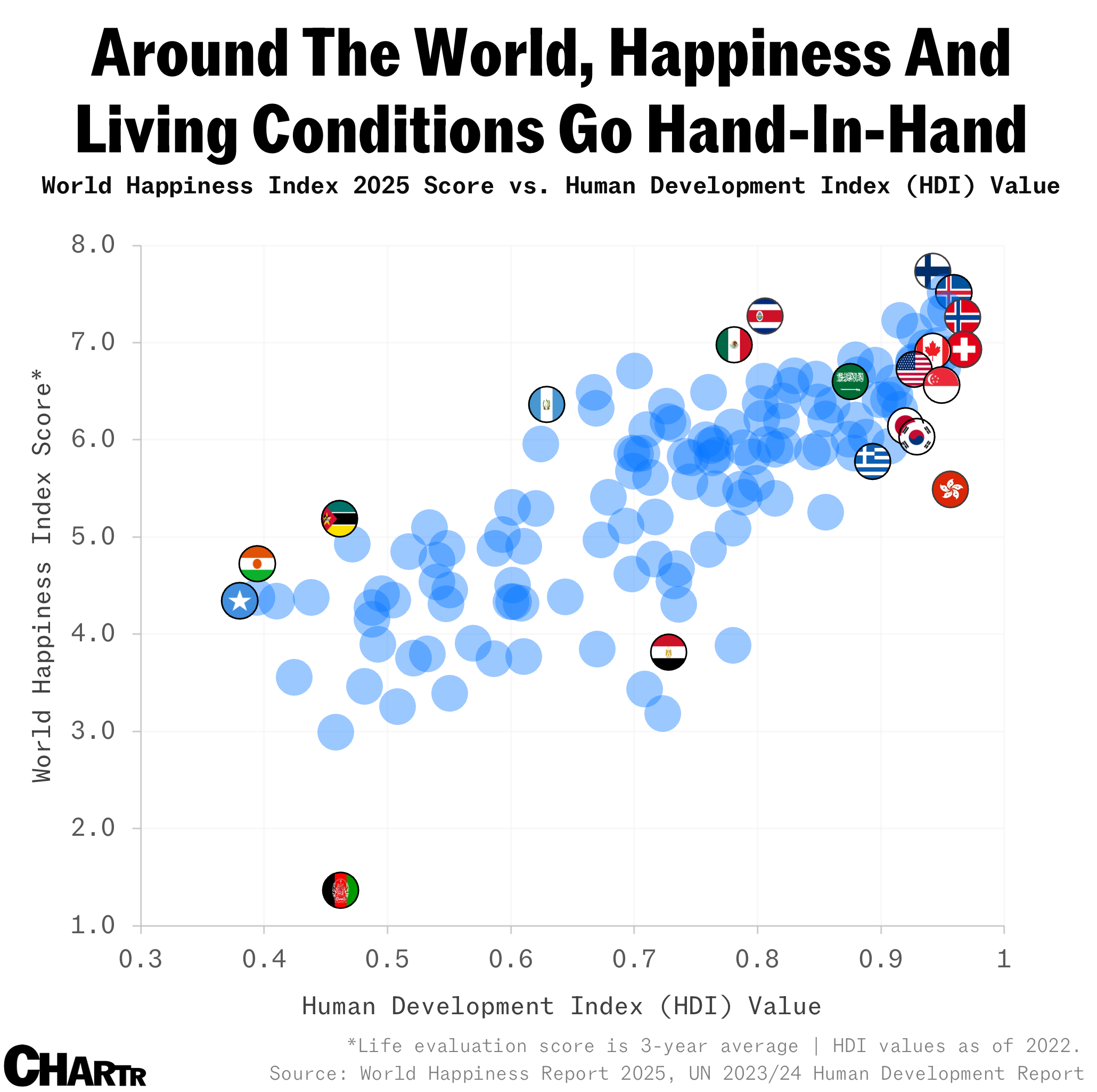
Fine, thanks
So, does the World Happiness Index actually quantify happiness effectively, or is it closer to an indicator of economic development?
As outlined in a fascinating article by Megan DeMatteo for Sherwood News last year, while the World Happiness Report takes into account life satisfaction, it lacks one crucial joy-determining factor: emotions.
Looking at the 2024 Gallup Global Emotions Report, a survey that specifically focuses on respondents’ positive and negative emotions — including how often people laugh, smile, or learn something new, as well as how often they feel pain, stress, or anger — Finland ranked in 25th place overall for feeling positive emotions specifically. Senegal, which ranked 107th in the Happiness Index, came first.
Indeed, Finland may have a high quality of life, but the quote-unquote “happiest” place doesn’t always make people happy: until recently, Finland had one of the highest suicide rates in the world, and the country is one of the worst places for expats. What the happiness ranking could speak to, then, is the Finnish custom of “sisu,” or inner strength, which means people rarely complain about their problems… or, for that matter, place themselves low on the life ladder.
Table for one
Another factor contributing to life satisfaction that the report highlighted was meal sharing. The growing number of people eating alone in the United States — in 2023, about 1 in 4 Americans reported eating all their meals alone the day before, up 53% from two decades prior — was said to have contributed to a decline in national well-being, as the US ranked 24th overall in the report, the lowest position it’s ever held.