
Globalization is over — at least the version we knew
Five charts on the pivot in globalization, as tariffs threaten the end of the global trade hegemony of the last 80 years.
In a week when trade tensions are climbing, tariffs are grabbing headlines, and stock markets are sinking, it’s hard to zoom out and look at the bigger picture.
But it’s worth revisiting the idea of globalization, that early-2000s buzzword that has shaped so much of our day-to-day lives since the end of the Cold War, or even as far back as World War II, depending on which historian you listen to.
As The New York Times columnist David Brooks put it back in 2022, globalization meant countries becoming more economically, politically, and culturally interdependent. Trade flowed more freely. McDonald’s opened in Moscow. Factories moved to China. And for a few decades, the world seemed to flatten, culture homogenized — for better or worse — and trade boomed.
However, that model seems to be unraveling.
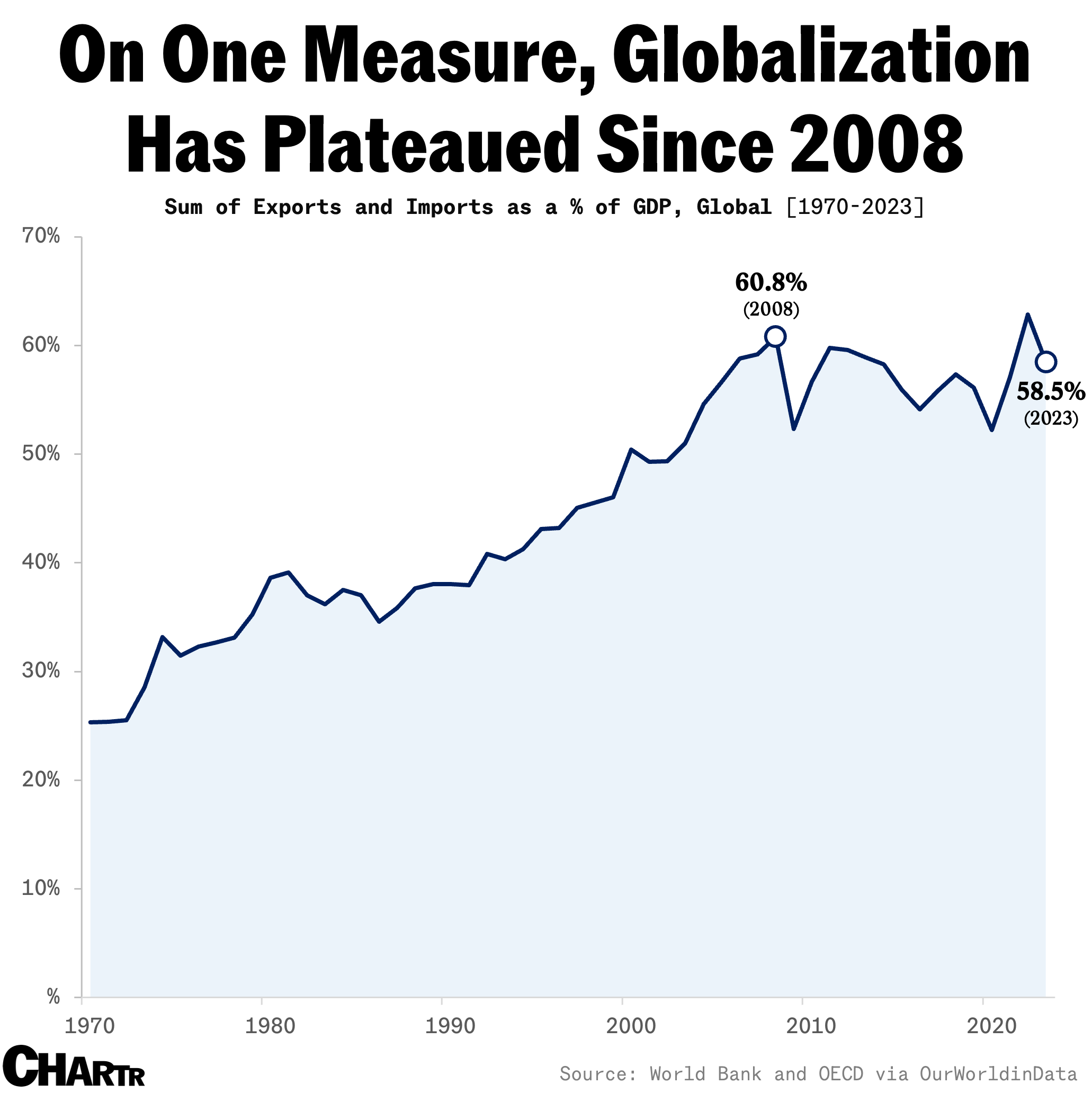
According to World Bank and OECD data, global trade rose from just 25% of global GDP in the 1970s to over 60% in 2008 — yet has remained flat since, hovering around 59% as of 2023. The long upward trend that defined the early globalization era has stalled for nearly two decades.
Now, with President Trump’s tariffs looking likely to spark a full-blown worldwide trade war, it’s hard to imagine global trade as a share of GDP going anywhere but down.
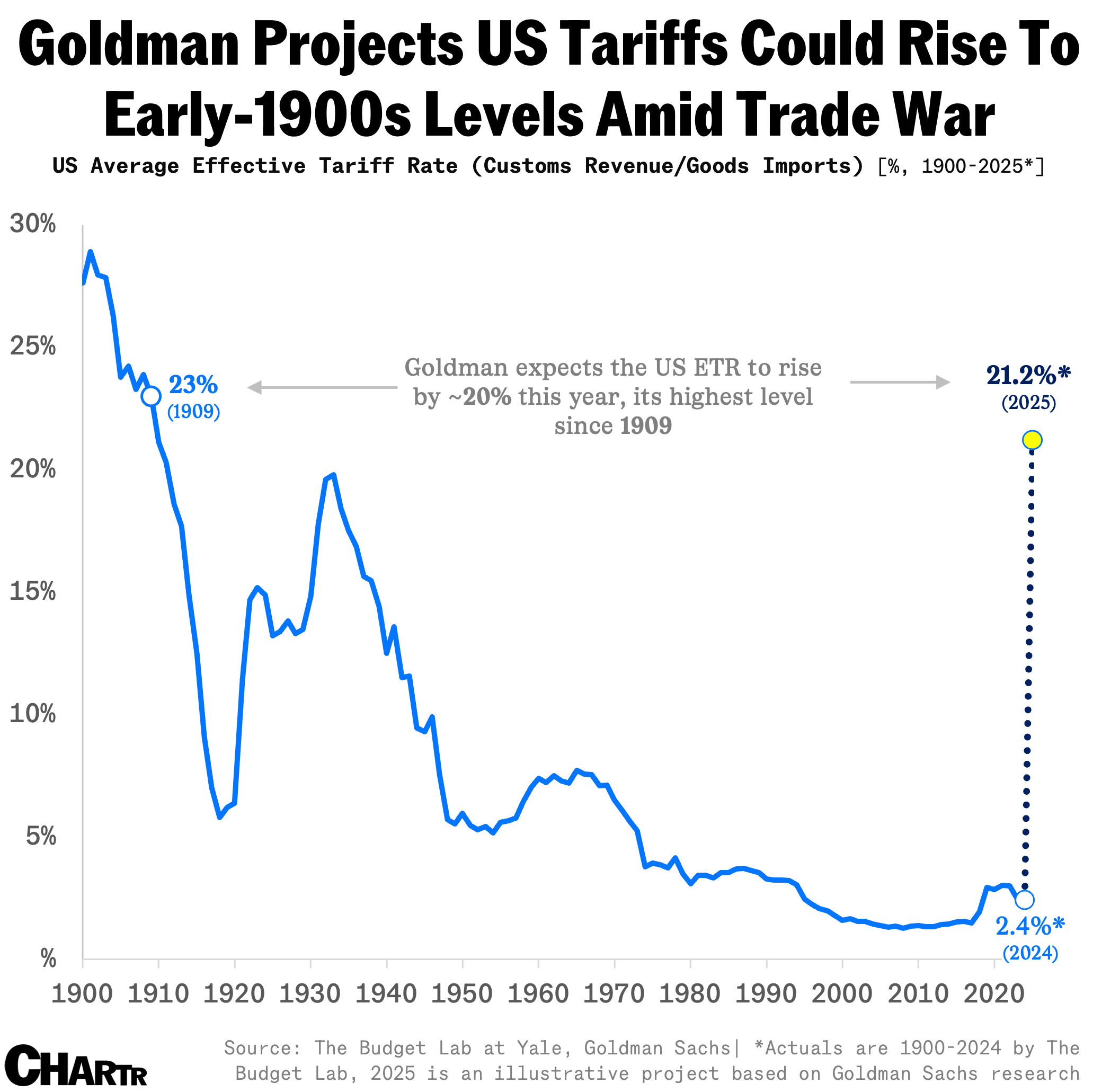
At least, that’s what early estimates on the announced tariffs would suggest, with economists expecting the effective US tariff rate to rise from 2.4% in 2024 to ~22% — the highest level since 1909, according to Goldman Sachs and Yale University’s Budget Lab.
Of course, global trade isn’t going to disappear overnight, but if tariffs are implemented and enforced in their current form, complex supply chains will have to be reinvented and many Western brands may have to rethink their expansion strategies. Even if these tariffs are eventually reversed, or end up being a bargaining tool to redress some of America’s largest trade imbalances, it seems likely that the uncertainty of the situation will be enough to delay some companies from investing or expanding.
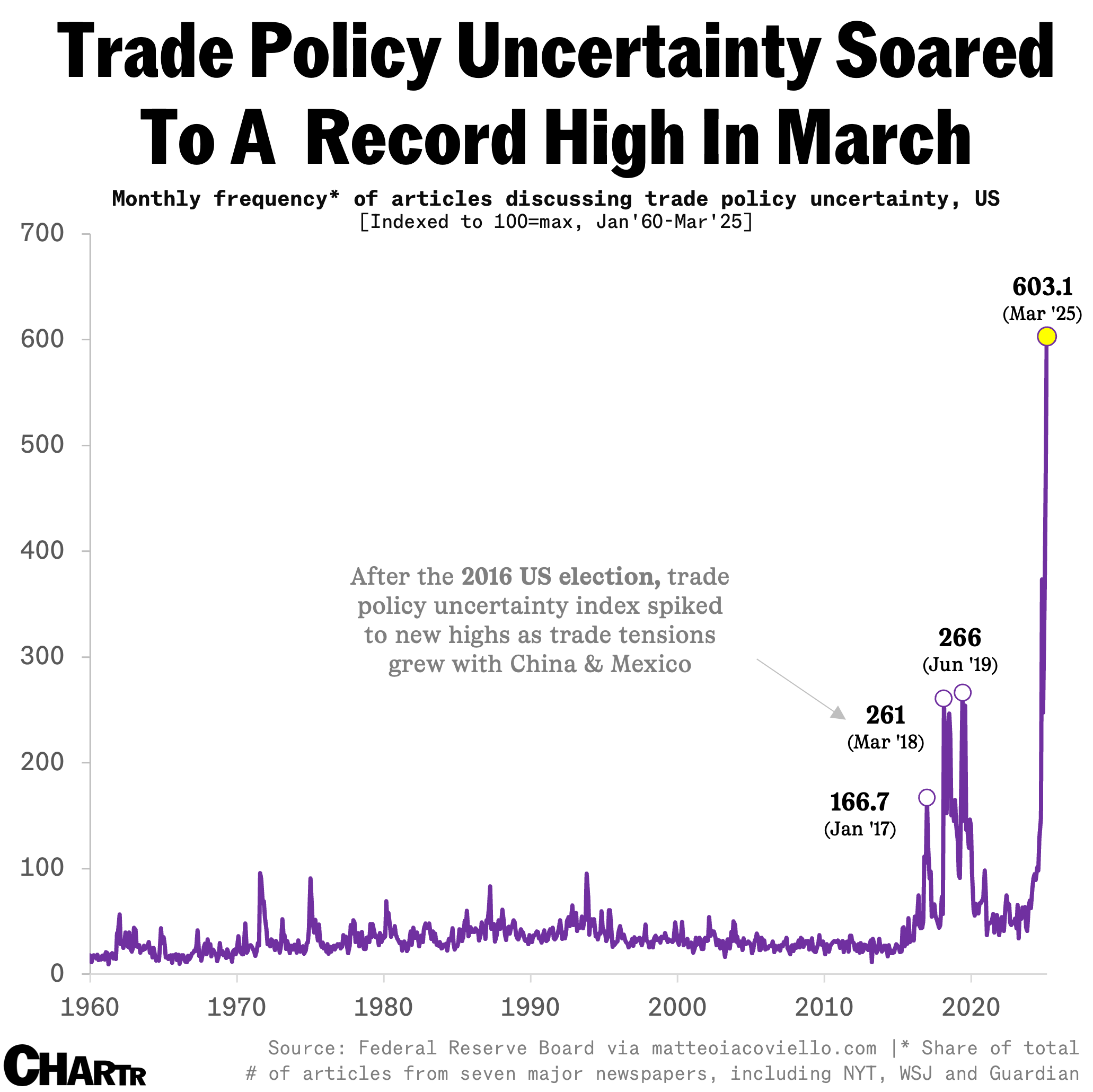
Indeed, the Trade Policy Uncertainty Index, which measures how frequently trade uncertainty appears in major newspapers, has surged in the past decade, hitting record highs after the 2016 US presidential election, driven by rising tensions with key partners like China and Mexico. The index soared again to an all-time peak this March.
Beyond the mechanical impacts of tariffs, the demise of globalization has dramatically changed how America views the world — and vice versa. As recently as 2017, roughly an equal number of people in the United States considered China an ally and an enemy.
Fast-forward to today and the feeling is wildly different, with 76% of Americans polled by YouGov viewing the world’s second-most-populous nation as a foe.
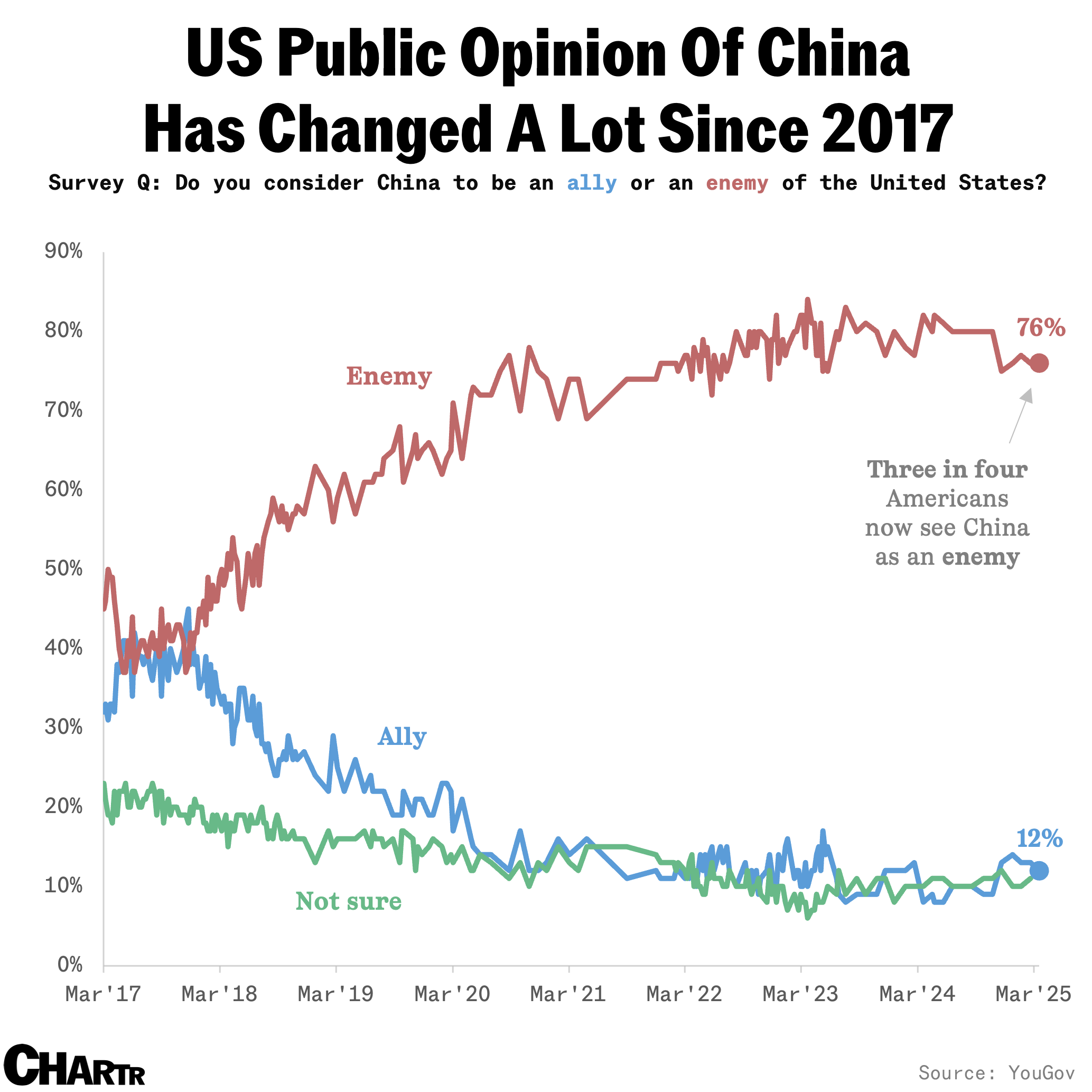
Only 12% now consider China an “ally” — down sharply from ~40% during the same period.
Even as we write this, the fate of one of the world’s most popular apps, TikTok, hangs in the balance over American concerns, very possibly well-founded ones, about the Chinese Communist Party’s level of influence at the tech company.
Domestic dynamos
The increasingly adversarial relationship between the world’s foremost superpowers makes it difficult to compete in China — particularly as local players in the country scale into formidable entities themselves.
Just in the last year, we’ve seen a number of global giants across industries, from restaurants to tech to retail, struggling in China and even being outpaced by local brands on the global stage.
China’s $1 tea and ice cream chain Mixue now operates more stores than McDonald’s or Starbucks. BYD surpassed Tesla in global EV revenue last year for the first time since 2017. Chinese smartphone makers now account for more than one-third of global shipments, and the country's fast-fashion and e-commerce upstarts, like Shein and Temu, have rapidly gained ground on legacy brands.
As HSBC Chair Mark Tucker said last month, “Globalization as we knew it may have now run its course.” That doesn’t mean the world is deglobalizing or turning inward entirely, but it’s clearly shifting away from the old, familiar model of “convergence” toward something more fragmented.