World
Newborn Baby Girl
Getty Images

Japan’s birth rate dropped to its lowest in 125 years

The number of new babies born dropped 5% last year.

Millie Giles

Even after then Prime Minister Fumio Kishida pledged up to 3.6 trillion yen (~$24 billion) annually to combat declining birth rates last year, Japan’s population problem is still getting worse.

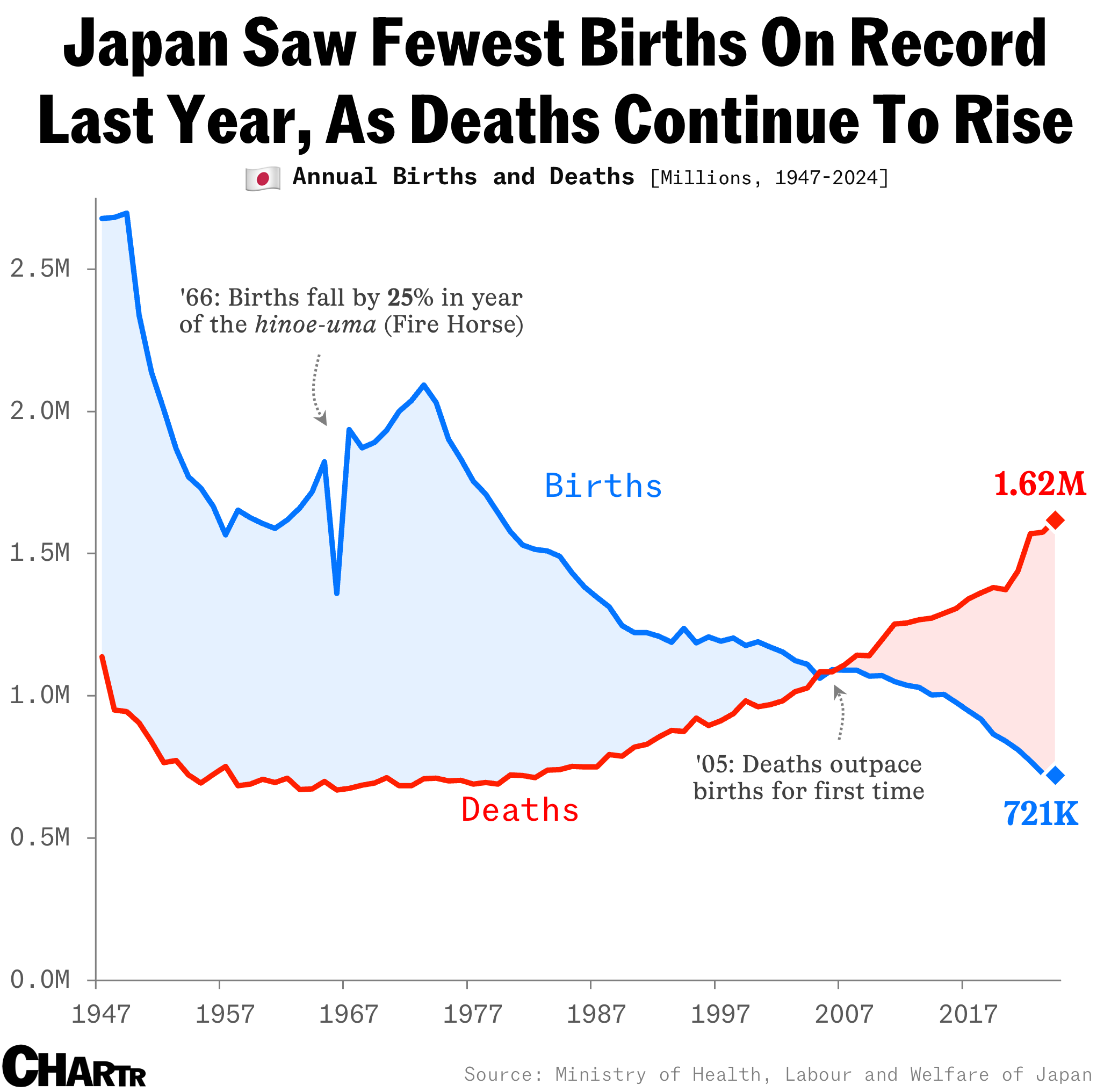
Preliminary data from the Ministry of Health, Labour and Welfare, published Thursday, found that there were just 720,988 births in Japan in 2024 — a 5% decline from the year before and the lowest figure since records began in 1899 — marking a continuation of the birth slump trend that’s being observed the world over. But Japan’s baby bust only appears to be escalating: per a 2011 study cited by the Financial Times, experts had only anticipated births to fall to ~720,000 in 2039

Japan births
Sherwood News

Alongside the number of deaths reaching a new high of ~1.62 million, this puts Japan’s natural population loss at nearly 900,000 people, ensuring that Japan will continue to wrestle with a rapidly graying population for years to come. In September, it was reported that almost one-third of the Japanese population was over 65 years old.

Family planning

Despite government efforts to encourage couples to have children — including introducing a four-day workweek in Tokyo and offering 1 million yen ($7,600) per child to families who moved out of the city — Japan has struggled to convince citizens to have kids, with births declining for nine consecutive years.

However, Japanese policymakers might take some hope from their neighbors, South Korea, the country that’s had the world’s lowest fertility rate since 2013. Government officials reported Wednesday that its fertility rate actually rose for the first time in nine years, as its policy push starts to take effect.

Dark horse... Japan saw its biggest single-year decline in births (down 25%) in 1966, the year of the hinoe-uma (Fire Horse) in the Chinese zodiac, due to superstitions about women born in this year — and, coming in hot as literally the last thing the Japanese government needs, the next Fire Horse year is in 2026.

More World

See all World
world
Tom Jones

The UAE’s OPEC exit will hit the group in the barrels

After just shy of 60 years in OPEC, its membership even predating its status as a nation-state, the United Arab Emirates yesterday announced its shocking departure from the oil production group, effective May 1, as the knock-on effects of the Iran war continue to play out across the Middle East and the energy landscape.

For context, the UAE produces the third-highest amount of oil in the group, per April data and OPEC’s latest set of annual statistics.

According to the cartel’s 2025 Annual Statistical Bulletin, the OPEC group was collectively exporting some 19 million barrels of crude oil a day last year, with the United Arab Emirates accounting for some 14% of that daily output.

UAExit means UAExit

The nation, whose energy minister told Reuters yesterday that the decision was taken “after a careful look at current and future policies related to level of production” and wasn’t made following discussions with any other country, made up a healthy share of the group’s total confirmed crude oil reserves, as well.

OPEC exports chart
Sherwood News

Of the 12 nations in the core group, which was founded by just five oil superpowers back in September 1960, only two (Iraq and Saudi Arabia) exported more barrels of crude oil daily, pumping out 3.36 million and 6.05 million barrels, respectively, each day to nations around the world.

For its part, the UAE said it will “continue its responsible role by gradually and thoughtfully increasing production, in line with demand and market conditions,” per the official state news agency. Clearly, the nation now wants a little more control of just how much oil it can pump around the world, with the UAE having to eat a large proportion of lost revenues due to its healthy abundance and OPEC restrictions.

According to the cartel’s 2025 Annual Statistical Bulletin, the OPEC group was collectively exporting some 19 million barrels of crude oil a day last year, with the United Arab Emirates accounting for some 14% of that daily output.

UAExit means UAExit

The nation, whose energy minister told Reuters yesterday that the decision was taken “after a careful look at current and future policies related to level of production” and wasn’t made following discussions with any other country, made up a healthy share of the group’s total confirmed crude oil reserves, as well.

OPEC exports chart
Sherwood News

Of the 12 nations in the core group, which was founded by just five oil superpowers back in September 1960, only two (Iraq and Saudi Arabia) exported more barrels of crude oil daily, pumping out 3.36 million and 6.05 million barrels, respectively, each day to nations around the world.

For its part, the UAE said it will “continue its responsible role by gradually and thoughtfully increasing production, in line with demand and market conditions,” per the official state news agency. Clearly, the nation now wants a little more control of just how much oil it can pump around the world, with the UAE having to eat a large proportion of lost revenues due to its healthy abundance and OPEC restrictions.

Latest Stories

Sherwood Media, LLC produces fresh and unique perspectives on topical financial news and is a fully owned subsidiary of Robinhood Markets, Inc., and any views expressed here do not necessarily reflect the views of any other Robinhood affiliate, including Robinhood Markets, Inc., Robinhood Financial LLC, Robinhood Securities, LLC, Robinhood Crypto, LLC, Robinhood Derivatives, LLC, or Robinhood Money, LLC. Futures and event contracts are offered through Robinhood Derivatives, LLC.