
World
Big Dill: Pickleball has surged in popularity in past few years

Big Dill: Pickleball has surged in popularity in past few years

Boredom, the mother of invention

Tracing its roots all the way back to 1965 when it was invented by a group of 3 dads who couldn’t find a shuttlecock to play badminton on a summer’s day, pickleball has had a slow-then-fast-then-really-fast rise in America. On that day in Washington nearly 60 years ago, the trio improvised with what they had: table tennis paddles, a plastic ball, and a badminton court — a combination that, once the net was lowered a few feet, proved an entertaining and accessible game to a variety of ages and abilities.

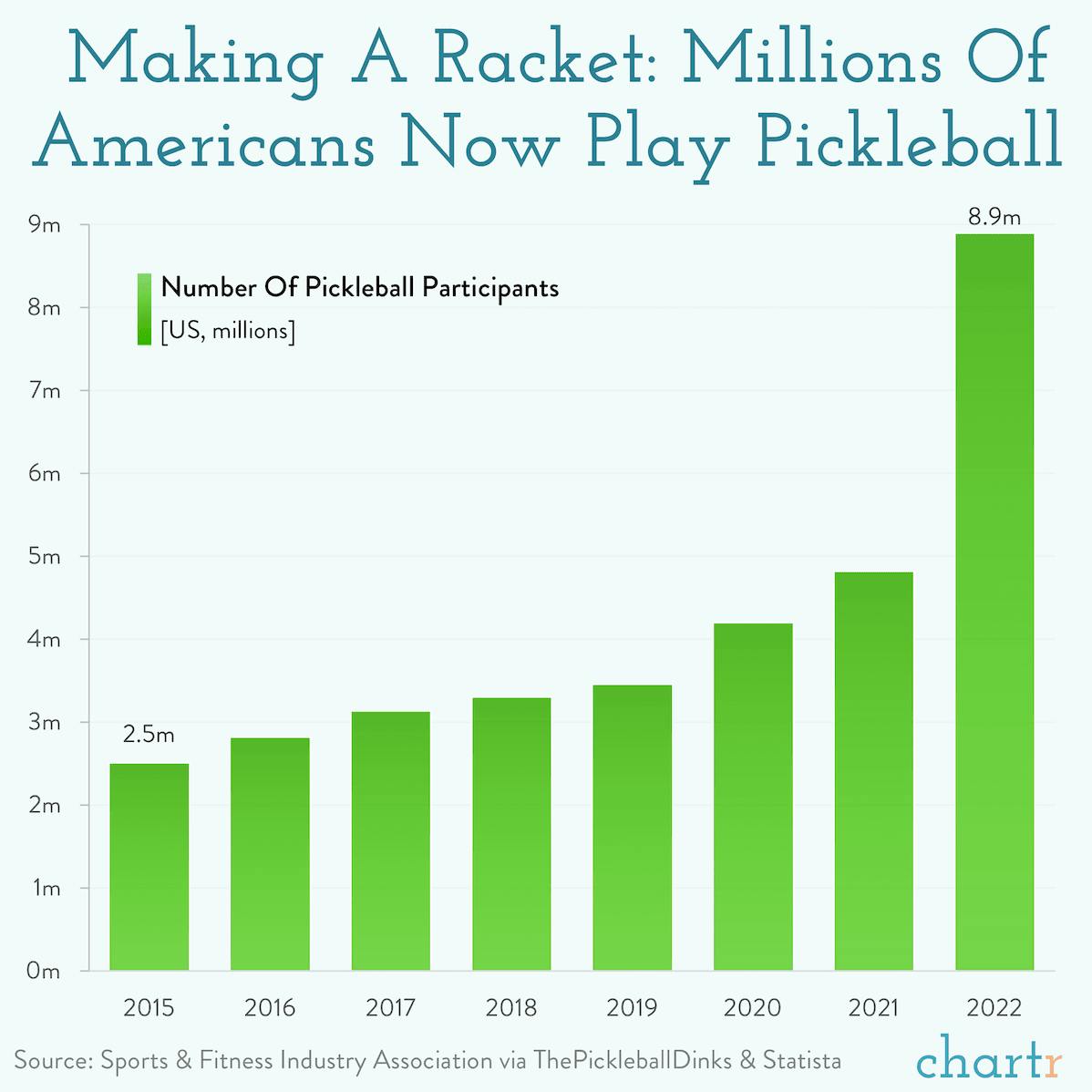
From those humble beginnings, it took the sport decades to really capture people’s interest, spreading organically across America, eventually being played in every state by 1990. But, cut to the present day, and pickleball has taken the US by storm: according to the Sport & Fitness Industry Association, 8.9 million players played the sport in 2022, up more than 80% on the prior year, making it the fastest growing sport in America.

Serving everyone

Arguably the main driver of pickleball’s popularity boom is its low-commitment versatility. Thanks to its perforated ball — which slows the game down — and smaller court, pickleball demands less raw athletic ability than many other sports, giving it a broad appeal, with many kids and seniors picking up the game.

In 2021, almost 73% of all record pickleball participants were ‘casual’ players who played fewer than 7x per year. In that same year, roughly 29% of pickleball players were aged 18-34 years old, while 21% were kids, ~20% were 35-54, and a whopping ~18% were 65+ — an astonishingly even demographic split for an increasingly mainstream sport. Out of those who play the most frequently, the older demographic was the dominant force, accounting for nearly one-third of that “core” player group.

More World

See all World
world

Google searches for “roman numerals” hit a new peak this Super Bowl

Following on from last year’s Super Bowl LIX, and Super Bowl LVIII before that, you’d be forgiven for thinking that the title “Super Bowl LX” might have created less confusion than previous iterations.

But it seems that the archaic notation denoting this year’s Big Game was no exception: monthly search volumes for “roman numerals” in the US were at the highest volume seen in over two decades this February, according to Google Trends data.

Roman numerals super bowl
Sherwood News

If people in shoulder pads throwing around a weirdly shaped ball is your Roman Empire, one thing you have to know is Roman numerals — or join the millions who turn to Google to work out how to read them every Super Bowl season.

Ironically, according to the NFL, the numbering system was adopted for clarity, as the game is played at the start of the year “following a chronologically recorded season.” And so, over its 60-year history, the NFL has labeled almost every Super Bowl with a selection of capital letters like X’s, I’s, and V’s — one of the rare exceptions being Super Bowl 50 in 2016, when the NFL ad designers felt Super Bowl L was too unmarketable.

At least stumped football fans in 2026 will be faring much better than those in the year 12,965 would be, who’d have to refer to the Big Game as Super Bowl (breathes in) MMMMMMMMMMDCCCCLXXXXVIIII.

Latest Stories

Sherwood Media, LLC produces fresh and unique perspectives on topical financial news and is a fully owned subsidiary of Robinhood Markets, Inc., and any views expressed here do not necessarily reflect the views of any other Robinhood affiliate, including Robinhood Markets, Inc., Robinhood Financial LLC, Robinhood Securities, LLC, Robinhood Crypto, LLC, or Robinhood Money, LLC.