World
Heat pump on a facade infrared thermal scan
(Getty Images)
cool coat

Could new “sweating” paint help alleviate the world’s AC dependency?

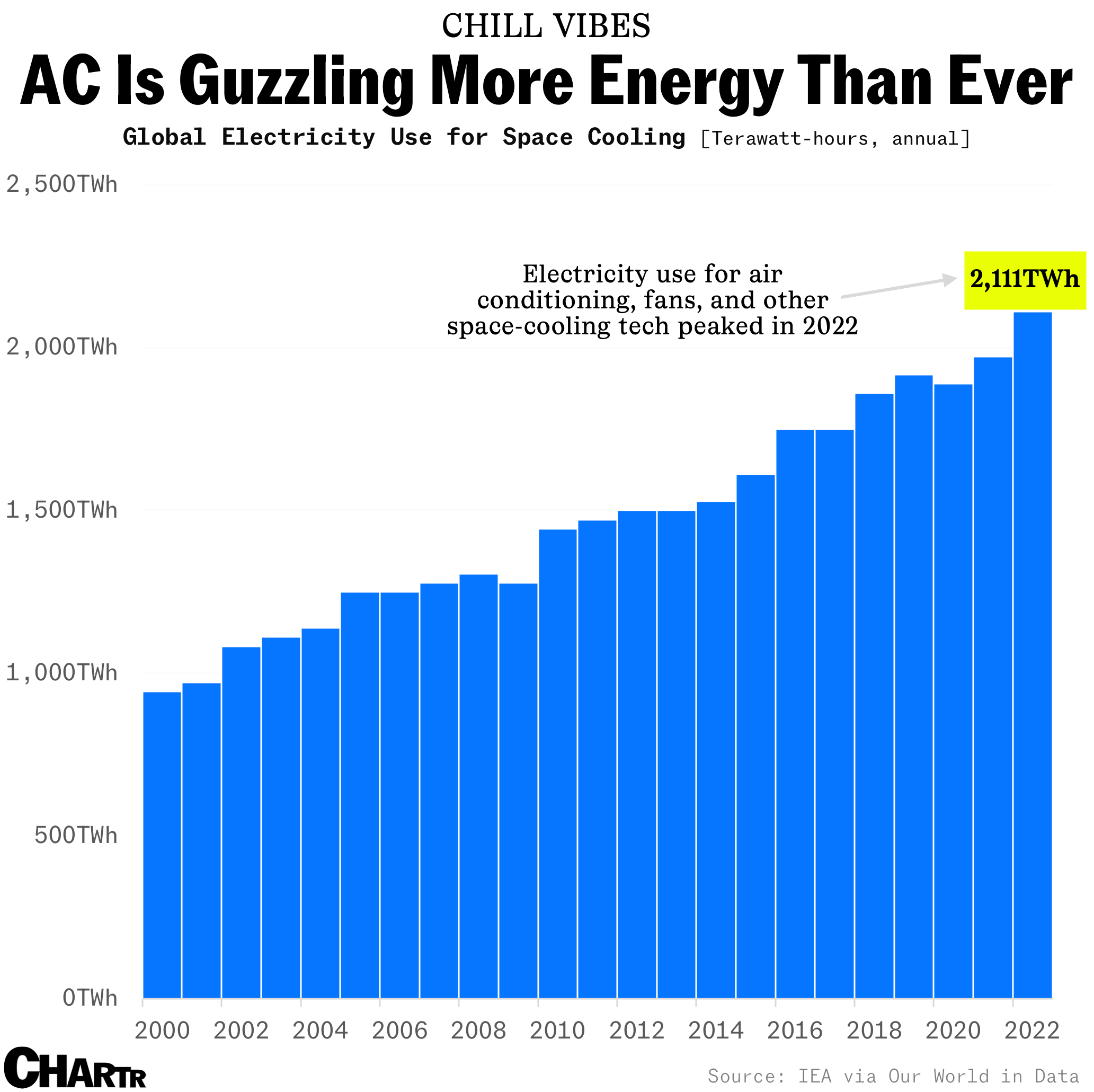
Air con electricity use has peaked in recent years.

Tom Jones

Scientists in Singapore, which often ranks as one of the most humid cities in the world, have developed a new cooling paint that works by reflecting sunlight and slowly releasing water, in a similar way to how the body produces sweat, per reporting from Science News.

Outstripping

That “sweating” element is what sets the new paint apart, ensuring that the product can be applied in more humid climes, unlike other paints that rely on the more traditional radiative method. While some cities have coated external walls and roofs with cooling paint for years — more than 10 million square feet of rooftops have been daubed with reflective paint since 2009 — the breakthrough from Singapore could reduce the world’s dependence on air conditioning, which accounts for a whopping ~7% of total electricity consumption, according to Our World In Data.
AC electricity use chart
Sherwood News

Though there’s still a chasm between rich and poor nations when it comes to air conditioning, related electricity usage has rocketed in the 21st century, as temperatures rise and AC becomes the norm in more homes around the world. In 2001, when 77% of US households had AC, compared to almost 90% in 2020, the world was using 972 terawatt-hours’ worth of electricity to power AC, fans, and other cooling tech, figures from the International Energy Agency show. By 2022, that had more than doubled.

Singapore’s first prime minister, Lee Kuan Yew, singled out air conditioning as “one of the signal inventions in history,” adding that it “changed the nature of civilization by making development possible in the tropics.” Now, an innovation from his compatriots could provide a more eco-friendly alternative.

More World

See all World
world

Google searches for “roman numerals” hit a new peak this Super Bowl

Following on from last year’s Super Bowl LIX, and Super Bowl LVIII before that, you’d be forgiven for thinking that the title “Super Bowl LX” might have created less confusion than previous iterations.

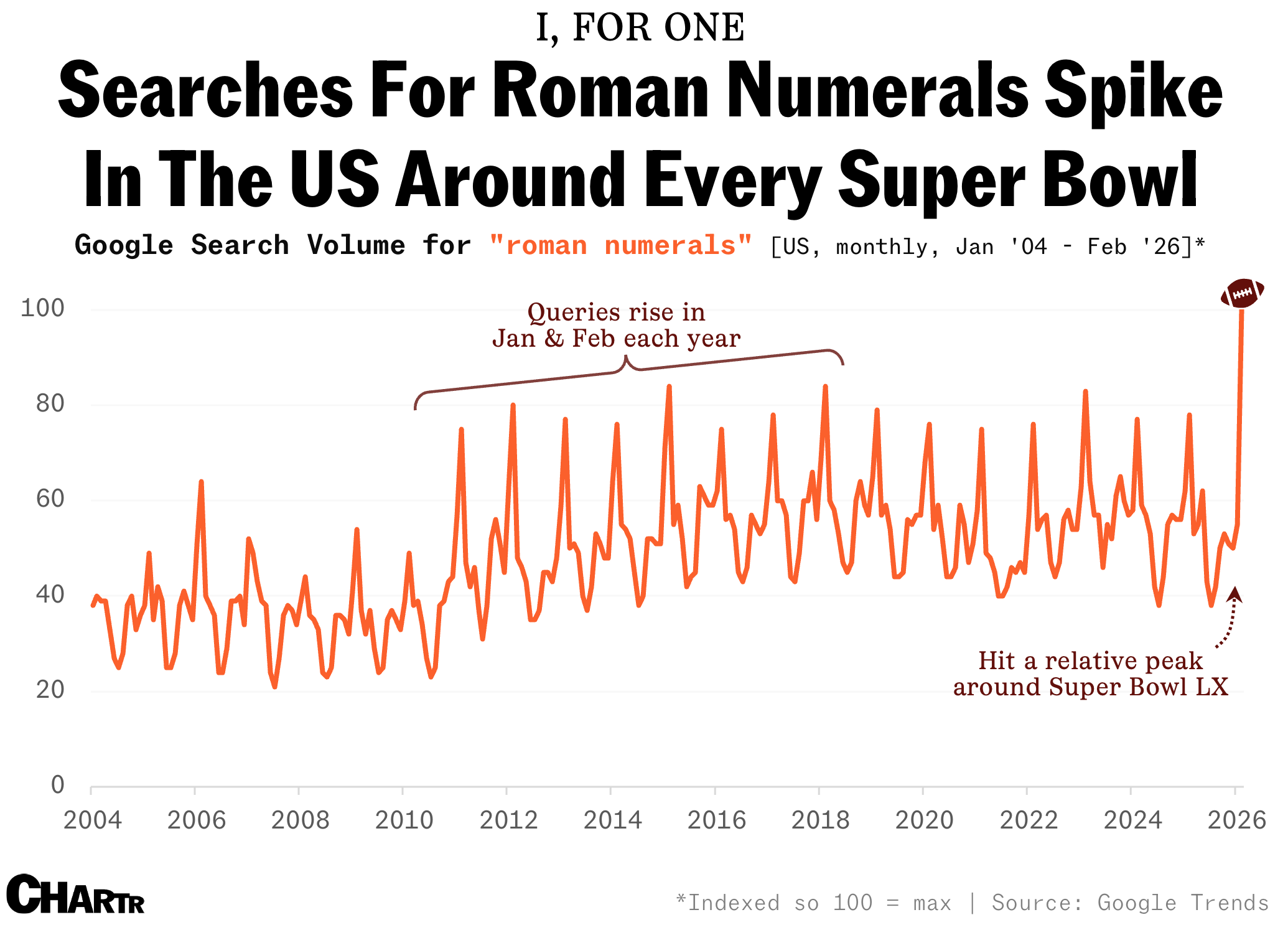
But it seems that the archaic notation denoting this year’s Big Game was no exception: monthly search volumes for “roman numerals” in the US were at the highest volume seen in over two decades this February, according to Google Trends data.

Roman numerals super bowl
Sherwood News

If people in shoulder pads throwing around a weirdly shaped ball is your Roman Empire, one thing you have to know is Roman numerals — or join the millions who turn to Google to work out how to read them every Super Bowl season.

Ironically, according to the NFL, the numbering system was adopted for clarity, as the game is played at the start of the year “following a chronologically recorded season.” And so, over its 60-year history, the NFL has labeled almost every Super Bowl with a selection of capital letters like X’s, I’s, and V’s — one of the rare exceptions being Super Bowl 50 in 2016, when the NFL ad designers felt Super Bowl L was too unmarketable.

At least stumped football fans in 2026 will be faring much better than those in the year 12,965 would be, who’d have to refer to the Big Game as Super Bowl (breathes in) MMMMMMMMMMDCCCCLXXXXVIIII.

Latest Stories

Sherwood Media, LLC produces fresh and unique perspectives on topical financial news and is a fully owned subsidiary of Robinhood Markets, Inc., and any views expressed here do not necessarily reflect the views of any other Robinhood affiliate, including Robinhood Markets, Inc., Robinhood Financial LLC, Robinhood Securities, LLC, Robinhood Crypto, LLC, or Robinhood Money, LLC.