World
Web of language: English dominates the internet

Web of language: English dominates the internet

Universal language

For more than 5.1 billion people (per a recent count), the internet has become an invaluable tool for education, entertainment and connection. For almost as many international netizens, however, a great portion of the online space is simply in the wrong language. English overwhelming dominates the internet, being used by more than 55% of online domains, according to a study published by Rest of World as of May 2023.

That makes English's representation on the internet more than 10x the 4.7% of the world’s population that speak it as their primary language. That’s the most staggering overrepresentation, although other nations like Japan, France, and Germany also see their languages overrepresented. Conversely, Chinese language groups like Mandarin and Min are employed on just 1.4% of web domains, despite being spoken as a primary language by 16.4% of the world’s population.

One UNESCO expert is concerned that, in 15 years, there will be “just 5 or 10 languages spoken prominently in business and online”.

Lost in translation

The World Wide Web was created by London-born computer scientist Tim Berners-Lee in 1989, before it was launched into the public domain in 1993. Predictably, English dominated the early portion of the internet, accounting for ~80**%** of online content in the mid-90s. Since then, things have only shifted modestly — the UN's efforts to get global universal internet access by 2030 could accelerate the pace of change.

Go deeper: With the full data analysis from Rest of World.

More World

See all World
world

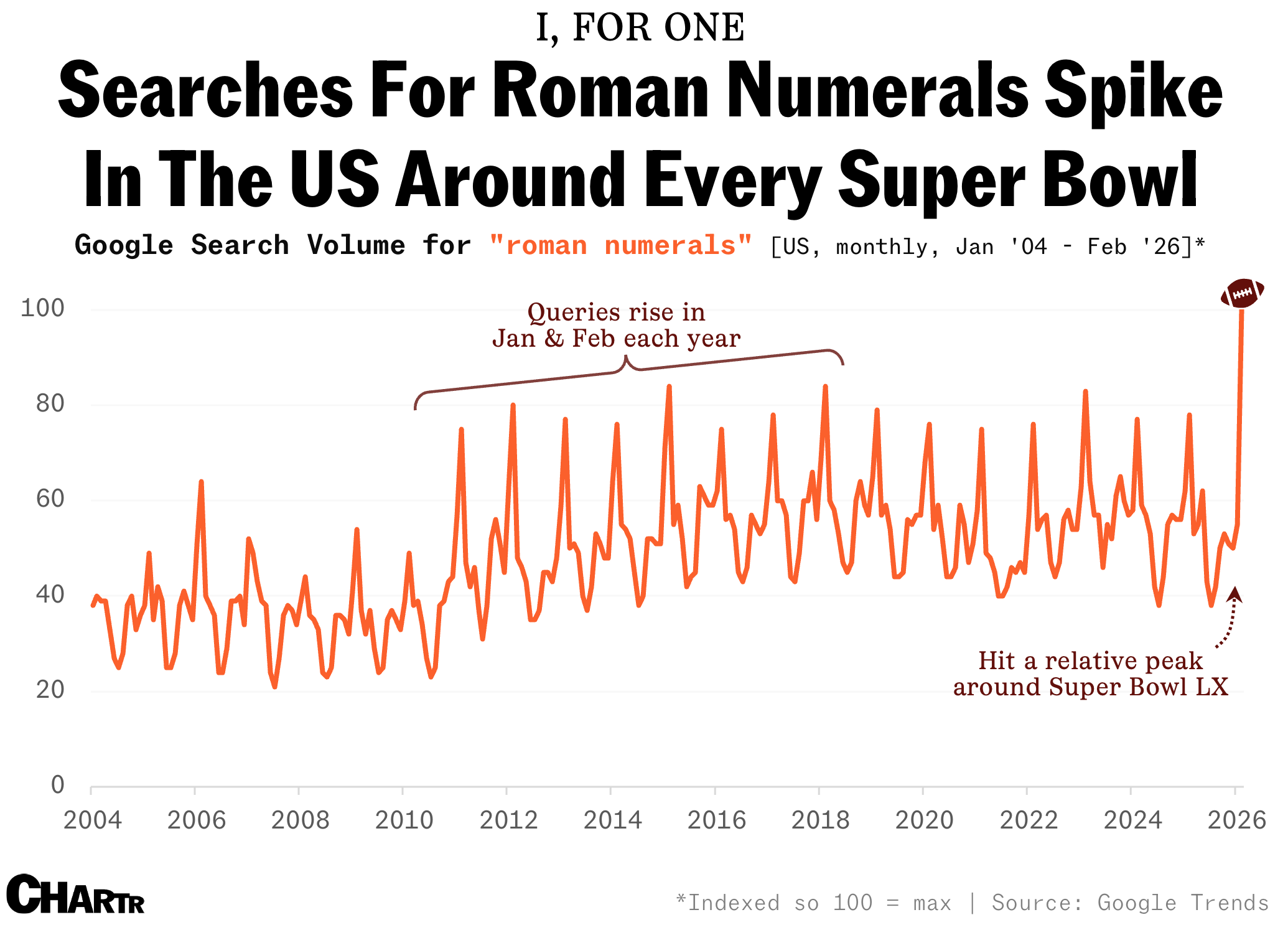
Google searches for “roman numerals” hit a new peak this Super Bowl

Following on from last year’s Super Bowl LIX, and Super Bowl LVIII before that, you’d be forgiven for thinking that the title “Super Bowl LX” might have created less confusion than previous iterations.

But it seems that the archaic notation denoting this year’s Big Game was no exception: monthly search volumes for “roman numerals” in the US were at the highest volume seen in over two decades this February, according to Google Trends data.

Roman numerals super bowl
Sherwood News

If people in shoulder pads throwing around a weirdly shaped ball is your Roman Empire, one thing you have to know is Roman numerals — or join the millions who turn to Google to work out how to read them every Super Bowl season.

Ironically, according to the NFL, the numbering system was adopted for clarity, as the game is played at the start of the year “following a chronologically recorded season.” And so, over its 60-year history, the NFL has labeled almost every Super Bowl with a selection of capital letters like X’s, I’s, and V’s — one of the rare exceptions being Super Bowl 50 in 2016, when the NFL ad designers felt Super Bowl L was too unmarketable.

At least stumped football fans in 2026 will be faring much better than those in the year 12,965 would be, who’d have to refer to the Big Game as Super Bowl (breathes in) MMMMMMMMMMDCCCCLXXXXVIIII.

Latest Stories

Sherwood Media, LLC produces fresh and unique perspectives on topical financial news and is a fully owned subsidiary of Robinhood Markets, Inc., and any views expressed here do not necessarily reflect the views of any other Robinhood affiliate, including Robinhood Markets, Inc., Robinhood Financial LLC, Robinhood Securities, LLC, Robinhood Crypto, LLC, or Robinhood Money, LLC.