
World
A newborn baby dressed in the colors of the American flag of the United States, blue studio background. A child in the clothes of the red and white USA flag
Getty Images
Bottleneck

The fertility rate in the US has fallen to a new record low

The latest CDC figures show that births per woman in the US slumped to under 1.6 — well below replacement level.

Millie Giles

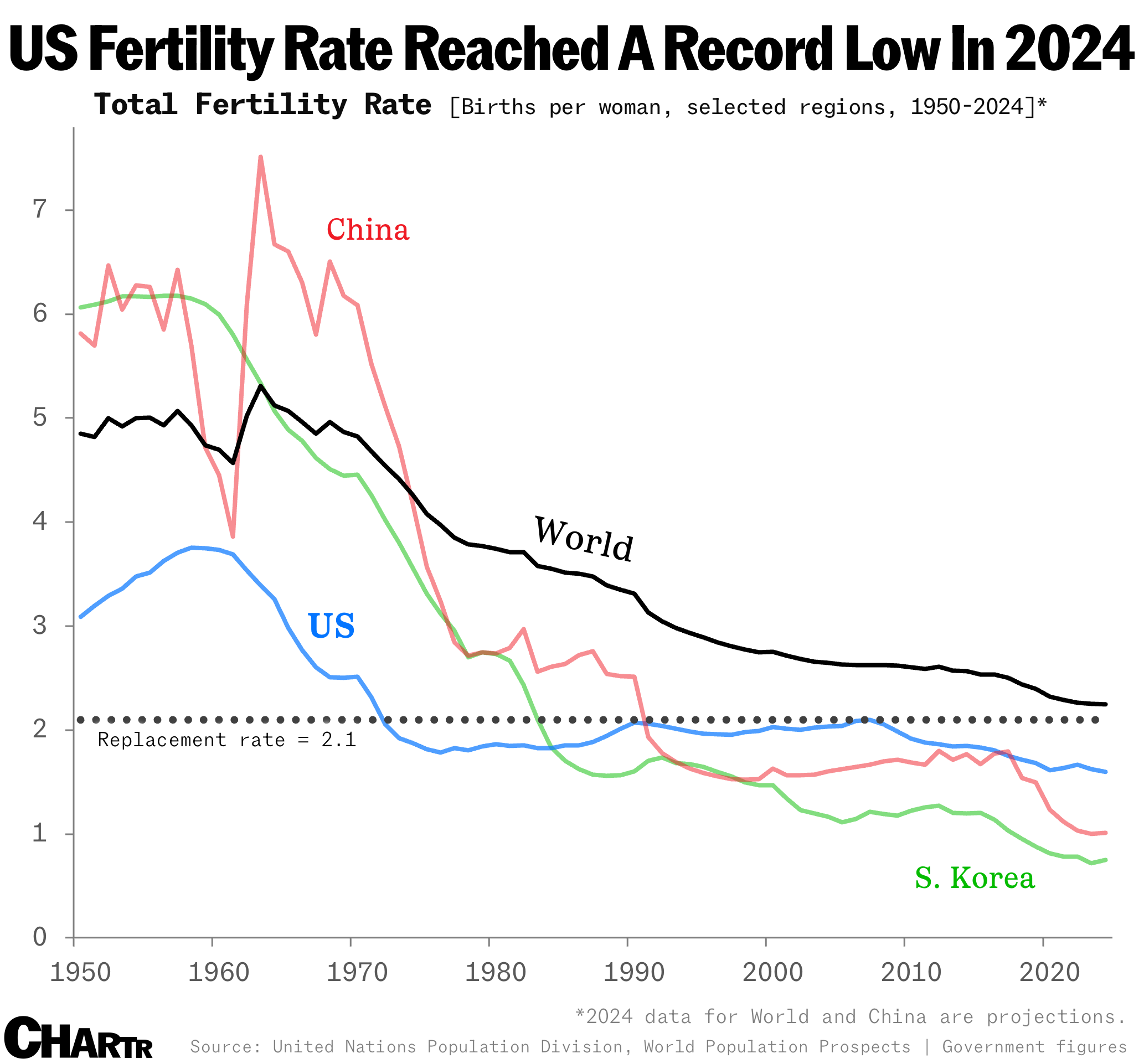
New CDC data released Thursday shows that America’s fertility rate dropped to an all-time low of just under 1.6 children per woman on average in 2024.

For context, this is lower than the UN’s projection for the world’s overall rate (2.25), as well as the figure forecast for the US (1.62) in its World Population Prospects report for 2024. Imperatively, it also falls well below the replacement level of 2.1 — or, the birth rate required for a population to replace itself from one generation to the next.
US fertility rate 2024
Sherwood News

Like much of the developed world, the US has seen its fertility rate slump in recent years as an increasing number of adults have decided to delay or opt out of altogether of having kids, citing economic and social limitations (though it seems that many still can’t decide whether there are currently too many children or not enough).

Natal attraction

As plunging fertility rates worldwide foretell an impending global baby bust, governments are experimenting with incentives to encourage citizens to have more children.

Among these is the US, with raising the national fertility rate being one of the Trump administration’s priorities. Back in April, as part of its pronatalist push, the White House reportedly considered a $5,000 “baby bonus” for new mothers.

Interestingly, last year saw a rare child-rearing win for the country with world’s lowest birth rate. South Korea’s birthrate rose for the first time in nine years to 0.75 in 2024, as reported in February, and just this week the country announced notching record birth growth in the first five months of the year.

Meanwhile, China, previously the global leader for fertility, is struggling with a reduced youth population: a Financial Times article published on Thursday outlined that the number of children in Chinese kindergartens has dropped by 12 million in just four years.

More World

See all World
world

The UAE’s OPEC exit will hit the group in the barrels

After just shy of 60 years in OPEC, its membership even predating its status as a nation-state, the United Arab Emirates yesterday announced its shocking departure from the oil production group, effective May 1, as the knock-on effects of the Iran war continue to play out across the Middle East and the energy landscape.

For context, the UAE produces the third-highest amount of oil in the group, per April data and OPEC’s latest set of annual statistics.

According to the cartel’s 2025 Annual Statistical Bulletin, the OPEC group was collectively exporting some 19 million barrels of crude oil a day last year, with the United Arab Emirates accounting for some 14% of that daily output.

UAExit means UAExit

The nation, whose energy minister told Reuters yesterday that the decision was taken “after a careful look at current and future policies related to level of production” and wasn’t made following discussions with any other country, made up a healthy share of the group’s total confirmed crude oil reserves, as well.

OPEC exports chart
Sherwood News

Of the 12 nations in the core group, which was founded by just five oil superpowers back in September 1960, only two (Iraq and Saudi Arabia) exported more barrels of crude oil daily, pumping out 3.36 million and 6.05 million barrels, respectively, each day to nations around the world.

For its part, the UAE said it will “continue its responsible role by gradually and thoughtfully increasing production, in line with demand and market conditions,” per the official state news agency. Clearly, the nation now wants a little more control of just how much oil it can pump around the world, with the UAE having to eat a large proportion of lost revenues due to its healthy abundance and OPEC restrictions.

According to the cartel’s 2025 Annual Statistical Bulletin, the OPEC group was collectively exporting some 19 million barrels of crude oil a day last year, with the United Arab Emirates accounting for some 14% of that daily output.

UAExit means UAExit

The nation, whose energy minister told Reuters yesterday that the decision was taken “after a careful look at current and future policies related to level of production” and wasn’t made following discussions with any other country, made up a healthy share of the group’s total confirmed crude oil reserves, as well.

OPEC exports chart
Sherwood News

Of the 12 nations in the core group, which was founded by just five oil superpowers back in September 1960, only two (Iraq and Saudi Arabia) exported more barrels of crude oil daily, pumping out 3.36 million and 6.05 million barrels, respectively, each day to nations around the world.

For its part, the UAE said it will “continue its responsible role by gradually and thoughtfully increasing production, in line with demand and market conditions,” per the official state news agency. Clearly, the nation now wants a little more control of just how much oil it can pump around the world, with the UAE having to eat a large proportion of lost revenues due to its healthy abundance and OPEC restrictions.

Latest Stories

Sherwood Media, LLC produces fresh and unique perspectives on topical financial news and is a fully owned subsidiary of Robinhood Markets, Inc., and any views expressed here do not necessarily reflect the views of any other Robinhood affiliate, including Robinhood Markets, Inc., Robinhood Financial LLC, Robinhood Securities, LLC, Robinhood Crypto, LLC, Robinhood Derivatives, LLC, or Robinhood Money, LLC. Futures and event contracts are offered through Robinhood Derivatives, LLC.