
World
Isometric group of businessmen carrying piles of documents in cardboard boxes left the office, unemployment, dismissal, career crisis, economic crisis leading to massive layoffs
Sherwood News

The UK job market just saw its biggest drop since Covid

Rising employer costs in April are likely to blame for a lot of the drop-off.

Hyunsoo Rim

The UK job market looked a little like 2020 again last month.

According to the Office for National Statistics, the number of payrolled workers dropped by 78,000 in March — the steepest monthly fall in almost five years, when Brits were coming to terms with the first national lockdown and businesses were working out what that meant for the world of work. At the same time, job vacancies also slipped to a four-year low in the first three months of the year, while a separate recruiter survey shows the number of job seekers is growing at its fastest pace since December 2020. 
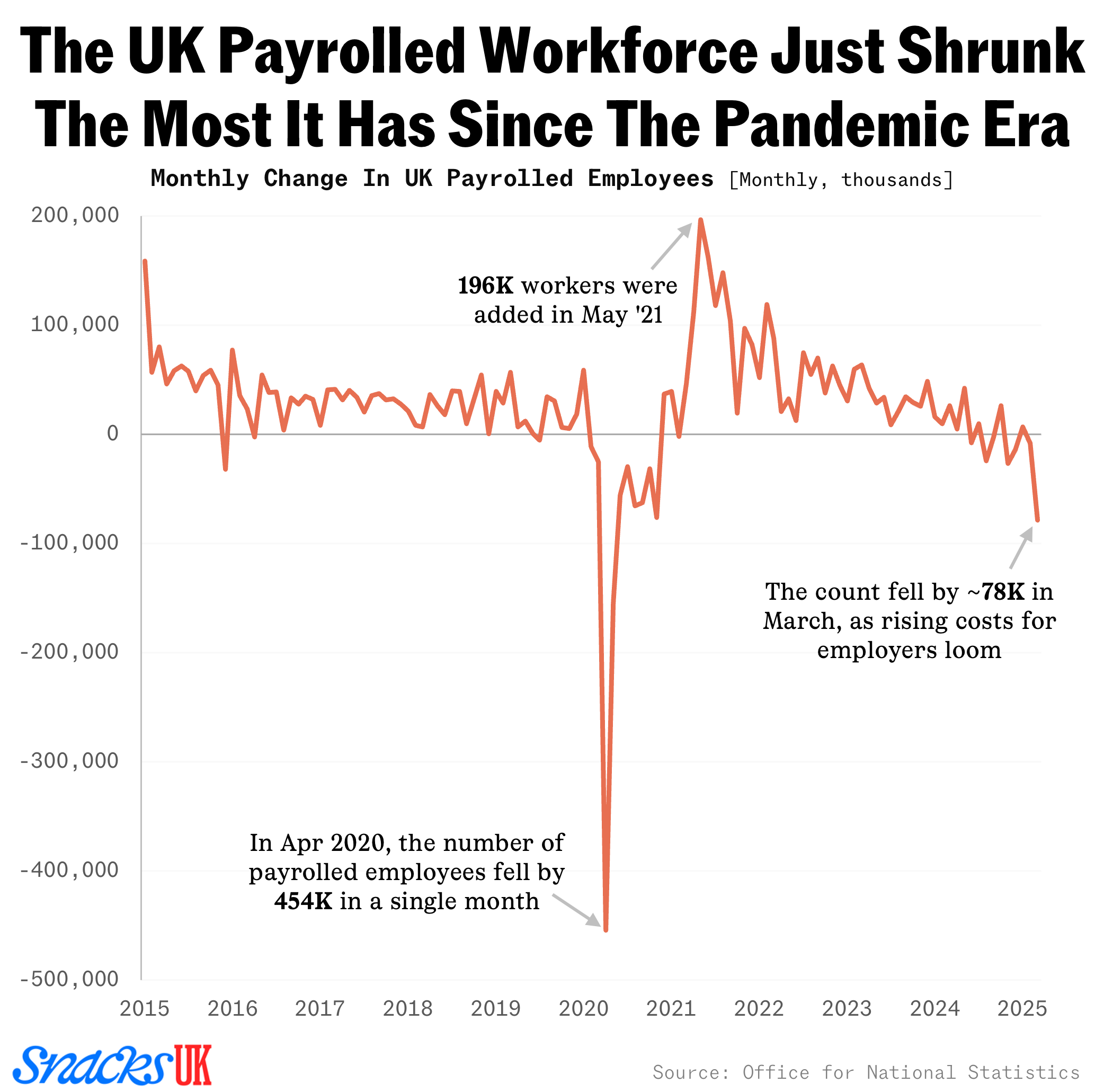
UK workers drop chart
Sherwood News

The decline in March arrived right before two major cost hikes for businesses, with a £25 billion rise in National Insurance contributions and a 6.7% national minimum wage increase both kicking in this month. The measures were announced in October as part of Labour Chancellor Rachel Reeves’ autumn budget.

Downsizing

Faced with those higher costs, companies clearly chose to shrink head counts, freeze hiring, or both, ahead of time — especially in labor-heavy and lower-wage industries like hospitality and retail. In a February survey, more than two-thirds of hospitality businesses said they planned to reduce staffing due to tax changes, while big-name retailers, including Tesco, Boots, and M&S, also warned of potential job cuts and higher prices. 

Elsewhere, however, wages have actually been looking pretty strong, rising 5.9% in the three months to February compared with the same period in 2024. But some economists expect that to cool later this year, as rising labor costs weigh on employers. And with tariff uncertainty looming larger in the global economy, companies may become even more cautious about hiring.

Interestingly, Americans are increasingly looking for work in the UK, data from Indeed and Google Trends shows — just as the British job market seems to be pulling back a little.

More World

See all World
world

The UAE’s OPEC exit will hit the group in the barrels

After just shy of 60 years in OPEC, its membership even predating its status as a nation-state, the United Arab Emirates yesterday announced its shocking departure from the oil production group, effective May 1, as the knock-on effects of the Iran war continue to play out across the Middle East and the energy landscape.

For context, the UAE produces the third-highest amount of oil in the group, per April data and OPEC’s latest set of annual statistics.

According to the cartel’s 2025 Annual Statistical Bulletin, the OPEC group was collectively exporting some 19 million barrels of crude oil a day last year, with the United Arab Emirates accounting for some 14% of that daily output.

UAExit means UAExit

The nation, whose energy minister told Reuters yesterday that the decision was taken “after a careful look at current and future policies related to level of production” and wasn’t made following discussions with any other country, made up a healthy share of the group’s total confirmed crude oil reserves, as well.

OPEC exports chart
Sherwood News

Of the 12 nations in the core group, which was founded by just five oil superpowers back in September 1960, only two (Iraq and Saudi Arabia) exported more barrels of crude oil daily, pumping out 3.36 million and 6.05 million barrels, respectively, each day to nations around the world.

For its part, the UAE said it will “continue its responsible role by gradually and thoughtfully increasing production, in line with demand and market conditions,” per the official state news agency. Clearly, the nation now wants a little more control of just how much oil it can pump around the world, with the UAE having to eat a large proportion of lost revenues due to its healthy abundance and OPEC restrictions.

According to the cartel’s 2025 Annual Statistical Bulletin, the OPEC group was collectively exporting some 19 million barrels of crude oil a day last year, with the United Arab Emirates accounting for some 14% of that daily output.

UAExit means UAExit

The nation, whose energy minister told Reuters yesterday that the decision was taken “after a careful look at current and future policies related to level of production” and wasn’t made following discussions with any other country, made up a healthy share of the group’s total confirmed crude oil reserves, as well.

OPEC exports chart
Sherwood News

Of the 12 nations in the core group, which was founded by just five oil superpowers back in September 1960, only two (Iraq and Saudi Arabia) exported more barrels of crude oil daily, pumping out 3.36 million and 6.05 million barrels, respectively, each day to nations around the world.

For its part, the UAE said it will “continue its responsible role by gradually and thoughtfully increasing production, in line with demand and market conditions,” per the official state news agency. Clearly, the nation now wants a little more control of just how much oil it can pump around the world, with the UAE having to eat a large proportion of lost revenues due to its healthy abundance and OPEC restrictions.

Latest Stories

Sherwood Media, LLC produces fresh and unique perspectives on topical financial news and is a fully owned subsidiary of Robinhood Markets, Inc., and any views expressed here do not necessarily reflect the views of any other Robinhood affiliate, including Robinhood Markets, Inc., Robinhood Financial LLC, Robinhood Securities, LLC, Robinhood Crypto, LLC, Robinhood Derivatives, LLC, or Robinhood Money, LLC. Futures and event contracts are offered through Robinhood Derivatives, LLC.