
World
Hands waving small British and American flags
Getty Images

The US and UK have agreed to a trade deal, or at least a trade framework

Buying from Britain is already more expensive, as the dollar has weakened nearly 10% against sterling since January.

US stocks were higher in trading on Thursday (SPDR S&P 500 Trust) after President Trump announced a “major trade deal” with the United Kingdom, the first of many big handshake opportunities the US administration will be hoping to deliver in the coming months.

In the press conference that followed, the president, Secretary of Commerce Howard Lutnick, and other members of the negotiating team outlined some major aspects of the deal, including teasing an order from the UK for $10 billion worth of Boeing planes.

As part of the agreement, the US is set to remove tariffs on British aluminum and steel, while the tariff rate charged on cars will fall from 27.5% to 10% for up to 100,000 vehicles from the UK.

In return, the UK will “remove the tariff on ethanol — which is used to produce beer — coming into the UK from the US, down to zero,” while US beef farmers may find greener pastures selling to the UK in future, thanks to a “new reciprocal market access on beef,” per a British government press release.

However, many of the finer points have yet to be ironed out, with the president saying that “final details are being written up in the coming weeks.” So, what does the US actually import from the UK?

Per the UK government, cars top the list, with some £9 billion worth of vehicles shipped across the Atlantic in 2024, while medicines, power generators, scientific instruments, and aircraft round out the top five.
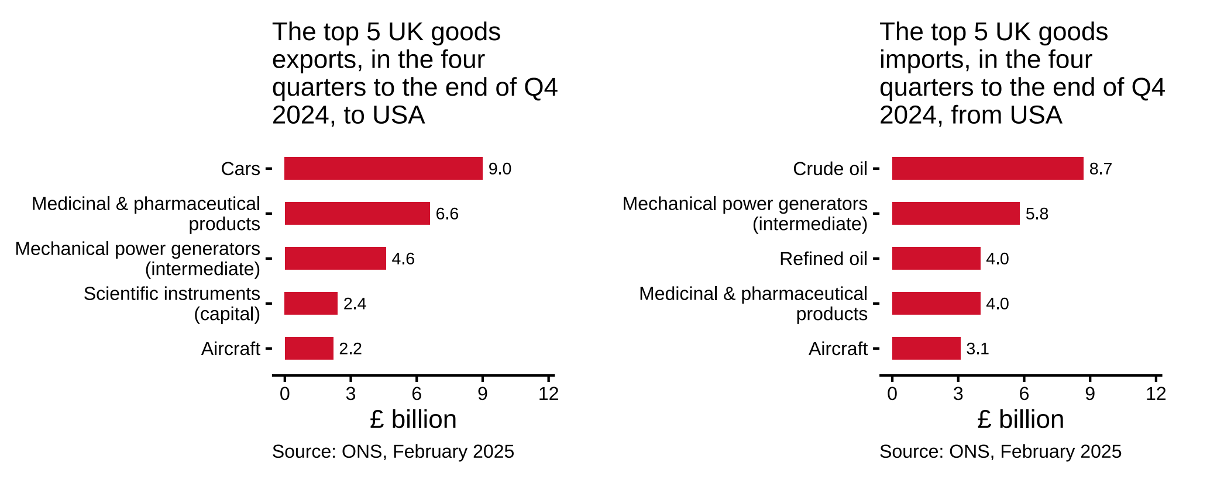
US-UK trade deal
United States Trade Factsheet (UK Department for Business & Trade)

With the US dollar slipping 9% against the pound since January, buying British from the United States is already looking a little more expensive.
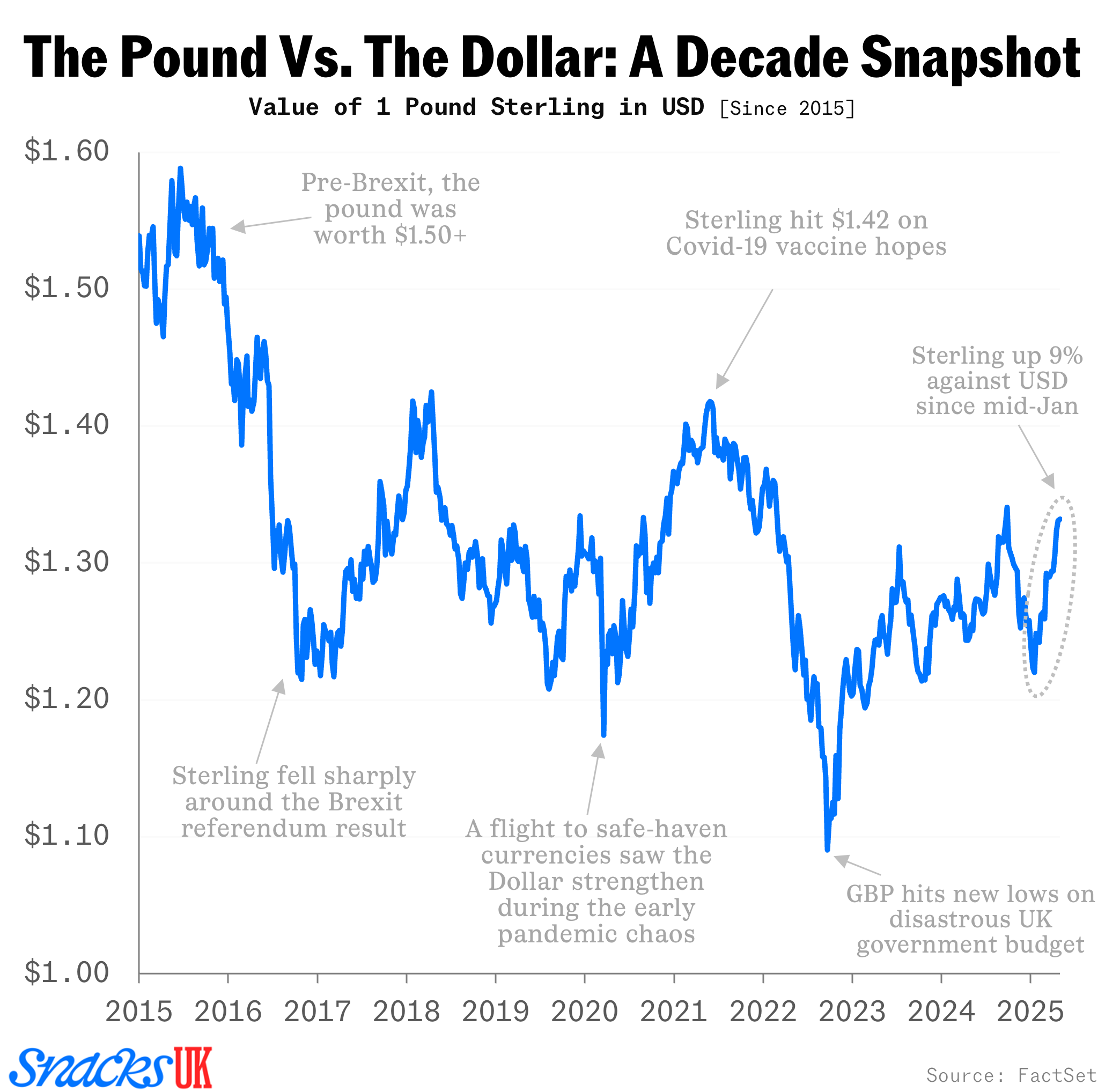

GBP USD
Sherwood News

More World

See all World
world
Tom Jones

The UAE’s OPEC exit will hit the group in the barrels

After just shy of 60 years in OPEC, its membership even predating its status as a nation-state, the United Arab Emirates yesterday announced its shocking departure from the oil production group, effective May 1, as the knock-on effects of the Iran war continue to play out across the Middle East and the energy landscape.

For context, the UAE produces the third-highest amount of oil in the group, per April data and OPEC’s latest set of annual statistics.

According to the cartel’s 2025 Annual Statistical Bulletin, the OPEC group was collectively exporting some 19 million barrels of crude oil a day last year, with the United Arab Emirates accounting for some 14% of that daily output.

UAExit means UAExit

The nation, whose energy minister told Reuters yesterday that the decision was taken “after a careful look at current and future policies related to level of production” and wasn’t made following discussions with any other country, made up a healthy share of the group’s total confirmed crude oil reserves, as well.

OPEC exports chart
Sherwood News

Of the 12 nations in the core group, which was founded by just five oil superpowers back in September 1960, only two (Iraq and Saudi Arabia) exported more barrels of crude oil daily, pumping out 3.36 million and 6.05 million barrels, respectively, each day to nations around the world.

For its part, the UAE said it will “continue its responsible role by gradually and thoughtfully increasing production, in line with demand and market conditions,” per the official state news agency. Clearly, the nation now wants a little more control of just how much oil it can pump around the world, with the UAE having to eat a large proportion of lost revenues due to its healthy abundance and OPEC restrictions.

According to the cartel’s 2025 Annual Statistical Bulletin, the OPEC group was collectively exporting some 19 million barrels of crude oil a day last year, with the United Arab Emirates accounting for some 14% of that daily output.

UAExit means UAExit

The nation, whose energy minister told Reuters yesterday that the decision was taken “after a careful look at current and future policies related to level of production” and wasn’t made following discussions with any other country, made up a healthy share of the group’s total confirmed crude oil reserves, as well.

OPEC exports chart
Sherwood News

Of the 12 nations in the core group, which was founded by just five oil superpowers back in September 1960, only two (Iraq and Saudi Arabia) exported more barrels of crude oil daily, pumping out 3.36 million and 6.05 million barrels, respectively, each day to nations around the world.

For its part, the UAE said it will “continue its responsible role by gradually and thoughtfully increasing production, in line with demand and market conditions,” per the official state news agency. Clearly, the nation now wants a little more control of just how much oil it can pump around the world, with the UAE having to eat a large proportion of lost revenues due to its healthy abundance and OPEC restrictions.

Latest Stories

Sherwood Media, LLC produces fresh and unique perspectives on topical financial news and is a fully owned subsidiary of Robinhood Markets, Inc., and any views expressed here do not necessarily reflect the views of any other Robinhood affiliate, including Robinhood Markets, Inc., Robinhood Financial LLC, Robinhood Securities, LLC, Robinhood Crypto, LLC, Robinhood Derivatives, LLC, or Robinhood Money, LLC. Futures and event contracts are offered through Robinhood Derivatives, LLC.