World
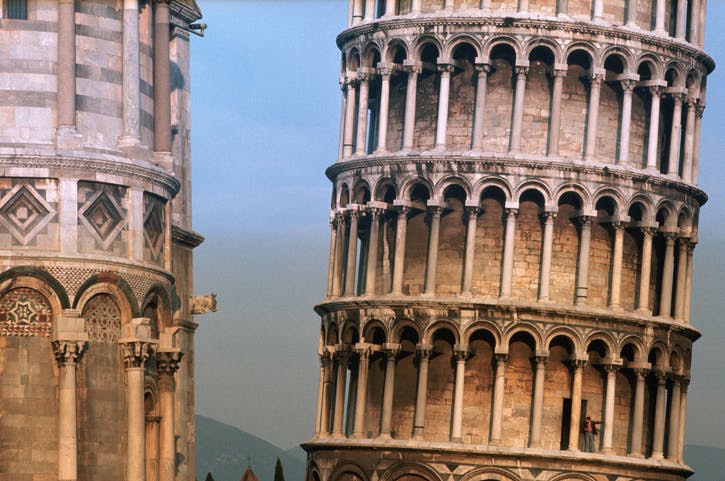
Duomo and Leaning Tower in Pisa
(Getty Images)

There are 319 skyscrapers in NYC. One of them leans 3 inches to the north.

The unfinished Seaport 1 is still slanting in the third-tallest skyline in the world.

Tom Jones

Humans have been building upward in towers since the dawn of time, and in the last few hundred years, we’ve gotten really good at it. But every now and then, even with the marvels of modern engineering, we get it wrong.

Cut short

Mired in controversy, marred by over a dozen lawsuits, and shaped more “like a banana” than a traditional apartment complex, the unfinished Seaport 1 building in Manhattan still looms large enough in the NYC mindscape to warrant a new feature piece in The New Yorker this week

Construction on “The Leaning Tower of New York,” which slants some three inches to the north and is pictured below, halted indefinitely almost five years ago now, as multiple litigations piled on top of the project after The Lean emerged in 2019.

In an effort to shave $6 million from their costs, the building’s developers reportedly chose a lesser-used method when it came to laying the complex’s foundations, looking away from the “pile” foundations that prop up much of Manhattan’s towering skyline.

Cityscapes

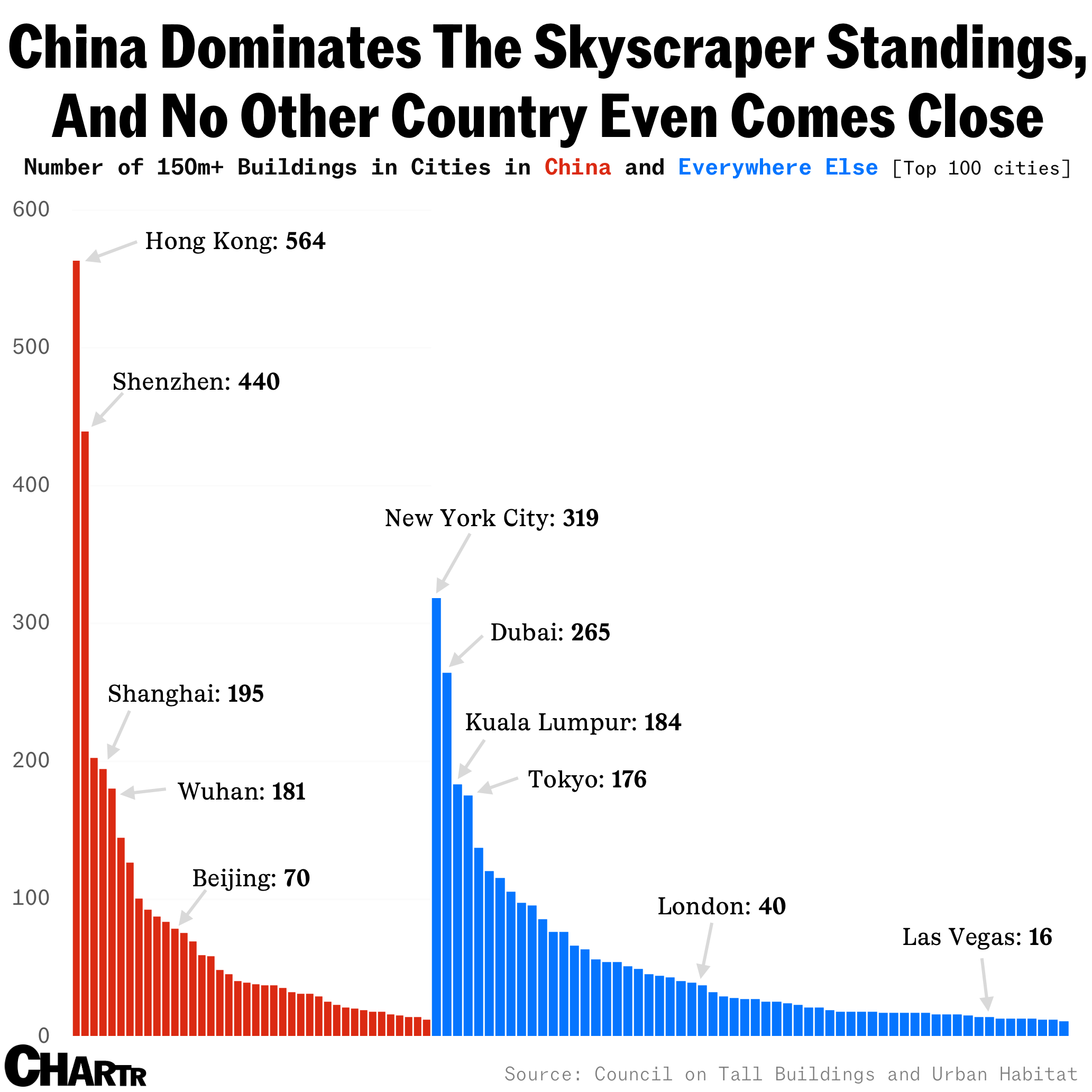
Indeed, with more than 300 buildings that are more than 150 meters tall, NYC is the skyscraper capital of the world... at least outside of China, that is.
Skyscraper capitals chart
Sherwood News

Of the 100 cities with the most skyscrapers (buildings that stand over 150 meters or 492 feet tall) in the world, 40 are in China alone. Hong Kong is officially the skyscraper capital of the world, with 564, while Shenzhen stands as the world’s second tallest city, with 440 buildings over 150 meters. New York comes in a distant third place, with 319 in total, including 17 structures above 300 meters (984 ft). 

Interestingly, according to the figures from the Council on Tall Buildings and Urban Habitat, there have been 91 skyscrapers built in Shenzhen since we covered the topic in 2022. Back then, the Big Apple only had 302 skyscrapers.

More World

See all World
world
Tom Jones

The UAE’s OPEC exit will hit the group in the barrels

After just shy of 60 years in OPEC, its membership even predating its status as a nation-state, the United Arab Emirates yesterday announced its shocking departure from the oil production group, effective May 1, as the knock-on effects of the Iran war continue to play out across the Middle East and the energy landscape.

For context, the UAE produces the third-highest amount of oil in the group, per April data and OPEC’s latest set of annual statistics.

According to the cartel’s 2025 Annual Statistical Bulletin, the OPEC group was collectively exporting some 19 million barrels of crude oil a day last year, with the United Arab Emirates accounting for some 14% of that daily output.

UAExit means UAExit

The nation, whose energy minister told Reuters yesterday that the decision was taken “after a careful look at current and future policies related to level of production” and wasn’t made following discussions with any other country, made up a healthy share of the group’s total confirmed crude oil reserves, as well.

OPEC exports chart
Sherwood News

Of the 12 nations in the core group, which was founded by just five oil superpowers back in September 1960, only two (Iraq and Saudi Arabia) exported more barrels of crude oil daily, pumping out 3.36 million and 6.05 million barrels, respectively, each day to nations around the world.

For its part, the UAE said it will “continue its responsible role by gradually and thoughtfully increasing production, in line with demand and market conditions,” per the official state news agency. Clearly, the nation now wants a little more control of just how much oil it can pump around the world, with the UAE having to eat a large proportion of lost revenues due to its healthy abundance and OPEC restrictions.

According to the cartel’s 2025 Annual Statistical Bulletin, the OPEC group was collectively exporting some 19 million barrels of crude oil a day last year, with the United Arab Emirates accounting for some 14% of that daily output.

UAExit means UAExit

The nation, whose energy minister told Reuters yesterday that the decision was taken “after a careful look at current and future policies related to level of production” and wasn’t made following discussions with any other country, made up a healthy share of the group’s total confirmed crude oil reserves, as well.

OPEC exports chart
Sherwood News

Of the 12 nations in the core group, which was founded by just five oil superpowers back in September 1960, only two (Iraq and Saudi Arabia) exported more barrels of crude oil daily, pumping out 3.36 million and 6.05 million barrels, respectively, each day to nations around the world.

For its part, the UAE said it will “continue its responsible role by gradually and thoughtfully increasing production, in line with demand and market conditions,” per the official state news agency. Clearly, the nation now wants a little more control of just how much oil it can pump around the world, with the UAE having to eat a large proportion of lost revenues due to its healthy abundance and OPEC restrictions.

Latest Stories

Sherwood Media, LLC produces fresh and unique perspectives on topical financial news and is a fully owned subsidiary of Robinhood Markets, Inc., and any views expressed here do not necessarily reflect the views of any other Robinhood affiliate, including Robinhood Markets, Inc., Robinhood Financial LLC, Robinhood Securities, LLC, Robinhood Crypto, LLC, Robinhood Derivatives, LLC, or Robinhood Money, LLC. Futures and event contracts are offered through Robinhood Derivatives, LLC.