


With federal jobs at a 60-year low, the US government looks to grow its workforce again
Following last year’s federal job cuts, the Trump administration is hiring once more... with some new rules.
To some Americans, it might feel like a lifetime since the DOGE era — when Elon Musk and Vivek Ramaswamy were called upon in late 2024 to make the US government more efficient through cutting federal costs, by way of cutting federal jobs.
While the program’s initial ambassadors were sooner or later phased out of their own government roles, DOGE still had a significant impact on shrinking the size of the US federal workforce over the past year. As reported by Pew Research Center last week, the government’s headcount contracted by 10.3% in 2025.
That shrinkage is corroborated by the latest data from the US Bureau of Labor Statistics, which shows that there were just 2.68 million federal workers in February — the lowest count in almost exactly 60 years.
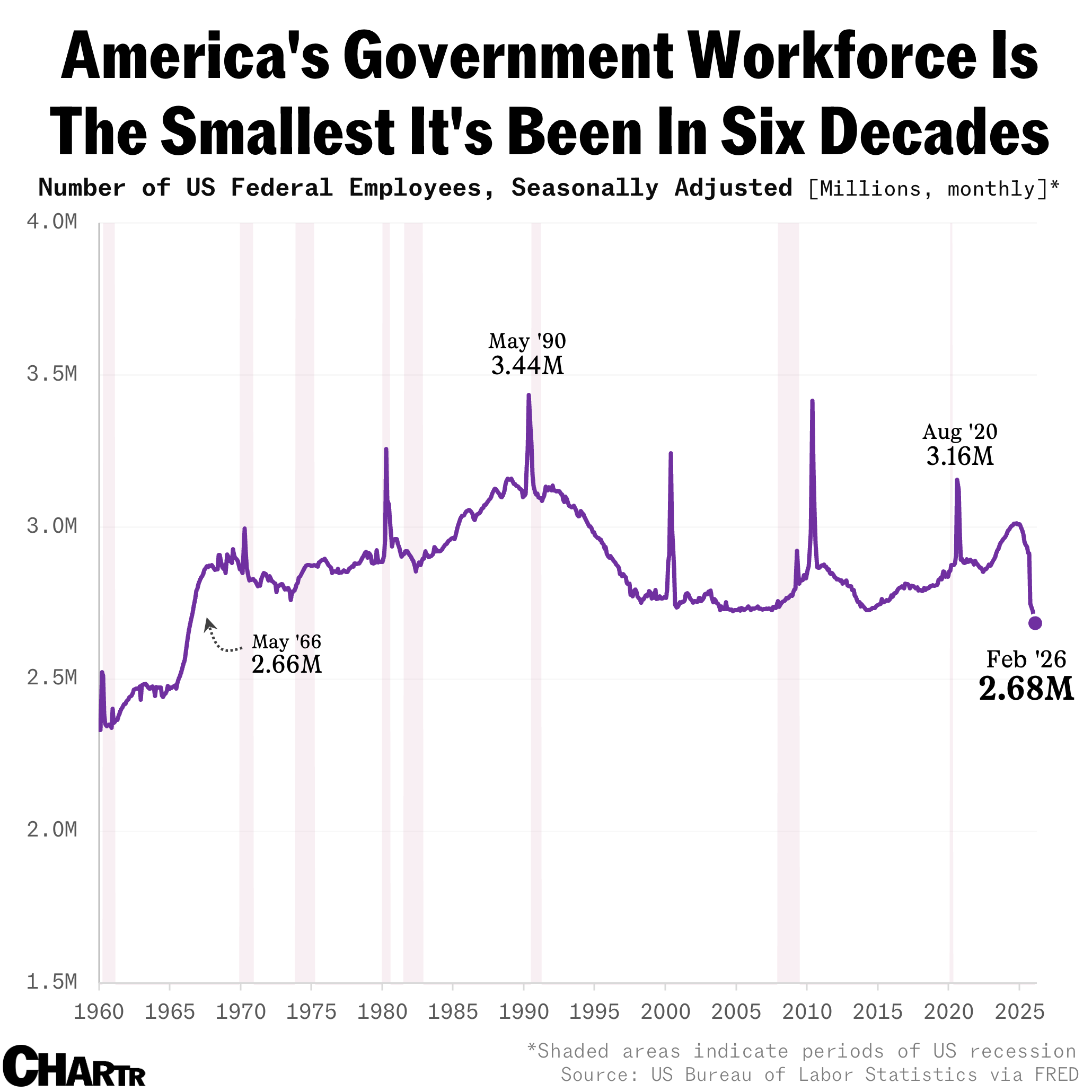
Last year’s jobs reversal is stark, especially considering that, at the outset of DOGE, direct employment within the federal government had remained stable for decades.
In its report, Pew outlined that as ~348,000 people quit, retired, were laid off, or otherwise left federal employment in 2025, government hiring also fell more than 55% from the year prior, with the largest absolute department cuts observed for Veterans Affairs (~29,000 fewer employees) and the Treasury (~27,000 fewer) from 2024-25.
Grounds for hiring
Now, it seems the Trump administration is rolling out a hiring push to fill in the gaps left by last year’s restructuring, per The Washington Post. This time, though, the government’s recruitment drive will be implemented with some new rules, seeing previous restrictions lifted and job classifications created “to hire employees aligned with the president’s priorities.”
For example, USAID — the independent agency worst affected by job cuts last year, shrinking some 92.4% — is now hiring again... for contractors that will close down remaining aid programs.
Historically, a spike in federal jobs accompanies economic shocks, as the government takes on temporary workers as part of stabilization programs.