
World
Olive oil prices
Sherwood News

With olive oil prices soaring, more fake products are hitting shelves

Weather events have caused drupe harvests to droop… and led to a rise in dangerous dupes

Anyone that raves about the Mediterranean diet, or, apparently, studies at Yale, will know all too well how expensive olive oil has gotten in recent years.

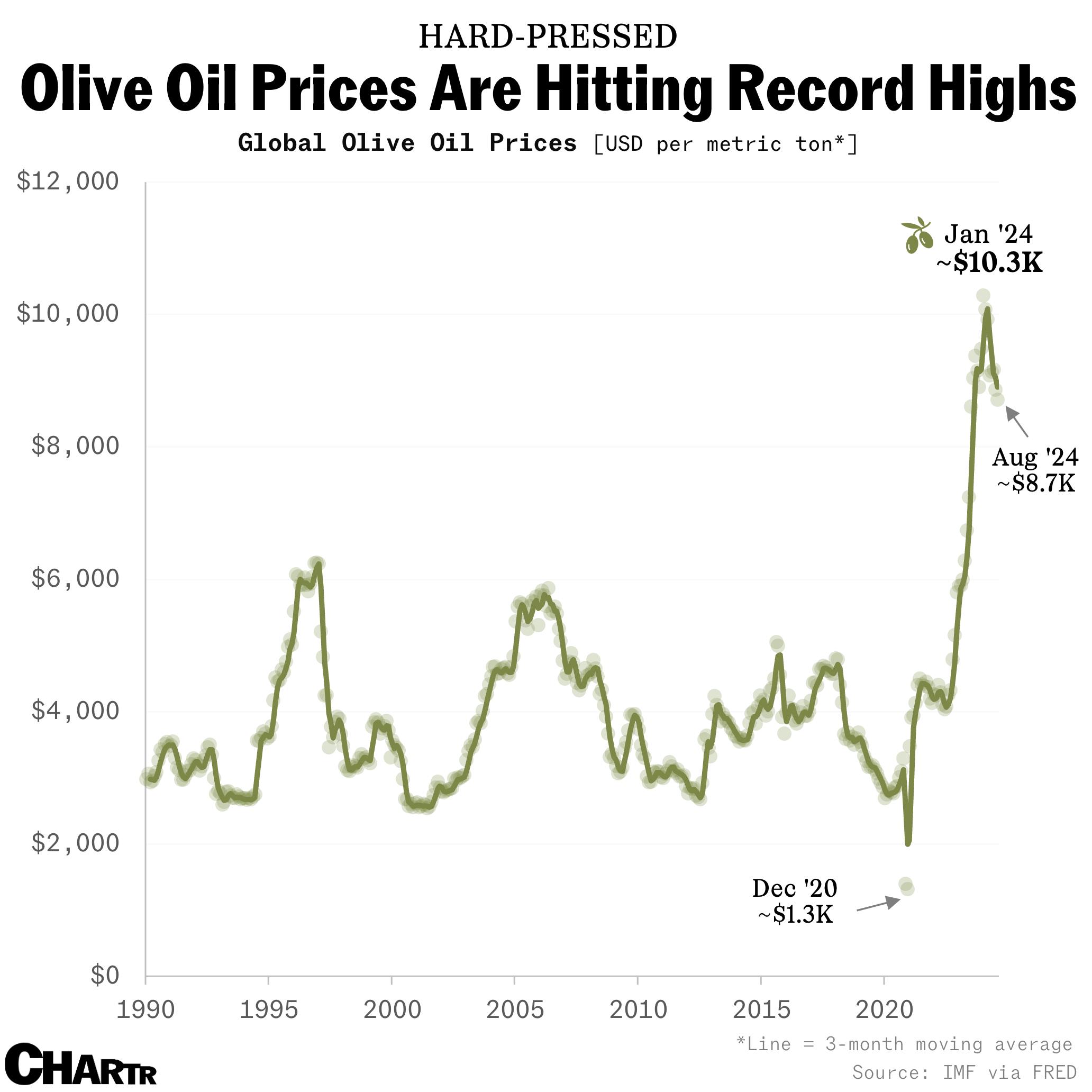
In case you missed it, today is National Extra Virgin Olive Oil Day… but the skyrocketing cost of liquid gold has left polyunsaturated fans with little to celebrate. Data from the IMF shows that global olive oil prices have almost tripled since the start of 2021, reaching ~$8,700 per metric ton in August after hitting a record high in January.

Extreme weather events observed across Europe, including droughts and heatwaves, is weighing on supply. Spain, the world’s leading producer, saw production fall more than 50% from the previous season to ~665K tons for 2022-23, according to the International Olive Council. Globally, production levels for 2023-24 are expected to be down 27% from 2018-19.

Snake oil

The price for EVOO is giving rise to another unwanted phenomenon, with Bloomberg reporting that criminals seeking to cash in on the price boom are peddling counterfeit oil products.

Data released to the Guardian in July found that 50 potential olive oil fraud and mislabelling cases took place in the EU in Q1 ‘24, compared with 15 in the first three months of 2018 — though the true figure is likely much higher. Last year, chainsaw-wielding thieves, known as “grove robbers”, cut down olive oil trees to steal precious harvests for themselves.

However, a surge in fake olive oil could be more sinister than just ripping off customers or farmers. In some instances, seized bottles have turned out to be lampante, a grade of olive oil deemed unfit for human consumption. And, with stunted production showing no signs of improving, better traceability will become imperative to avoid public health issues.

More World

See all World
world
Tom Jones

The UAE’s OPEC exit will hit the group in the barrels

After just shy of 60 years in OPEC, its membership even predating its status as a nation-state, the United Arab Emirates yesterday announced its shocking departure from the oil production group, effective May 1, as the knock-on effects of the Iran war continue to play out across the Middle East and the energy landscape.

For context, the UAE produces the third-highest amount of oil in the group, per April data and OPEC’s latest set of annual statistics.

According to the cartel’s 2025 Annual Statistical Bulletin, the OPEC group was collectively exporting some 19 million barrels of crude oil a day last year, with the United Arab Emirates accounting for some 14% of that daily output.

UAExit means UAExit

The nation, whose energy minister told Reuters yesterday that the decision was taken “after a careful look at current and future policies related to level of production” and wasn’t made following discussions with any other country, made up a healthy share of the group’s total confirmed crude oil reserves, as well.

OPEC exports chart
Sherwood News

Of the 12 nations in the core group, which was founded by just five oil superpowers back in September 1960, only two (Iraq and Saudi Arabia) exported more barrels of crude oil daily, pumping out 3.36 million and 6.05 million barrels, respectively, each day to nations around the world.

For its part, the UAE said it will “continue its responsible role by gradually and thoughtfully increasing production, in line with demand and market conditions,” per the official state news agency. Clearly, the nation now wants a little more control of just how much oil it can pump around the world, with the UAE having to eat a large proportion of lost revenues due to its healthy abundance and OPEC restrictions.

According to the cartel’s 2025 Annual Statistical Bulletin, the OPEC group was collectively exporting some 19 million barrels of crude oil a day last year, with the United Arab Emirates accounting for some 14% of that daily output.

UAExit means UAExit

The nation, whose energy minister told Reuters yesterday that the decision was taken “after a careful look at current and future policies related to level of production” and wasn’t made following discussions with any other country, made up a healthy share of the group’s total confirmed crude oil reserves, as well.

OPEC exports chart
Sherwood News

Of the 12 nations in the core group, which was founded by just five oil superpowers back in September 1960, only two (Iraq and Saudi Arabia) exported more barrels of crude oil daily, pumping out 3.36 million and 6.05 million barrels, respectively, each day to nations around the world.

For its part, the UAE said it will “continue its responsible role by gradually and thoughtfully increasing production, in line with demand and market conditions,” per the official state news agency. Clearly, the nation now wants a little more control of just how much oil it can pump around the world, with the UAE having to eat a large proportion of lost revenues due to its healthy abundance and OPEC restrictions.

Latest Stories

Sherwood Media, LLC produces fresh and unique perspectives on topical financial news and is a fully owned subsidiary of Robinhood Markets, Inc., and any views expressed here do not necessarily reflect the views of any other Robinhood affiliate, including Robinhood Markets, Inc., Robinhood Financial LLC, Robinhood Securities, LLC, Robinhood Crypto, LLC, Robinhood Derivatives, LLC, or Robinhood Money, LLC. Futures and event contracts are offered through Robinhood Derivatives, LLC.