
Business
Adobe’s revenue

Adobe’s subscription business is still booming

Updated 6/17/24 4:17PM

On Friday, shares in Adobe rose more than 15%, after the company reported record quarterly sales of $5.3B and raised its annual revenue forecast. The design software giant appears to be reaping the rewards from its generative AI tool Firefly, with net-new annualized recurring revenue for its Digital Media division coming in $50M ahead of analyst forecasts.

That came after a tough week for the company’s PR team, who found themselves fighting a backlash against its updated terms and conditions — yes, thankfully there are some people who read them cover to cover — after users criticized language which seemed to suggest that Adobe could use customers’ work to train generative AI models.

Turns out this week won’t be that easy for Adobe PR, either: The US Justice Department sued the company, saying its subscriptions — which help drive the aforementioned revenue gains — are too hard for its users to cancel.

Trust fall

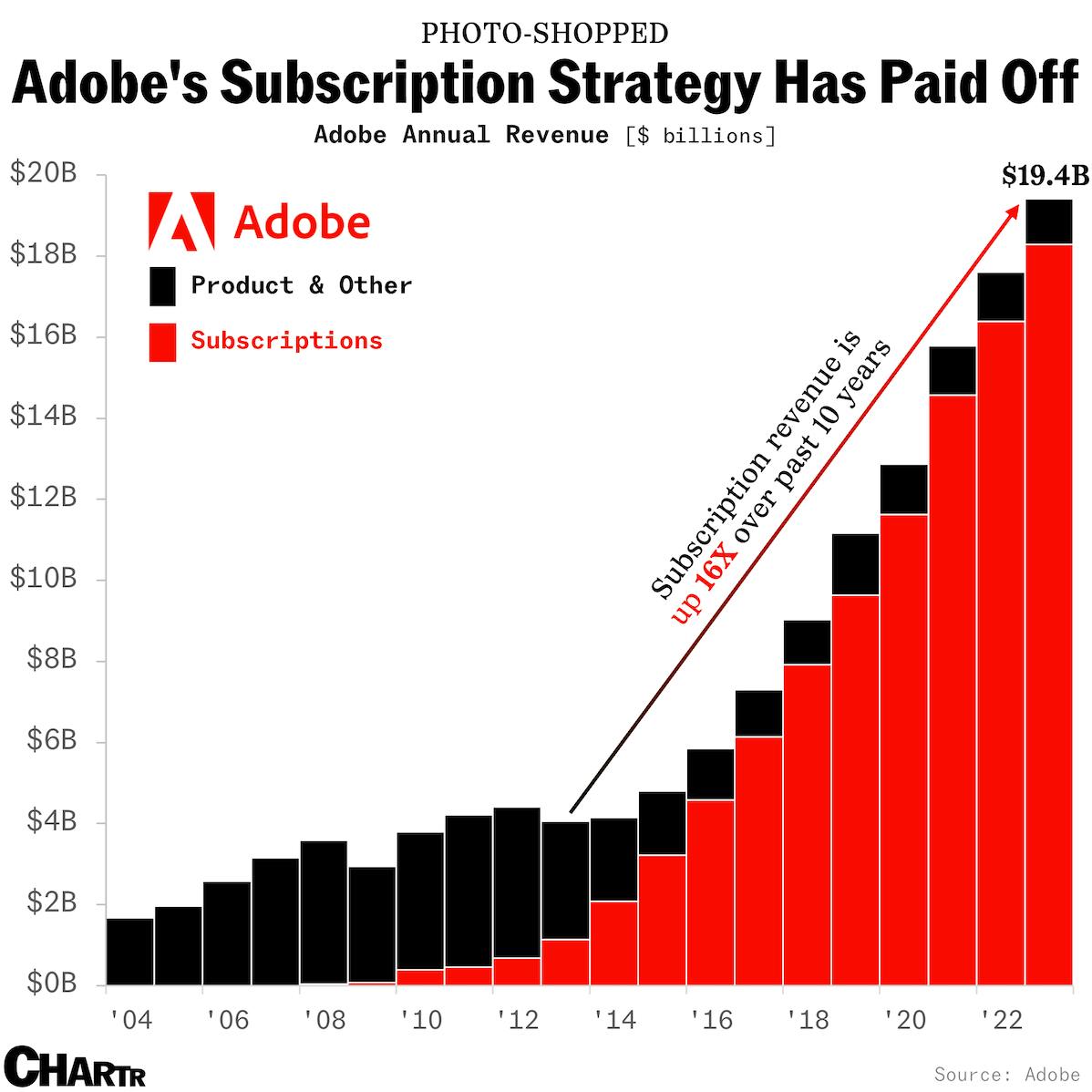
From a financial perspective, Adobe has done a phenomenal job of pivoting away from its old perpetual license model, where customers would buy once and own for a lifetime, to a monthly subscription model in which the product, and the terms of use that govern the product, are always changing. Indeed, over the past 10 years, subscription revenue has grown 16x, driving much of the company’s growth and turning it into a $200B+ giant… albeit one that isn’t universally trusted, per viral posts on X.

To clear up any confusion, Adobe says it will roll out a new terms of use agreement tomorrow, which will clarify that users own their work and that the company doesn’t train generative AI on customer content.

Zoom out: In a year marked by a record number of global elections, generative AI is taking off and users are asking simple questions like “how do I know what’s real?” and “how do I know my likeness or content isn’t being used by AI?” Companies don’t always have the answers.

Update (4 p.m. EST): Added new information following DOJ suit against Adobe.

More Business

See all Business
9.3%

As the war with Iran produces the biggest spike in US gas prices since Hurricane Katrina, car retailer CarMax is continuing to see heightened interest in EVs, hybrids, and plug-in hybrids.

“From Feb 1st - March 1st (inclusive), compared to March 2nd to March 15th (inclusive), we saw a 9.3% lift in page views for these vehicles,” a spokesperson for the company told Sherwood News.

As industry insiders recently told us, EV interest climbs when gas prices rise. That appears to be holding true even without EV tax credits, which the Trump administration ended under its new budget package.

CarMax also saw EV searches spike in 2022, amid Russia’s invasion of Ukraine and the resulting oil price spike.

Walt Disney Chairman And CEO Bob Iger Rings Opening Bell At NY Stock Exchange

It’s the end of Disney’s Iger era (again)

Incoming CEO Josh D’Amaro is replacing Bob Iger on Wednesday, though Iger will remain a senior adviser through the end of the year.

$35.4B

The tariffs imposed by the Trump administration have cost automakers at least $35.4 billion since the start of 2025, according to a new analysis by Automotive News.

That total will continue to climb this year, since the Supreme Court’s February tariff ruling largely leaves the 25% levy on vehicles and auto parts untouched.

Toyota has taken the biggest hit, projecting more than $9 billion in tariff costs in its fiscal year ending this month, while Detroit’s big three automakers — Ford, GM, and Stellantis — were hit with a combined $6.5 billion tariff charge in 2025.

In the fourth quarter, automakers sold about 8% fewer imported vehicles in the US compared to the same period a year ago, per the Automotive News Research & Data Center.

Tariff charges come at a rough time for legacy carmakers, which are also scaling back EV plans following the Trump administration’s elimination of tax credits and fuel standard goals. According to Automotive News, the cost of EV write-downs and restructuring is, so far, nearly $70 billion.

Universal Studios Orlando Theme Park

Universal Studios is giving theaters a longer minimum exclusive run

Universal will now guarantee a minimum of five weekends before a movie hits home screens — which might help theater companies like AMC finally get back to profitability.

Latest Stories

Sherwood Media, LLC produces fresh and unique perspectives on topical financial news and is a fully owned subsidiary of Robinhood Markets, Inc., and any views expressed here do not necessarily reflect the views of any other Robinhood affiliate, including Robinhood Markets, Inc., Robinhood Financial LLC, Robinhood Securities, LLC, Robinhood Crypto, LLC, Robinhood Derivatives, LLC, or Robinhood Money, LLC. Futures and event contracts are offered through Robinhood Derivatives, LLC.