
Business
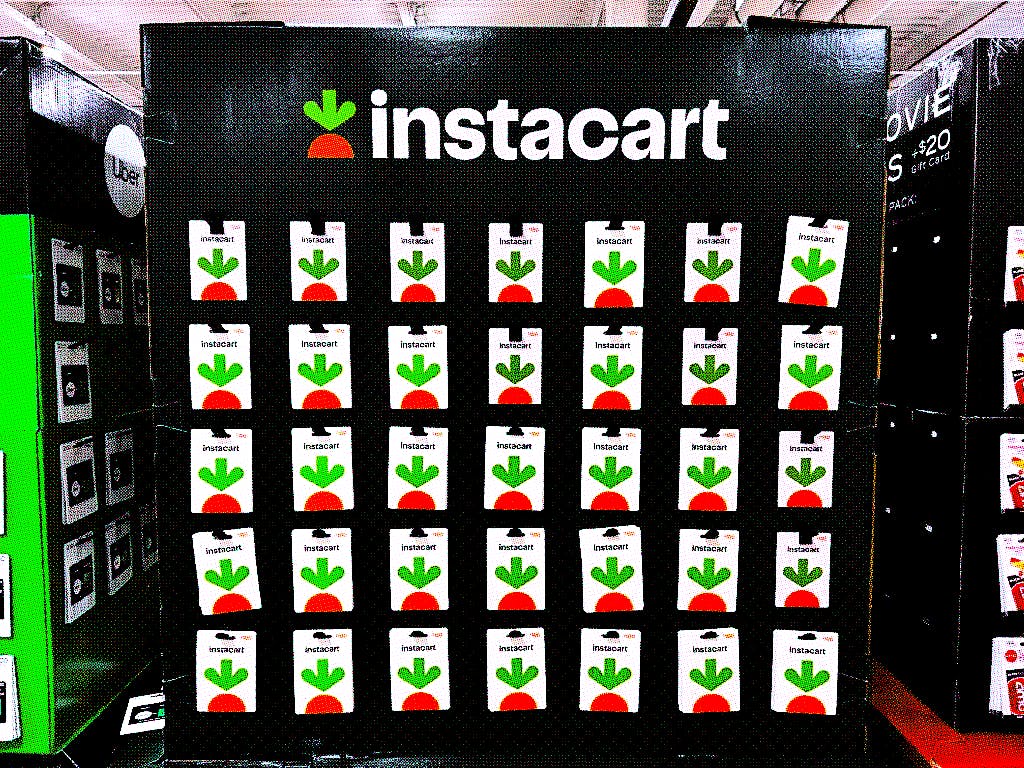
Instacart gift card display in Costco store, Queens, New York
Instacart gift card display in Costco store, Queens, New York (Lindsey Nicholson/Getty Images)
CART VS. GOLIATH

The economics of Instacart’s grocery delivery are pretty tight — AI might help, or hurt

AI proved to be a double-edged sword this week for Instacart, as the gains from a new ChatGPT integration were wiped out by an AI pricing allegation.

Claire Yubin Oh

This week was a roller-coaster ride for Instacart investors. Traders loved the announcement on Monday that the grocery delivery app will be embedded in ChatGPT, becoming the “first company to offer [a] new instant checkout app experience” on the leading AI chatbot. 

But AI can also be a double-edged sword.

A separate report released Wednesday took some of the shine off, with the company’s AI-enabled experiments accused of charging consumers different prices for the same items — by as much as 23% in one case. The e-commerce platform lost its OpenAI-driven gains on the news, with its parent company dropping some 6% in Wednesday trading. 

Thought for food 

Instacart, like so much of Corporate America, has been doubling down on an AI-centered strategy — offering personalized recommendations to consumers and time-saving and performance-driving tools for advertisers and retailers while deepening its partnership with OpenAI — all in the hope of improving the economics of a grocery delivery business that runs on pretty tight margins.

The company took a whopping $9.17 billion in orders through its marketplace, most of which is obviously passed through to merchants, with Instacart taking a ~7% slice, worth some $670 million in Q3. After operating costs, that revenue alone would probably not be enough to keep the company in the black — but Instacart also made a cool $270 million from advertising and other fees, services that are much higher-margin — helping it eke out a total of $166 million in operating profit, or 1.8% of its gross transaction value.
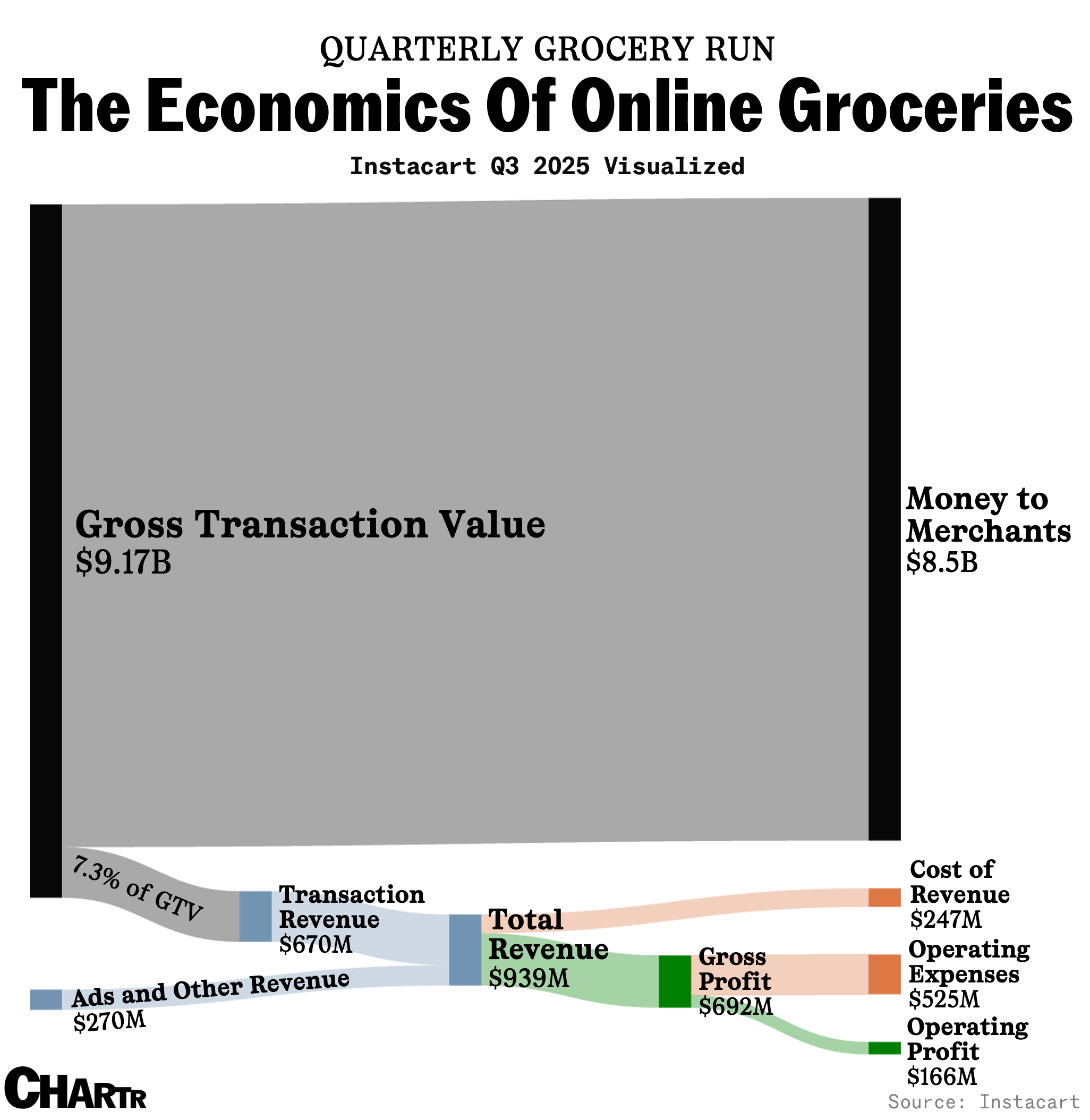
How Instacart makes money
Sherwood News

But profit growth has slowed at Instacart, and the company has some increasingly scary competitors, most notably Amazon, which is pushing into the on-demand online grocery space. The e-commerce giant announced this week it would expand its same-day delivery service to over 2,300 cities and towns in the US, leveraging millions of potential customers with a Prime membership through its free-for-Prime service.

With Amazon bearing down, it’s no wonder Instacart is looking to AI as a tool to fight back — but some on Wall Street think it will be a losing battle, with Wedbush Securities analysts including Instacart as one of 12 stocks in its “AI losers” basket, noting how AI’s automations of functions will improve delivery routing and cost efficiency in ecosystems with already established customer relationships like Amazon, moving customers away from intermediaries like Instacart.

More Business

See all Business
Daily Life In Warsaw

Smartphones are 12% cheaper than last year, according to the latest inflation data... except they’re not

Phones are one of a few important categories that get quality, or “hedonic,” adjustments in the Consumer Price Index — which make their price go down in the official statistics.

business

Texas sues Netflix, accusing streamer of spying on children and collecting user data without consent

The state of Texas filed a lawsuit Monday against streaming giant Netflix, alleging that the company has built a “behavioral-surveillance program of staggering scale.”

The suit alleges that Netflix is “deceptively designed” to be addictive, using features like autoplay to get viewers hooked, “mining those users for data, and then converting that data into lucrative intelligence for global advertising juggernauts.”

“When you watch Netflix, Netflix watches you,” the lawsuit reads.

“This lawsuit lacks merit and is based on inaccurate and distorted information,” Netflix said in a statement to Sherwood News. “Netflix takes our members’ privacy seriously and complies with privacy and data‑protection laws everywhere we operate.”

Texas is seeking civil penalties of “up to $10,000 per violation” of the Texas Deceptive Trade Practices-Consumer Protection Act, along with an additional penalty of up to $250,000 per violation involving a consumer aged 65 or older.

“Netflix is not the ad-free and kid-friendly platform it claims to be. Instead, it has misled consumers while exploiting their private data to make billions,” said Texas Attor­ney Gen­er­al Ken Pax­ton in the press release announcing the lawsuit.

Netflix did not immediately respond to a request for comment.

“This lawsuit lacks merit and is based on inaccurate and distorted information,” Netflix said in a statement to Sherwood News. “Netflix takes our members’ privacy seriously and complies with privacy and data‑protection laws everywhere we operate.”

Texas is seeking civil penalties of “up to $10,000 per violation” of the Texas Deceptive Trade Practices-Consumer Protection Act, along with an additional penalty of up to $250,000 per violation involving a consumer aged 65 or older.

“Netflix is not the ad-free and kid-friendly platform it claims to be. Instead, it has misled consumers while exploiting their private data to make billions,” said Texas Attor­ney Gen­er­al Ken Pax­ton in the press release announcing the lawsuit.

Netflix did not immediately respond to a request for comment.

Latest Stories

Sherwood Media, LLC and Chartr Limited produce fresh and unique perspectives on topical financial news and are fully owned subsidiaries of Robinhood Markets, Inc., and any views expressed here do not necessarily reflect the views of any other Robinhood affiliate, including Robinhood Markets, Inc., Robinhood Financial LLC, Robinhood Securities, LLC, Robinhood Crypto, LLC, Robinhood Money, LLC, Robinhood U.K. Ltd, Robinhood Derivatives, LLC, Robinhood Gold, LLC, Robinhood Asset Management, LLC, Robinhood Credit, Inc., Robinhood Ventures DE, LLC and, where applicable, its managed investment vehicles.
