Business
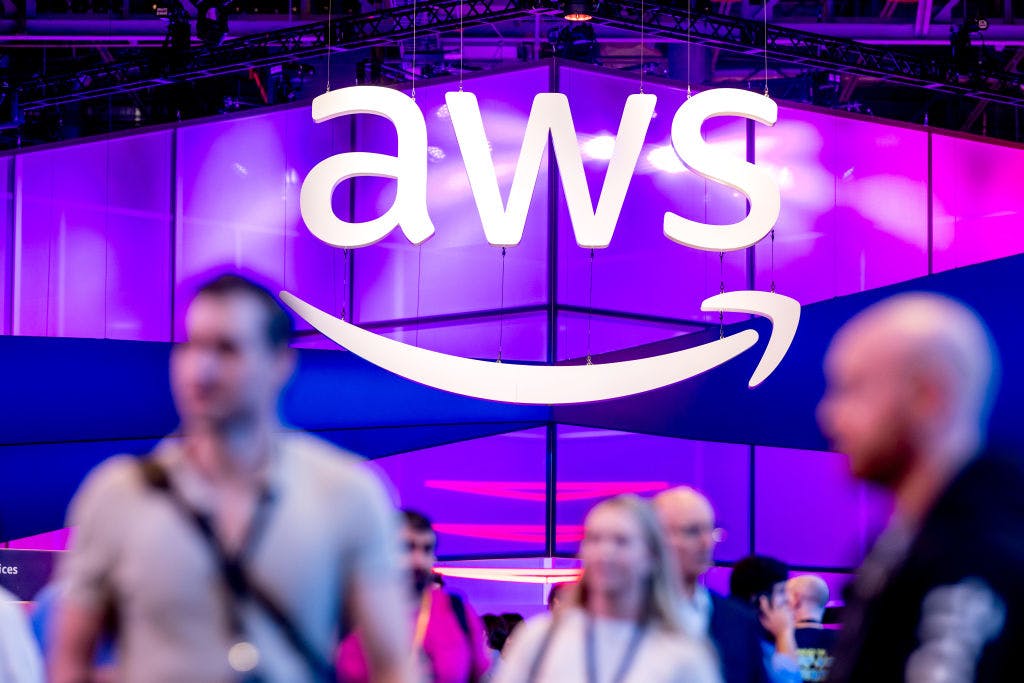
AWS re:Invent 2024
(Noah Berger/Getty Images)
CAPEXPECTATIONS

Amazon plans on spending more than $100 billion on capex in 2025

In total, Amazon, Meta, Microsoft, and Alphabet intend to spend a whopping $315 billion in capital expenditures this year.

Jon Keegan, David Crowther

While Amazon’s Q4 earnings may have disappointed investors with some gloomy guidance for the current quarter, its plans for 2025 are grand indeed.

In the past few weeks, all of Big Tech has been revealing the scale of its plans for spending on AI infrastructure, and it’s like everyone is trying to outdo each other with increasingly massive capex estimates.

  • At the start of the year, Microsoft’s president, Brad Smith, wrote in a blog post that the company was on track to spend $80 billion on AI data centers in 2025.

  • Then, Meta CEO Mark Zuckerberg said his company would spend up to $65 billion on capex, including a city-sized data center.

  • Alphabet CEO Sundar Pichai upped the ante, pledging $75 billion for AI and related infrastructure, including undersea cables.

  • Not to be outdone, Amazon CFO Brian T. Olsavsky told analysts on the Q4 earnings call that his company’s Q4 capex of $26.3 billion “will be reasonably representative of our 2025 capital investment rate,” which works out to over $100 billion.

Taken together, the top players in the industry are committing over $315 billion for this year alone.
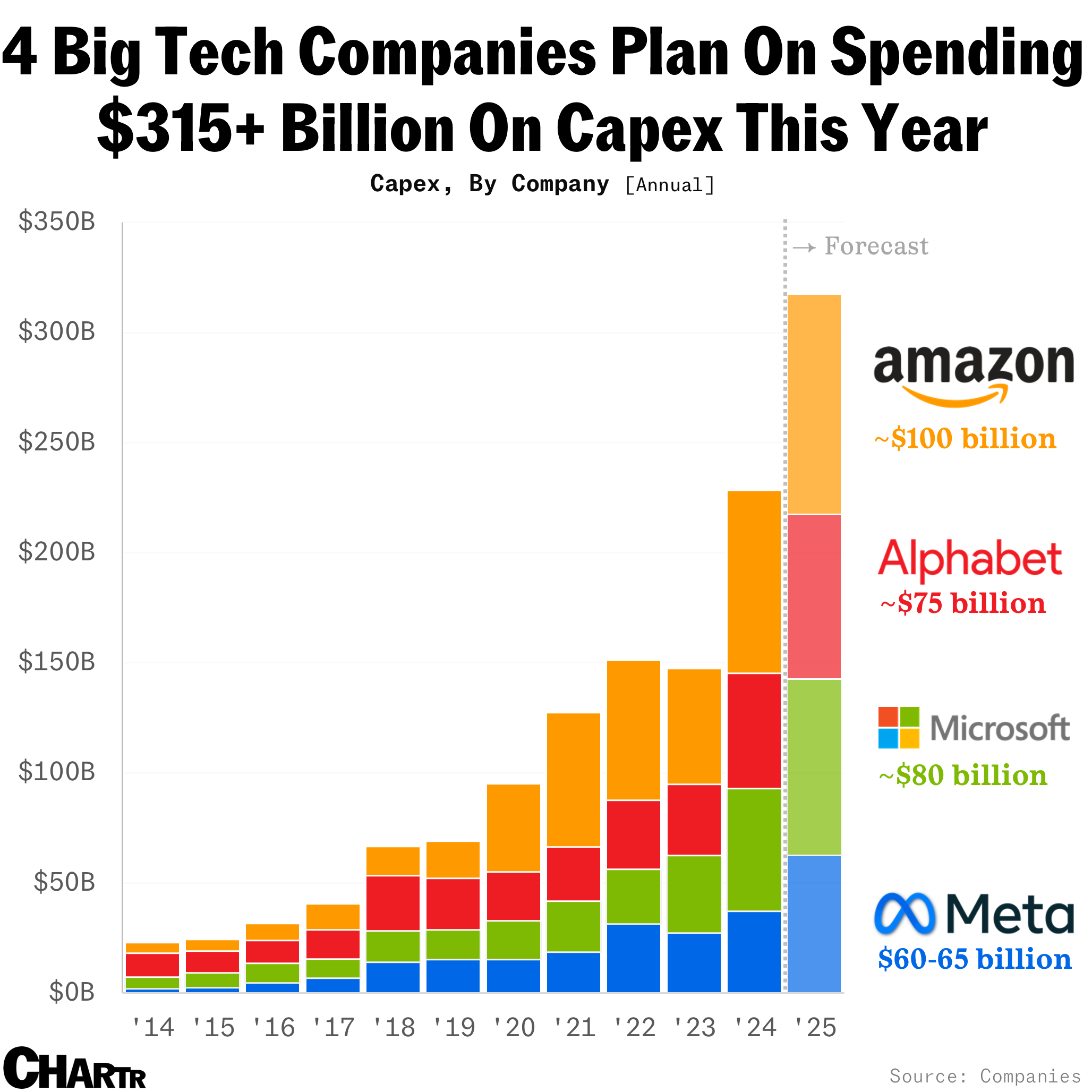
4 big tech companies plan on spending $315+ billion on capex this year

“Lumpy” growth for AWS

Amazon CEO Andy Jassy sounded extremely bullish about the company’s AWS cloud computing unit — which had $28.8 billion in sales for Q4 — but warned, “We expect growth will be lumpy over the next few years,” due to fast-changing technology and unpredictable capacity planning.

Amazon is in a unique position in the current AI revolution, as it offers up solutions for each layer of the “AI stack.” It hosts cloud computing to train new models, runs any number of leading AI models, and quickly offered DeepSeek’s breakthrough models for its customers on its Bedrock and SageMaker platforms.

It also makes its own foundational model family named Nova, in addition to its Rufus AI shopping assistant, and is still working out the kinks on its next-generation Alexa.

In addition to selling cloud computing powered by market leader Nvidia, Amazon is also a few generations into its own specialized AI computing chips, “Trainium” and “Inferentia.”

When asked about the race to the bottom for computing costs fueled by new, cheaper approaches to train and run AI systems like DeepSeek, Jassy thought it would just translate into more business for the company, agreeing with Jevons Paradox:

“People thought that people would spend a lot less money on infrastructure technology. And what happens is companies will spend a lot less per unit of infrastructure, and that is very, very useful for their businesses. But then they get excited about what else they could build that they always thought was cost prohibitive before, and they usually end up spending a lot more in total on technology once you make the per unit cost less.”

Leap year wrinkle

As a reminder of the massive scale of Amazon’s business, the extra day on the 2024 calendar due to leap year actually affected the company’s guidance for the current quarter.

Just that one extra day generated $1.5 billion in sales across all of its units.

More Business

See all Business
Capsule Pill and Dots

Justice Department accuses telehealth Zealthy of fraud, says remedy may bankrupt it

The feds say they don’t think Zealthy has the liquidity to pay what it owes customers.

Netflix playground

Will investing in kids games finally make Netflix Games “the Netflix of games”?

Netflix is launching a game for preschoolers, its latest foray into stuff-you-play instead of stuff-you-watch.

business

American Airlines joins the flock, hiking bag fees amid higher jet fuel prices

American Airlines on Thursday announced that it, too, will be hiking the fees it charges customers to check luggage.

With the move, all four of the major US airlines, which together control about 80% of the US market, have now hiked their baggage fees in recent days amid surging jet fuel prices.

The change will go into effect on tickets bought on or after Thursday, the same day Southwest’s hike begins.

Since late March, JetBlue, Delta Air Lines, United Airlines, Canada’s WestJet, and Southwest have hiked their fees. Experts expect more major carriers to follow, and to potentially tweak the pricing of other ancillary revenue sources like seat assignments and carry-on luggage.

The change will go into effect on tickets bought on or after Thursday, the same day Southwest’s hike begins.

Since late March, JetBlue, Delta Air Lines, United Airlines, Canada’s WestJet, and Southwest have hiked their fees. Experts expect more major carriers to follow, and to potentially tweak the pricing of other ancillary revenue sources like seat assignments and carry-on luggage.

business

Less than a year after implementing them, Southwest is also hiking its bag fees

Southwest Airlines has joined the growing list of airlines opting to hike their bag fees amid sustained higher jet fuel costs.

Starting today, the first checked bag at the carrier — which implemented bag fees less than a year ago — will jump from $35 to $45, and the second from $45 to $55. Southwest quietly disclosed the change Tuesday.

Southwest assigned the decision to “part of an ongoing analysis of the business and against the evolving global backdrop.”

As of Wednesday, jet fuel prices dropped to $4.16 a gallon, per the Argus US Jet Fuel Index, down from $4.81 on Tuesday following President Trump’s ceasefire announcement, which sent travel stocks soaring. Major airlines have shed some of those gains in premarket trading Thursday.

With the move to hike bag fees, Southwest joins JetBlue, United Airlines, Delta Air Lines, and Canada’s WestJet, all of which also boosted fees this month. Experts expect more major carriers to follow, and to potentially tweak the pricing of other ancillary revenue sources like seat assignments and carry-on luggage.

Southwest assigned the decision to “part of an ongoing analysis of the business and against the evolving global backdrop.”

As of Wednesday, jet fuel prices dropped to $4.16 a gallon, per the Argus US Jet Fuel Index, down from $4.81 on Tuesday following President Trump’s ceasefire announcement, which sent travel stocks soaring. Major airlines have shed some of those gains in premarket trading Thursday.

With the move to hike bag fees, Southwest joins JetBlue, United Airlines, Delta Air Lines, and Canada’s WestJet, all of which also boosted fees this month. Experts expect more major carriers to follow, and to potentially tweak the pricing of other ancillary revenue sources like seat assignments and carry-on luggage.

Latest Stories

Sherwood Media, LLC produces fresh and unique perspectives on topical financial news and is a fully owned subsidiary of Robinhood Markets, Inc., and any views expressed here do not necessarily reflect the views of any other Robinhood affiliate, including Robinhood Markets, Inc., Robinhood Financial LLC, Robinhood Securities, LLC, Robinhood Crypto, LLC, Robinhood Derivatives, LLC, or Robinhood Money, LLC. Futures and event contracts are offered through Robinhood Derivatives, LLC.