Business
Amazon turns 30

Amazon at 30: A brief history of the e-commerce giant

Life and Primes

Depending on which millennial you ask, turning 30 in 2024 seems like a pretty good (or pretty daunting) opportunity to reflect... for Jeff Bezos’s ~$2 trillion baby, the financial results are more pleasing than most.

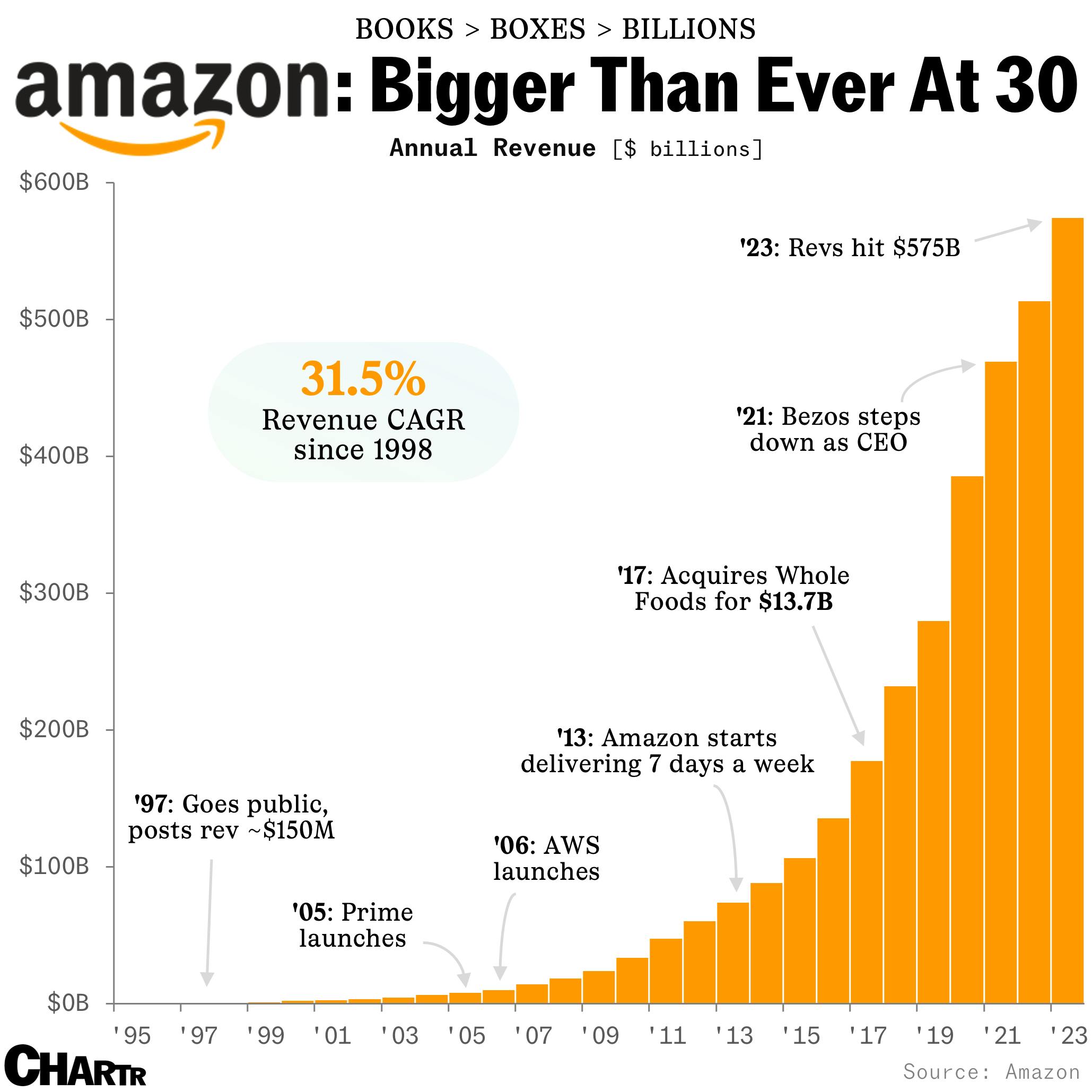
Since launching as an online bookstore on July 5th 1994, Amazon has seen its revenues grow every single year, becoming a one-stop online shop for hundreds of millions of customers around the world. In fact, in the last 25 years, the company has grown at an astonishing CAGR (compound annual growth rate) of 31.5% — the equivalent of doubling its revenue approximately every two and a half years.

All of that revenue growth has translated into AMZN becoming one of the biggest businesses in the world, its share price having soared more than 220,000% at the time of writing since it went public in 1997. 

The everything store

It’s impossible here to unpack the boxed-up behemoth that is Amazon, but even the most whistle-stop tour of its history reveals many chapters that would, by themselves, dominate the stories of most other businesses.

In 2005, for example, Amazon launched its Prime subscription service, which has since been hailed as “the internet’s most successful and devastating membership program”. Just one year later, the company introduced Amazon Web Services, its cloud computing division that provides servers, storage, and basically everything else to some of the world’s most visited online real estate — the division accounted for 67% of its $37B operating profit last year.

Today, Amazon negotiates a trickier e-commerce landscape. Its forays into advertising have been wildly profitable, but the company still continues to struggle with long-standing issues like its huge global workforce’s unionization efforts, as well as newer battles too. China’s online marketplace phenomenon Temu, for instance, has quickly become serious competition, forcing Amazon to reportedly make plans to emulate the platform.

More Business

See all Business
The entrance of Allbirds seen from Hayes St. in San Francisco, Calif.

Allbirds, the once buzzy multibillion-dollar sneaker startup, is selling up for $39 million

That’s less than 1% of its peak market cap about four years ago.

Tom Jones3/31/26
business

JetBlue is raising its bag fees as fuel costs squeeze airlines

JetBlue will reportedly hike its bag fees, as the cost of jet fuel continues to climb amid the war in Iran. It’s the latest example of carriers finding ways to push rising costs onto travelers.

Last week, United Airlines CEO Scott Kirby said that if fuel prices remain elevated, fares would need to rise another 20% for his airline to break even this year.

As CNBC reported, when one airline raises fees, others tend to follow.

Earlier this month, JetBlue hiked its first-quarter outlook for operating revenue per seat mile to between 5% and 7%, saying that strong Q1 demand helped “partially offset additional expenses realized from operational disruptions and rising fuel costs.” Now, the carrier appears to be making moves to further boost revenue to offset those costs.

Earlier on Monday, JetBlue rival Alaska Air lowered its Q1 profit forecast. The refining margins for the carrier’s cheapest fuel option — sourced from Singapore and representing about 20% of Alaska’s overall supply — have spiked 400% since February.

JetBlue did not immediately respond to a request for comment.

As CNBC reported, when one airline raises fees, others tend to follow.

Earlier this month, JetBlue hiked its first-quarter outlook for operating revenue per seat mile to between 5% and 7%, saying that strong Q1 demand helped “partially offset additional expenses realized from operational disruptions and rising fuel costs.” Now, the carrier appears to be making moves to further boost revenue to offset those costs.

Earlier on Monday, JetBlue rival Alaska Air lowered its Q1 profit forecast. The refining margins for the carrier’s cheapest fuel option — sourced from Singapore and representing about 20% of Alaska’s overall supply — have spiked 400% since February.

JetBlue did not immediately respond to a request for comment.

Latest Stories

Sherwood Media, LLC produces fresh and unique perspectives on topical financial news and is a fully owned subsidiary of Robinhood Markets, Inc., and any views expressed here do not necessarily reflect the views of any other Robinhood affiliate, including Robinhood Markets, Inc., Robinhood Financial LLC, Robinhood Securities, LLC, Robinhood Crypto, LLC, Robinhood Derivatives, LLC, or Robinhood Money, LLC. Futures and event contracts are offered through Robinhood Derivatives, LLC.