Business
Too sweet: America's sugar consumption has fallen

Too sweet: America's sugar consumption has fallen

No way to sugarcoat it

This morning brought bad news for our moderately Diet-Coke addicted editor, as the World Health Organization is set to label Aspartame — an artificial sweetener found in many diet sodas, chewing gum and many other products — as “possibly carcinogenic to humans”.

The report could prove controversial. Aspartame has been approved for consumption in the US since 1974, originally for use as a tabletop sweetener, before finding its way into many diet drinks as America began to watch its consumption of sugar.

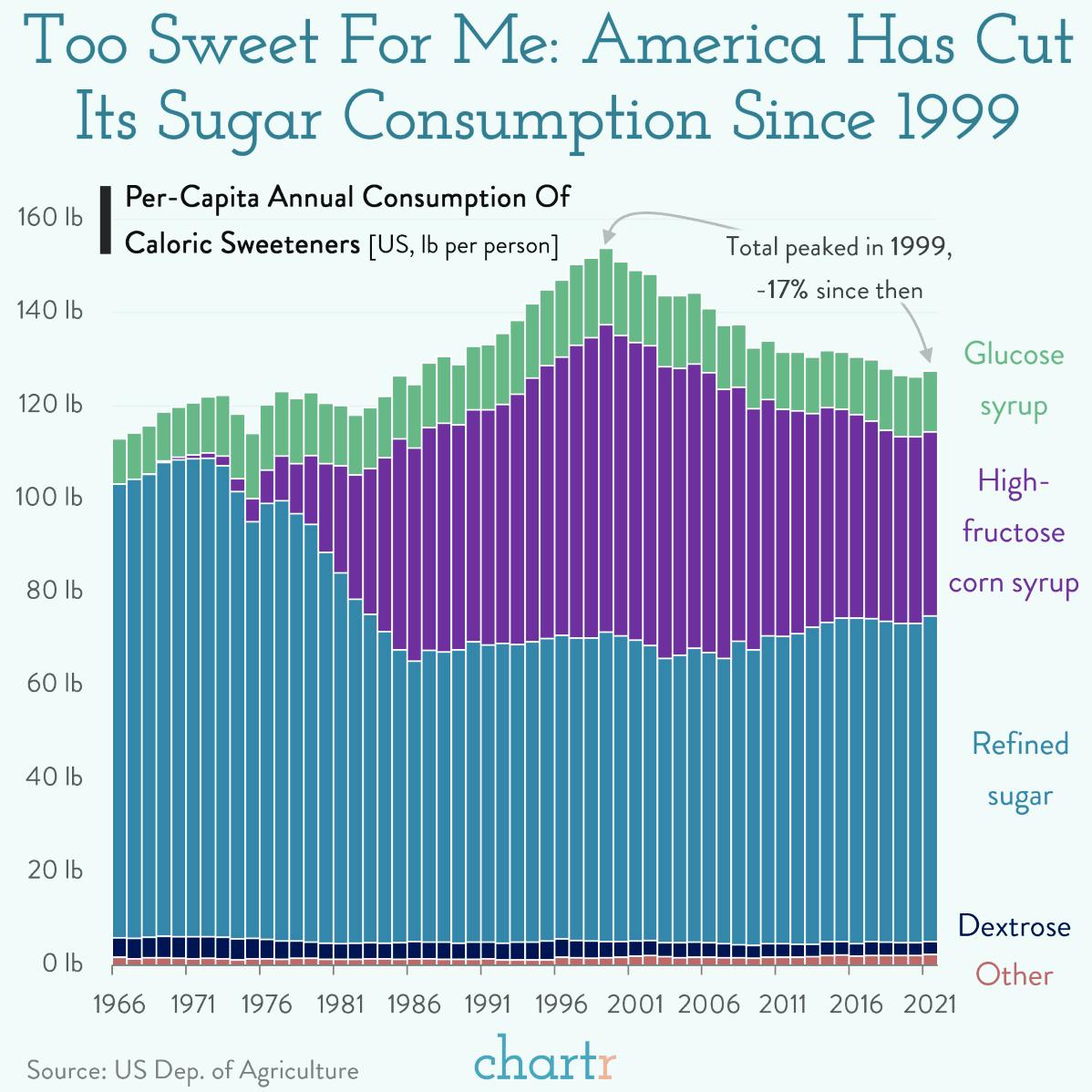
Indeed — perhaps surprisingly — Americans have been cutting down on their sugar intake for the last 20 years. Data from the USDA reveals that per-capita consumption of sugar peaked in 1999, following the boom in high-fructose corn syrups, and has fallen ~17% since.

Make it til you fake it

The soaring use of Aspartame and other artificial sweeteners is easy to understand — the Food & Drug Administration estimates that Aspartame is roughly 200 times sweeter than table sugar. Other products are even sweeter. Sucralose, the non-nutritive sweetener found in Splenda, is estimated to be 600 times sweeter than table sugar.

The FDA’s definition of what’s a safe and acceptable daily limit for artificial sweeteners is high. According to their guidelines, an adult weighing 150 pounds would have to consume around 18 cans of zero-sugar soda a day to experience severe negative health effects.


More Business

See all Business
Delta Airlines empty plane interior

Delta, the K-shaped airline

Delta’s premium ticket sales grew more than 7% in 2025. Its main cabin ticket sales fell 5%.

business

Paramount sues Warner Bros. for more info on its deal with Netflix, says it plans to nominate new directors

It’s a fresh week and that means a fresh bit of escalation in the ongoing Warner Bros. Discovery merger drama.

At an upcoming meeting, Paramount Skydance plans to “nominate a slate of [WBD] directors who, in accordance with their fiduciary duties, will... enter into a transaction with Paramount,” CEO David Ellison wrote in a letter to WBD shareholders disclosed on Monday.

Ellison also said that Paramount sued WBD in Delaware court in an effort to force the board to disclose “basic information” that will allow shareholders to make an informed decision between Paramount’s offer and one from Netflix. WBD shares dipped about 2% on Monday morning.

The latest update follows Paramount’s move last week to reaffirm — but not raise — its $30-per-share offer for WBD. Some saw that decision as Paramount effectively throwing in the towel on its merger hopes, given that the same deal has been rejected twice by the WBD board and winning over shareholders directly is a difficult process. Monday’s disclosure appears to signal that whether it loses or not, Paramount isn’t going to make Netflix’s acquisition easy.

Latest Stories

Sherwood Media, LLC produces fresh and unique perspectives on topical financial news and is a fully owned subsidiary of Robinhood Markets, Inc., and any views expressed here do not necessarily reflect the views of any other Robinhood affiliate, including Robinhood Markets, Inc., Robinhood Financial LLC, Robinhood Securities, LLC, Robinhood Crypto, LLC, or Robinhood Money, LLC.