Business
Dutch Bros opens in Southern California
(Paul Bersebach/Getty Images)

America’s fast-food scene had some big winners, and even bigger losers, in Q2 2025

Taco Bell is beating Chipotle, Dutch Bros is crushing Starbucks, and the chicken wars are fiercer than ever.

Much was made of America’s inflation-weary fast-food consumers becoming more price conscious over the last few years.

Now, with Q2 in the rearview mirror, we can ask: which fast-food chains are winning in America?

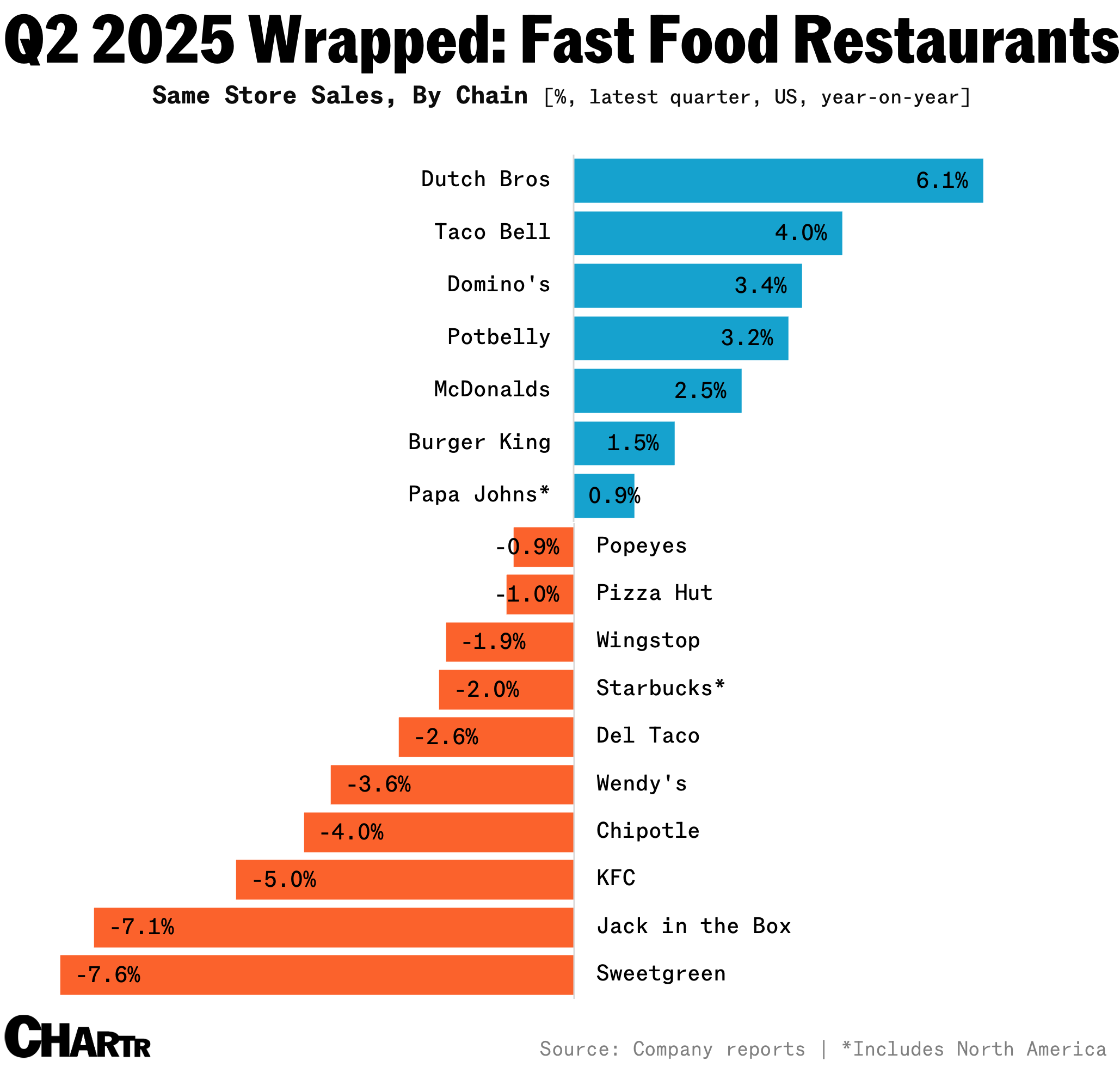
Let’s start with the biggest in the game. McDonald’s actually had a great quarter, with the Golden Arches posting year-on-year same-store sales growth of 2.5% in the US, digging the Big Mac maker out of a hole after a lackluster year of declines. That was significant considering that the company’s execs characterized the quarter as “challenging,” as visits across the industry by low-income consumers declined by “double-digit” percentages.

Value option Taco Bell put up even better numbers, with same-store sales up 4% — crushing Chipotle in the Mexican-inspired scene as its more expensive competitor struggles to lure customers back for burritos and bowls, with same-store sales dropping 4% year on year.
Fast food growth
Sherwood News

Topping the list, however, was coffee chain Dutch Bros, where same-store sales rose 6.1% — perhaps benefiting from the difficulties at coffee giant Starbucks, which continues to invest heavily in a bid to reinvigorate the “coffeehouse experience.”

Elsewhere, with consumers’ love for chicken inspiring an entire generation of entrepreneurs to enter the chicken wars, the competition in all things wings has never been more intense — and it seems to be weighing on Yum! Brands’ KFC, where sales dropped 5%. But no company had a worse quarter than fast-casual salad chain Sweetgreen, where revenue resembled spinach being cooked: store sales shrunk a whopping 7.6% in the latest quarter.

Related reading: Battle of the sad desk lunches: Both Cava and Sweetgreen want to become the next Chipotle

More Business

See all Business
business
Tom Jones

Demis Hassabis, Google DeepMind’s CEO and founder, was also an early Anthropic investor

A chess prodigy and an actual a knight of the realm in the UK, it’s perhaps no surprise that Demis Hassabis has made some strategic moves about his exposure to AI upside. According to people familiar with the matter, the influential AI architect became an angel investor in Anthropic, currently behind many of the leading AI models, per Arena AI leaderboards.

The Nobel Prize winner’s position in the Claude creator was previously undisclosed and, per the Financial Times, highlights Hassabis’ “growing influence across the AI industry.”

Google, which bought DeepMind, the company that Hassabis cofounded and heads to this day, for a reported ~$400 million in 2014, is also a key Anthropic investor. The tech giant reportedly plans to invest up to $40 billion in the AI company as part of the mutually beneficial relationship the pair have forged, with reports that Anthropic has committed to spending $200 billion in the other direction on Google’s cloud services over the next five years.

Im playing all sides, so I always come out on top

In addition to his financial support for Anthropic, Hassabis has also invested in a range of AI startups launched by colleagues, such as Inflection AI, a company set up by DeepMind cofounder Mustafa Suleyman (who is now CEO of Microsoft AI), as well as efforts from other collaborators, like David Silver’s Ineffable Intelligence.

Hassabis also emerged as a recurring figure on the fringes of the recent Elon Musk v. Sam Altman trial, cropping up repeatedly in testimonies and court documents and appearing to live, as The Verge put it, “rent-free” in Musk’s head.

Founded in 2021, Anthropic has recently raised funding at a reported $900 billion valuation, sending it soaring ahead of competitor OpenAI.

The Nobel Prize winner’s position in the Claude creator was previously undisclosed and, per the Financial Times, highlights Hassabis’ “growing influence across the AI industry.”

Google, which bought DeepMind, the company that Hassabis cofounded and heads to this day, for a reported ~$400 million in 2014, is also a key Anthropic investor. The tech giant reportedly plans to invest up to $40 billion in the AI company as part of the mutually beneficial relationship the pair have forged, with reports that Anthropic has committed to spending $200 billion in the other direction on Google’s cloud services over the next five years.

Im playing all sides, so I always come out on top

In addition to his financial support for Anthropic, Hassabis has also invested in a range of AI startups launched by colleagues, such as Inflection AI, a company set up by DeepMind cofounder Mustafa Suleyman (who is now CEO of Microsoft AI), as well as efforts from other collaborators, like David Silver’s Ineffable Intelligence.

Hassabis also emerged as a recurring figure on the fringes of the recent Elon Musk v. Sam Altman trial, cropping up repeatedly in testimonies and court documents and appearing to live, as The Verge put it, “rent-free” in Musk’s head.

Founded in 2021, Anthropic has recently raised funding at a reported $900 billion valuation, sending it soaring ahead of competitor OpenAI.

Latest Stories

Sherwood Media, LLC and Chartr Limited produce fresh and unique perspectives on topical financial news and are fully owned subsidiaries of Robinhood Markets, Inc., and any views expressed here do not necessarily reflect the views of any other Robinhood affiliate, including Robinhood Markets, Inc., Robinhood Financial LLC, Robinhood Securities, LLC, Robinhood Crypto, LLC, Robinhood Money, LLC, Robinhood U.K. Ltd, Robinhood Derivatives, LLC, Robinhood Gold, LLC, Robinhood Asset Management, LLC, Robinhood Credit, Inc., Robinhood Ventures DE, LLC and, where applicable, its managed investment vehicles.