Business
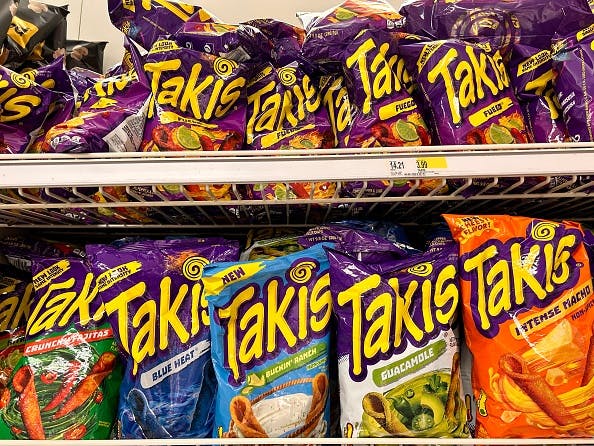
Retail display of Takis snack food in various spicy flavors in Target store, Queens, New York
(Lindsey Nicholson/Getty Images)

America’s love for spicy food and mouth-tingling sauces has surged, but are we approaching “peak heat”?

Takis doesn’t think so, as it searches for a “Chief Intensity Officer.”

Some intense news for spice-loving job seekers: Takis, the popular corn tortilla chip brand, launched a public hunt last week for its first-ever “Chief Intensity Officer,” a paid brand ambassador role targeting content creators with a unique competition format that involves public voting and live judging for a $30,000 winning prize.

The job ad — that is, of course, really a marketing campaign — is emblematic of a country that no longer settles for mild. For some time now, America has been quite happily setting its mouth on fire, embracing heat in almost anything edible, with chilis and spice making their way into everything from mac ‘n’ cheese to sandwiches, lemonade to ice cream.

Condimentary

Perhaps in part because of a new generation of spice ninjas who carry their own mini Tabasco bottles and sriracha key chains, chili sauce is outgrowing its condiment peers. Indeed, it was the only one to grow in retail volume from 2019 to 2024 in the US among data provider Euromonitor’s list of sauce categories, squeezing up 13% while more traditional accompaniments like BBQ sauce, mayonnaise, ketchup, and soy sauce all saw their volumes drop.

America’s loving chilli sauces
Sherwood News

For restaurants and packaged food companies battling rising food costs, spice has become a relatively cheap and effective way to get restaurant-goers’ attention and mark up menu prices. Snack makers like Frito-Lay were early to the trend, with its Flamin’ Hot flavoring first created in 1989 — which now occupies the No. 1 spot in spicy salty snacks, generating more than $3 billion in retail sales a year.

Turning up the heat

America’s melting pot of cultures has also seen its collective palette expand, with influences from Latin, Asian, and African cuisine bringing up the collective spice tolerance of the nation. That’s particularly true in younger people, with 51% of Gen Z in a 2024 survey considering themselves “hot sauce connoisseurs.” A whopping 35% have even signed a waiver (like this?) before eating something spicy. The soaring success of shows like “Hot Ones,” which invites celebrities to eat progressively hotter hot wings, have only poured fuel on the spicy fire.

As such, trends during the pandemic appeared to accelerate the spicy trend, though growth has calmed down ever since. Menu data from Datassential provided to Sherwood News reveals that 95.5% of some 4,861 restaurants surveyed offered at least one spicy menu item in the second quarter of 2025, more than the number of restaurants that offered chicken (95.1%).

However, the share of menu items with the word “spicy” has stayed relatively flat since 2023, at ~9% as of Q2 2025, suggesting that we may have hit a bit of a spice plateau.

Spicy menus dominate America’s restaurants
Sherwood News

That said, Google data suggests that when it comes to searching for a mouth-tingling meal, America’s appetite is still growing: searches for “spicy food” are at their all-time high.

Which is the spiciest state?

At the state level, data from grocery delivery platform Instacart found that New Mexico was America’s hot sauce capital — with residents there ordering 31.9 ounces of the stuff between October 2023 and September 2024, followed by, perhaps ironically, Alaska, where residents eager to warm up ordered 29.2 ounces per customer.

Bottom of the spice list, per Instacart? Alabama.

Instacart state level spice
Instacart

More Business

See all Business
business
Tom Jones

OpenAI’s ARR reached over $20 billion in 2025, CFO says

Sam Altman’s $500 billion artificial intelligence behemoth hit a major financial milestone last year, according to a new blog post over the weekend from OpenAI CFO Sarah Friar, as the company confirmed it had hit a more than $20 billion annual revenue run rate at the end of 2025.

Elsewhere in the blog post, Friar spent time addressing the company’s shifting goals, referencing plans to “close the distance between where intelligence is advancing and how individuals, companies, and countries actually adopt and use it.” As has become customary in the AI company press release genre, the CFO was also keen to tout the unending growth of the business, writing:

  • Both our Weekly Active User (WAU) and Daily Active User (DAU) figures continue to produce all-time highs. This growth is driven by a flywheel across compute, frontier research, products, and monetization.

  • Compute grew 3X year over year or 9.5X from 2023 to 2025: 0.2 GW in 2023, 0.6 GW in 2024, and ~1.9 GW in 2025.

And, perhaps most importantly for current backers and those keeping an eye on the private company before its rumored mega IPO:

  • Revenue followed the same curve growing 3X year over year, or 10X from 2023 to 2025: $2B ARR in 2023, $6B in 2024, and $20B+ in 2025. This is never-before-seen growth at such scale.

That latest figure has certainly set tongues in the tech world wagging, just as the company announced it would begin rolling out ads to free and ChatGPT Go users. It also puts the chatbot giant a fair way ahead of competitors like Anthropic, the company behind Claude.

OpenAI Anthropic ARR race
Sherwood News

Elsewhere in the blog post, Friar spent time addressing the company’s shifting goals, referencing plans to “close the distance between where intelligence is advancing and how individuals, companies, and countries actually adopt and use it.” As has become customary in the AI company press release genre, the CFO was also keen to tout the unending growth of the business, writing:

  • Both our Weekly Active User (WAU) and Daily Active User (DAU) figures continue to produce all-time highs. This growth is driven by a flywheel across compute, frontier research, products, and monetization.

  • Compute grew 3X year over year or 9.5X from 2023 to 2025: 0.2 GW in 2023, 0.6 GW in 2024, and ~1.9 GW in 2025.

And, perhaps most importantly for current backers and those keeping an eye on the private company before its rumored mega IPO:

  • Revenue followed the same curve growing 3X year over year, or 10X from 2023 to 2025: $2B ARR in 2023, $6B in 2024, and $20B+ in 2025. This is never-before-seen growth at such scale.

That latest figure has certainly set tongues in the tech world wagging, just as the company announced it would begin rolling out ads to free and ChatGPT Go users. It also puts the chatbot giant a fair way ahead of competitors like Anthropic, the company behind Claude.

OpenAI Anthropic ARR race
Sherwood News
The Sphere In Las Vegas

Washington, DC, looks set to get America’s second Sphere

Revenue for the Las Vegas version of the big orb has soared, but the Sphere is still a money pit.

business

Ford reportedly in talks to buy hybrid vehicle batteries from Chinese auto giant BYD

Detroit’s Ford and China’s BYD are said to be in ongoing talks to partner on an agreement that would see Ford buy hybrid vehicle batteries from BYD, according to reporting from The Wall Street Journal.

The report comes just days after President Trump toured a Ford factory in Michigan and implied openness to Chinese automakers coming to the US.

“If they want to come in and build a plant... that’s great, I love that,” Trump said on January 13. “Let China come in, let Japan come in.”

Last week, China’s Geely Automobile Holdings said it expects to make an announcement about expanding into the US within the next three years. Chinese carmakers currently face huge tariffs and software restrictions, effectively barring their vehicles from the US.

Ford has doubled down on hybrid vehicles amid high EV costs and the end of federal EV tax credits. The automaker is currently building a battery plant in Michigan where it plans to use tech from Chinese battery maker CATL.

“If they want to come in and build a plant... that’s great, I love that,” Trump said on January 13. “Let China come in, let Japan come in.”

Last week, China’s Geely Automobile Holdings said it expects to make an announcement about expanding into the US within the next three years. Chinese carmakers currently face huge tariffs and software restrictions, effectively barring their vehicles from the US.

Ford has doubled down on hybrid vehicles amid high EV costs and the end of federal EV tax credits. The automaker is currently building a battery plant in Michigan where it plans to use tech from Chinese battery maker CATL.

Latest Stories

Sherwood Media, LLC produces fresh and unique perspectives on topical financial news and is a fully owned subsidiary of Robinhood Markets, Inc., and any views expressed here do not necessarily reflect the views of any other Robinhood affiliate, including Robinhood Markets, Inc., Robinhood Financial LLC, Robinhood Securities, LLC, Robinhood Crypto, LLC, or Robinhood Money, LLC.