Business
Times Square, New York City: US flag designed on the United...
US flag in Times Square (Photo by Roberto Machado Noa/LightRocket via Getty Images)

These are the brands that divide America

Your dish soap and coffee can say a lot about your politics.

While a Trump presidency might be bad news for, say, Tesla, and while a Harris presidency might be good for Planned Parenthood, the vast majority of American brands have little real stake in the upcoming election. That said, most brands are certainly partisan, in the sense that their customer base leans notably liberal or conservative. And in turn, that’s an important bit of information for those companies.

Only 29% of brands are considered bipartisan, according to a new report by survey firm YouGov, meaning liberals and conservatives consider purchasing them at roughly equal rates, or within 10 percent of each other. (Note that YouGov only surveyed the 53.9% of Americans who consider themselves to be either liberal or conservative, while the 32.5% that said they were moderate and another 13.7% said they weren’t sure were not included in this study.)

“For most of these brands where their bottom line are revenue- and dollar-based, I think being nonpartisan is probably the goal,” Ryan Gmerick, VP of new business sales at YouGov, told Sherwood.

The aspiration may be to live up to Michael Jordan’s famous quip from 1990 – "Republicans buy sneakers, too” – but in practice, public perception doesn’t usually pan out this way. To paraphrase the libs, what is most interesting is our differences. YouGov ranked a bunch of brands by consumer category with the biggest gap between the share of liberals and conservatives who would consider purchasing them (not necessarily which brand each preferred the most).

The real gems are when seemingly benign consumer brands seem to have a huge partisan slant.

Liberals, for example, over-index on Target and Ikea for retail, while conservatives lean most stringently toward Hobby Lobby.

You’ve got your LaCroix liberals and A&W conservatives. Conservatives go in for Folgers coffee while liberals like Naked Juice.
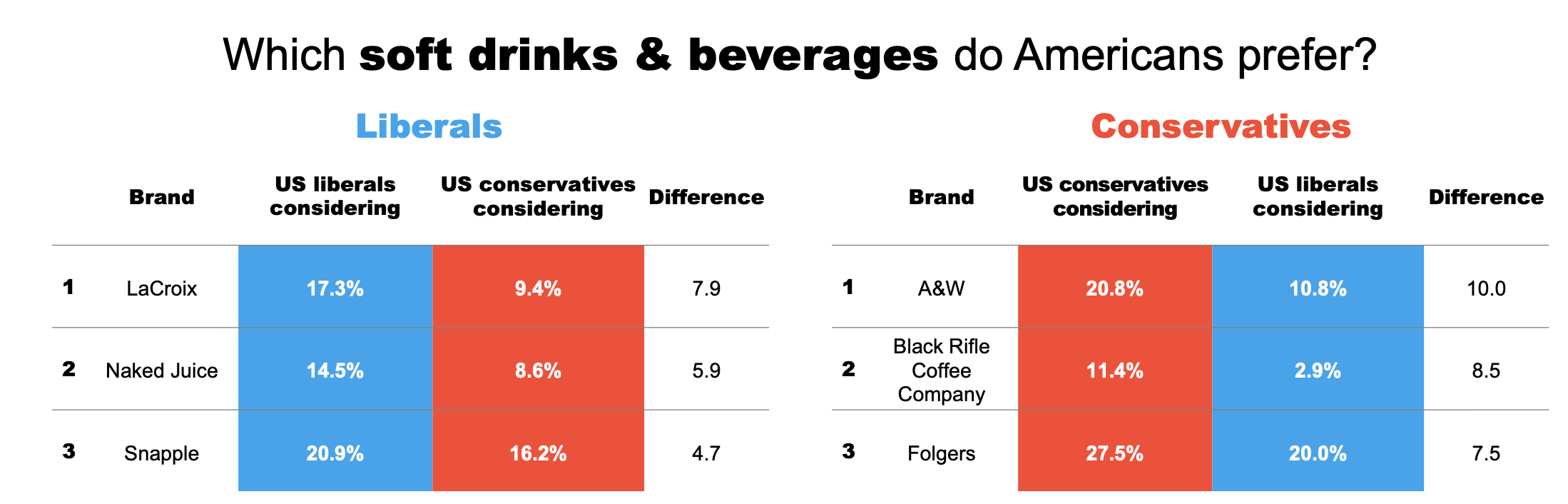
Which soft drinks & beverages do Americans prefer?
YouGov

Conservatives were more likely to shop for Jimmy Dean by a 15 percentage point margin, while vegetarian meat brands Impossible Foods and Beyond Meat led with liberals by about 10 percentage points.

Liberals place a premium on Subarus, whereas conservatives opt for Fords.
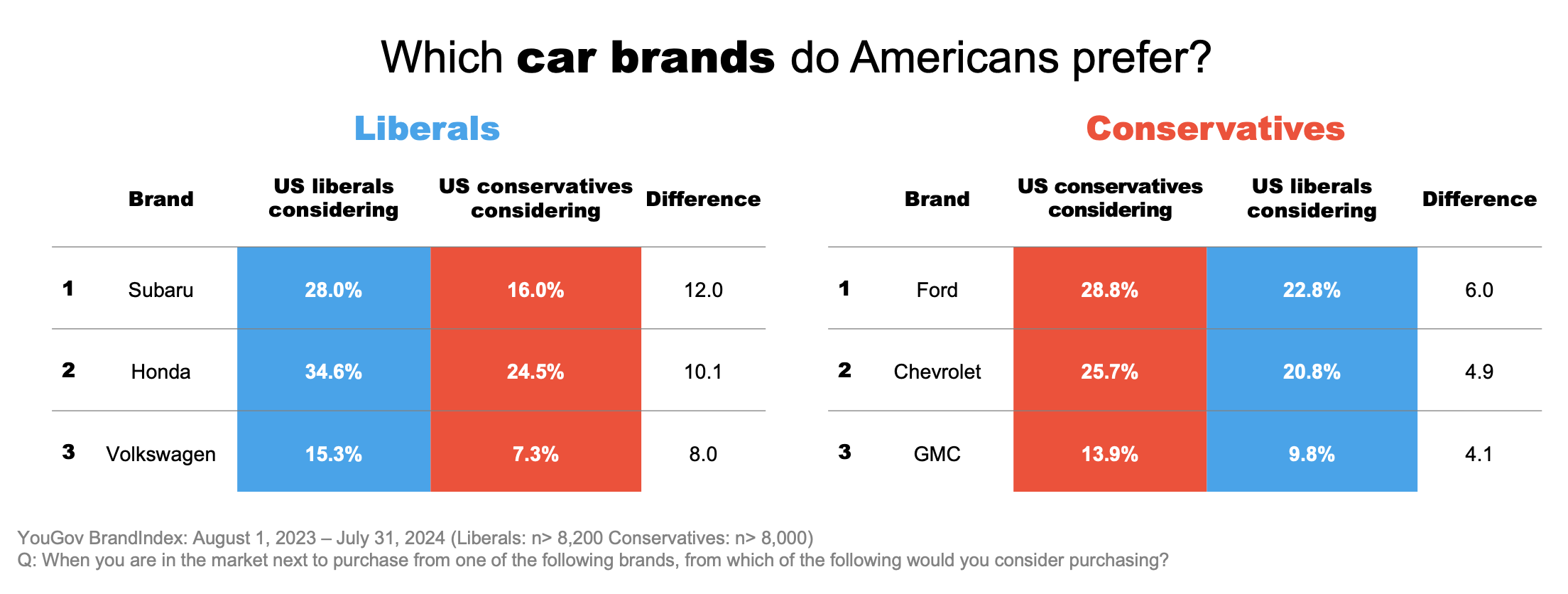
Which car brands do Americans prefer?
YouGov

Conservatives are more likely to choose Dawn for their dishes, while liberals wash up after meals with the more environmentally conscious Seventh Generation.

Conservatives chow down on Cracker Barrel and Olive Garden, while liberals are more likely to eat out at California Pizza Kitchen and The Cheesecake Factory.
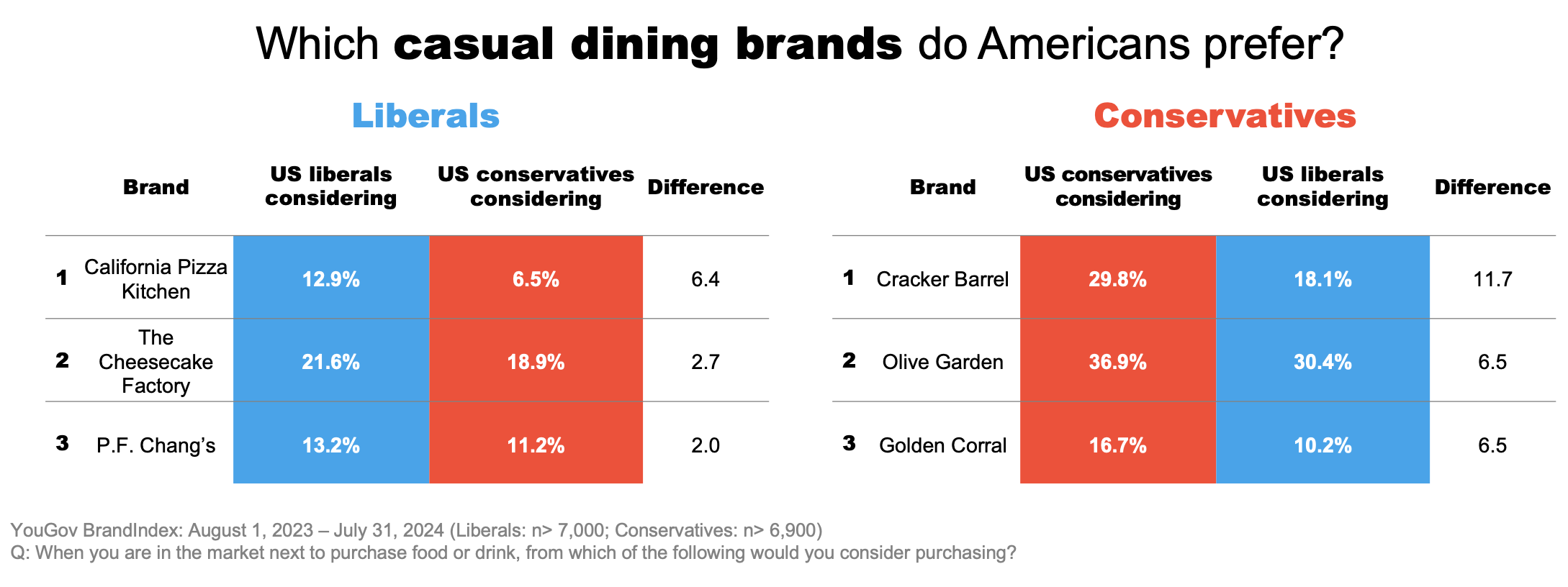
Which casual dining brands do Americans prefer?
YouGov

Google Docs, Reddit, and Instagram had a big advantage among the left, while X is preferred by the right.
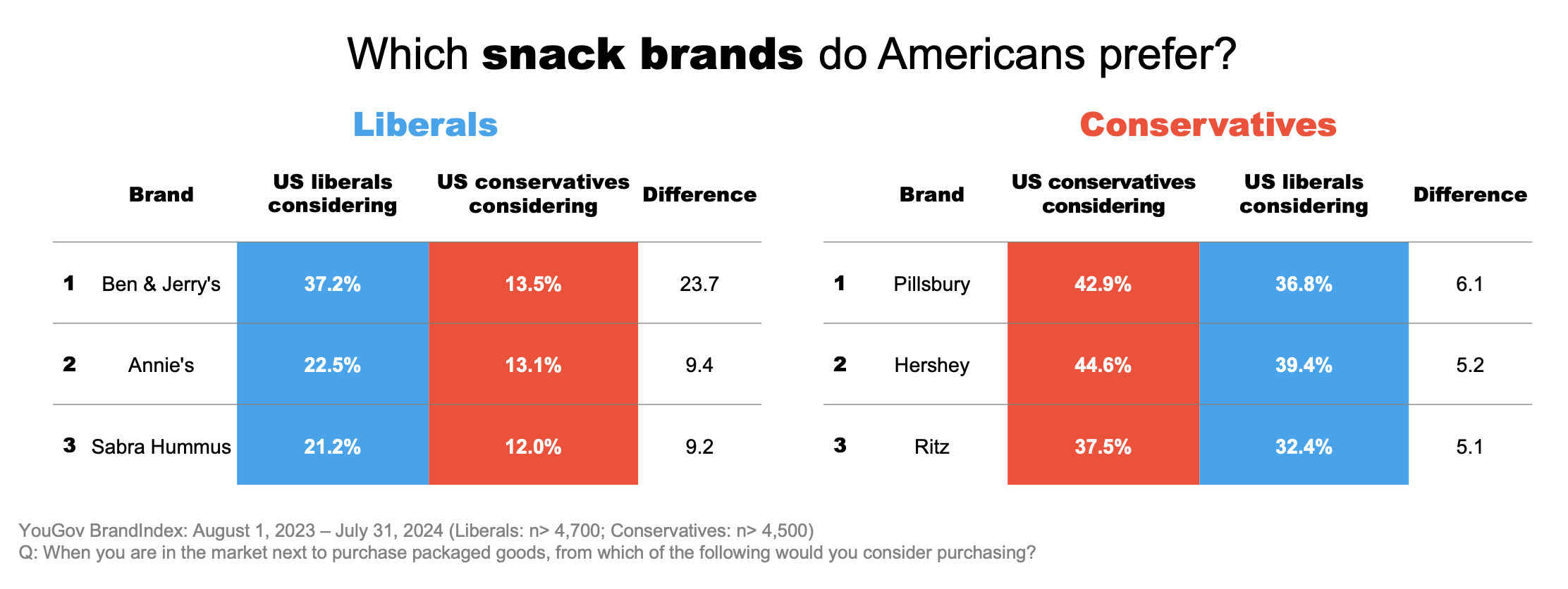
Which snack brands do Americans prefer?
YouGov

Of course, a lot of this disparity can be chalked up to demographic differences among liberals — who are more likely to be younger, female and live in cities in the North or West — and conservatives — who are relatively older, male, rural, and live in the South.

“The drivers behind the differences are probably going to vary greatly depending on what the category is,” Gmerick said.

A store like Bass Pro Shops is going to be more popular among conservatives in rural areas where there’s more fishing and hunting, for example, while stores that are more common on the coasts, like Trader Joe’s, may be preferred among the majority liberals who live there.

Age also is a major factor.

“You have conservatives that tend to be older,” according to Gmerick. “I think that part of the story is that people are just kind of set in what they do after a certain period in their life. It's more difficult for a new brand to break through, no matter what the category is.”

Something like conservatives’ relative willingness to consider staying at Trump Hotels, however, is much more overtly political. (Liberals veered toward Airbnb.)

The biggest differences, of course, are in advocacy groups, with conservatives vastly preferring the NRA while liberals flocked most divergently to Planned Parenthood and the ACLU. The same goes for TV networks. I’ll let you guess who prefers Fox News and Newsmax to MSNBC and CNN.

And for some brands whose consumers lean one way or another, their difference is a selling point. That’s led some of those brands to take part in the culture wars, like Ben & Jerry’s (Ritz leans right) and Chic-fil-A (liberals prefer Starbucks and Chipotle). Bud Light, which ended up in conservative crosshairs because of an endorsement by a transgender influencer, is now favored by liberals, while Coors Light is preferred by conservatives.

A brand’s success can come down to how they spin this partisanship.

“For certain categories, certain brands, their products or what they sell isn't necessarily tailored to the general population,” Gmerick said. “They know their audience, they know who they want to go after, and so they can actually lean in to some of the ideology in their messaging to really cater to what they know their audience set wants.”

Of course, some brands manage to thread the political needle, though those are few and far between.

Here’s a look at the most bipartisan brands by sector:
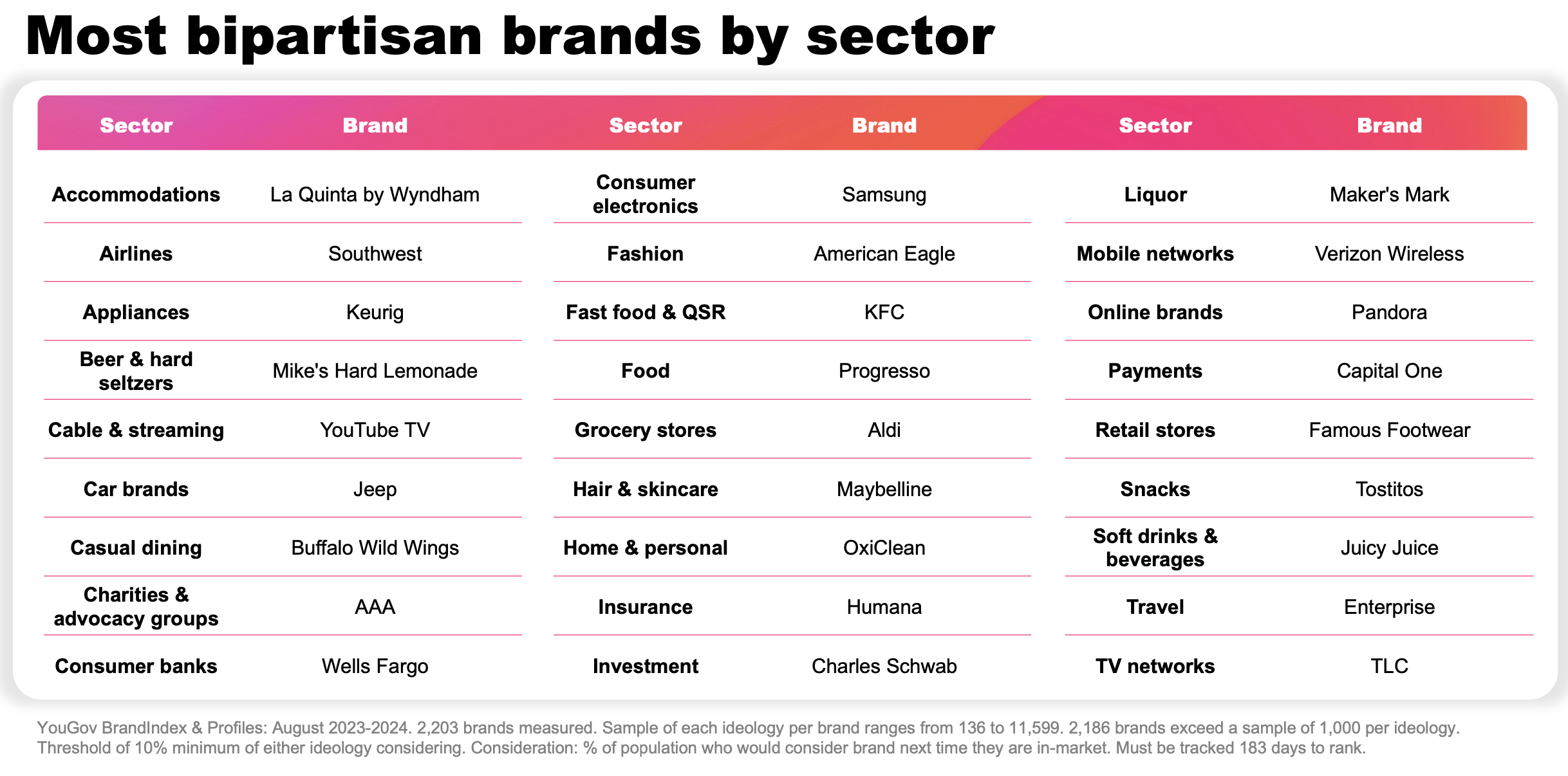
Most bipartisan brands by sector
YouGov

Just 28 brands of nearly a thousand popular brands YouGov looked at had less than 1 percent difference in purchase consideration by political ideology, meaning there was virtually no difference in whether a liberal or conservative would consider purchasing them.

Those safest brands include Amazon, Maybelline, KFC, the very American-sounding American Eagle and Best Western, the organizer of the great American pastime, the MLB, and Neosporin, because if we’re pricked do we not all bleed?
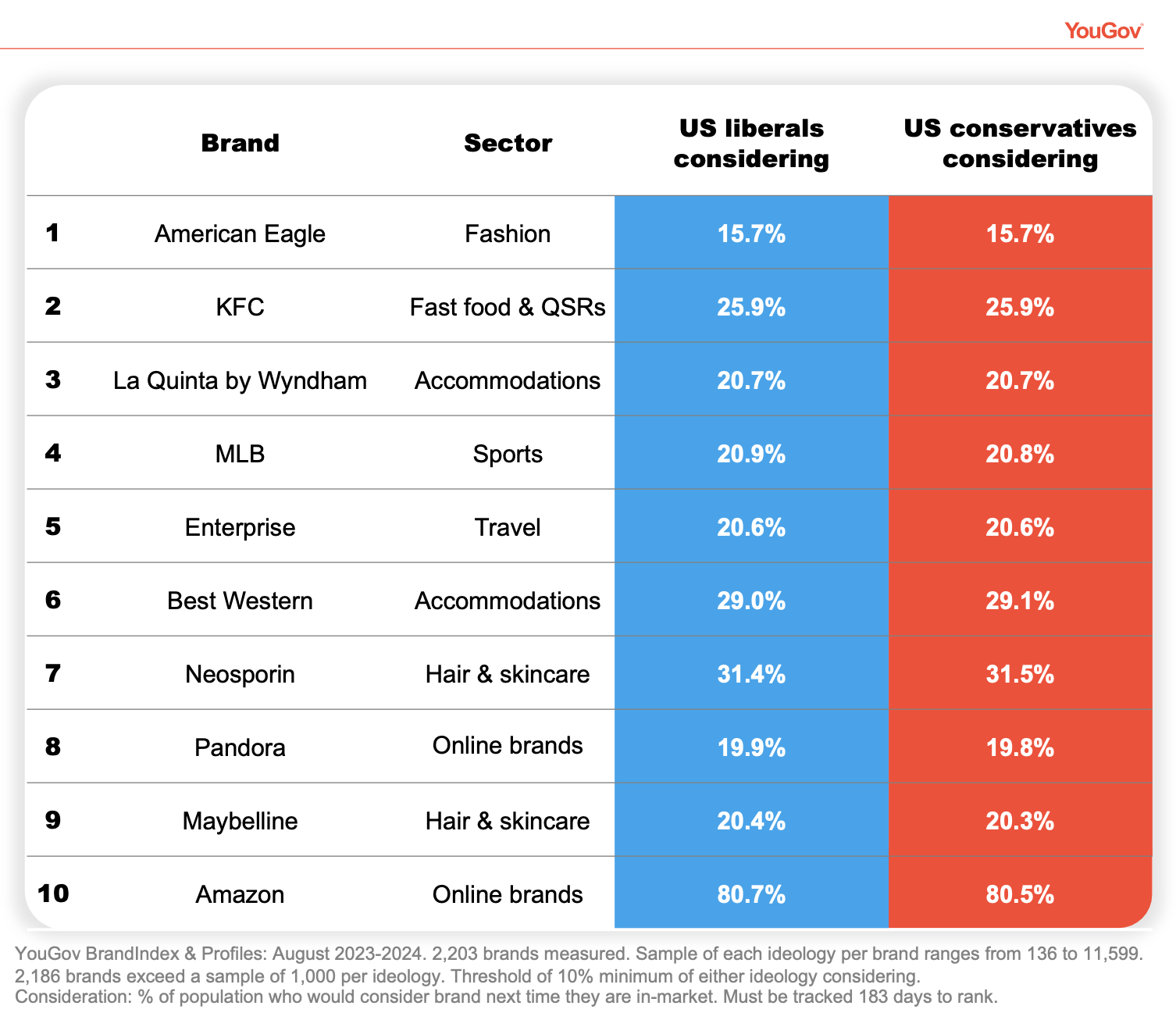
Most bipartisan brands
YouGov

More Business

See all Business
business

The Trump administration is reportedly planning a 50% made-in-America requirement for USMCA tariff relief

Qualifying for USMCA-related lower tariffs may soon require more US-made vehicle components, according to reporting by The Wall Street Journal.

The Trump administration is reportedly planning to introduce a 50% US content requirement for vehicles covered by the trade pact to receive lower tariffs. The content would be measured by cost, according to the WSJ.

There currently isn’t any US-specific requirement for those lower tariff rates, but in order to receive preferential tariffs, vehicles are must contain at least 75% regional content (components made in North America). Per Reuters reporting, the Trump admin is seeking to raise the regional requirement to 82%.

These reported plans are subject to change as the US negotiates USMCA terms with Mexico over the next few months.

Overall, Tesla will likely have the easiest time qualifying for any stricter requirements. The automaker’s vehicles contained the highest amount of US/Canadian content in 2025, according to American University research. Ford, GM, and Stellantis all scored lower.

Notably: the underlying government data that many domestic content measurements rely on intentionally combines US and Canadian components, so it’s difficult to know exactly how much of any given vehicle is specifically US-made.

There currently isn’t any US-specific requirement for those lower tariff rates, but in order to receive preferential tariffs, vehicles are must contain at least 75% regional content (components made in North America). Per Reuters reporting, the Trump admin is seeking to raise the regional requirement to 82%.

These reported plans are subject to change as the US negotiates USMCA terms with Mexico over the next few months.

Overall, Tesla will likely have the easiest time qualifying for any stricter requirements. The automaker’s vehicles contained the highest amount of US/Canadian content in 2025, according to American University research. Ford, GM, and Stellantis all scored lower.

Notably: the underlying government data that many domestic content measurements rely on intentionally combines US and Canadian components, so it’s difficult to know exactly how much of any given vehicle is specifically US-made.

business
Tom Jones

The $640,000 Luce makes the average Ferrari look like a bargain

Put aside the shape; put aside the smoothing out of Ferrari’s iconic sharp edges; put aside, even, the calls from former Chairman and President Luca Cordero di Montezemolo to “take the Prancing Horse off.” On the grounds of price alone, Luce detractors might have a point.

By now, many of us will have read the criticisms of Ferrari’s first fully electric vehicle, as the Luce — which was unveiled to the world earlier this week and promptly saw the company’s shares crash out in New York and Milan — gets subtly shaded by competitors online and not-so-subtly shaded by basically everyone else.

What makes all of this worse for Ferrari is that, even by the luxury car maker’s notoriously high standards, they’ve slapped a pretty hefty price tag on the Luce, and the company’s CEO, Benedetto Vigna, has already been forced to defend the €550,000 ($640,000) price point, saying yesterday that it’s “fair to pay for innovation,” per Reuters.

While Ferrari’s cars have been getting more expensive of late, as recently as 2022, Ferrari’s average revenue per car sold was around $340,000. At nearly twice that price, this new electric model is obviously proving a little much (visually, conceptually, and financially) for many loyal and long-standing fans of the Prancing Horse to stomach.

Ferrari Luce cost chart
Sherwood News

By now, many of us will have read the criticisms of Ferrari’s first fully electric vehicle, as the Luce — which was unveiled to the world earlier this week and promptly saw the company’s shares crash out in New York and Milan — gets subtly shaded by competitors online and not-so-subtly shaded by basically everyone else.

What makes all of this worse for Ferrari is that, even by the luxury car maker’s notoriously high standards, they’ve slapped a pretty hefty price tag on the Luce, and the company’s CEO, Benedetto Vigna, has already been forced to defend the €550,000 ($640,000) price point, saying yesterday that it’s “fair to pay for innovation,” per Reuters.

While Ferrari’s cars have been getting more expensive of late, as recently as 2022, Ferrari’s average revenue per car sold was around $340,000. At nearly twice that price, this new electric model is obviously proving a little much (visually, conceptually, and financially) for many loyal and long-standing fans of the Prancing Horse to stomach.

Ferrari Luce cost chart
Sherwood News

Latest Stories

Sherwood Media, LLC and Chartr Limited produce fresh and unique perspectives on topical financial news and are fully owned subsidiaries of Robinhood Markets, Inc., and any views expressed here do not necessarily reflect the views of any other Robinhood affiliate, including Robinhood Markets, Inc., Robinhood Financial LLC, Robinhood Securities, LLC, Robinhood Crypto, LLC, Robinhood Money, LLC, Robinhood U.K. Ltd, Robinhood Derivatives, LLC, Robinhood Gold, LLC, Robinhood Asset Management, LLC, Robinhood Credit, Inc., Robinhood Ventures DE, LLC and, where applicable, its managed investment vehicles.