
Business
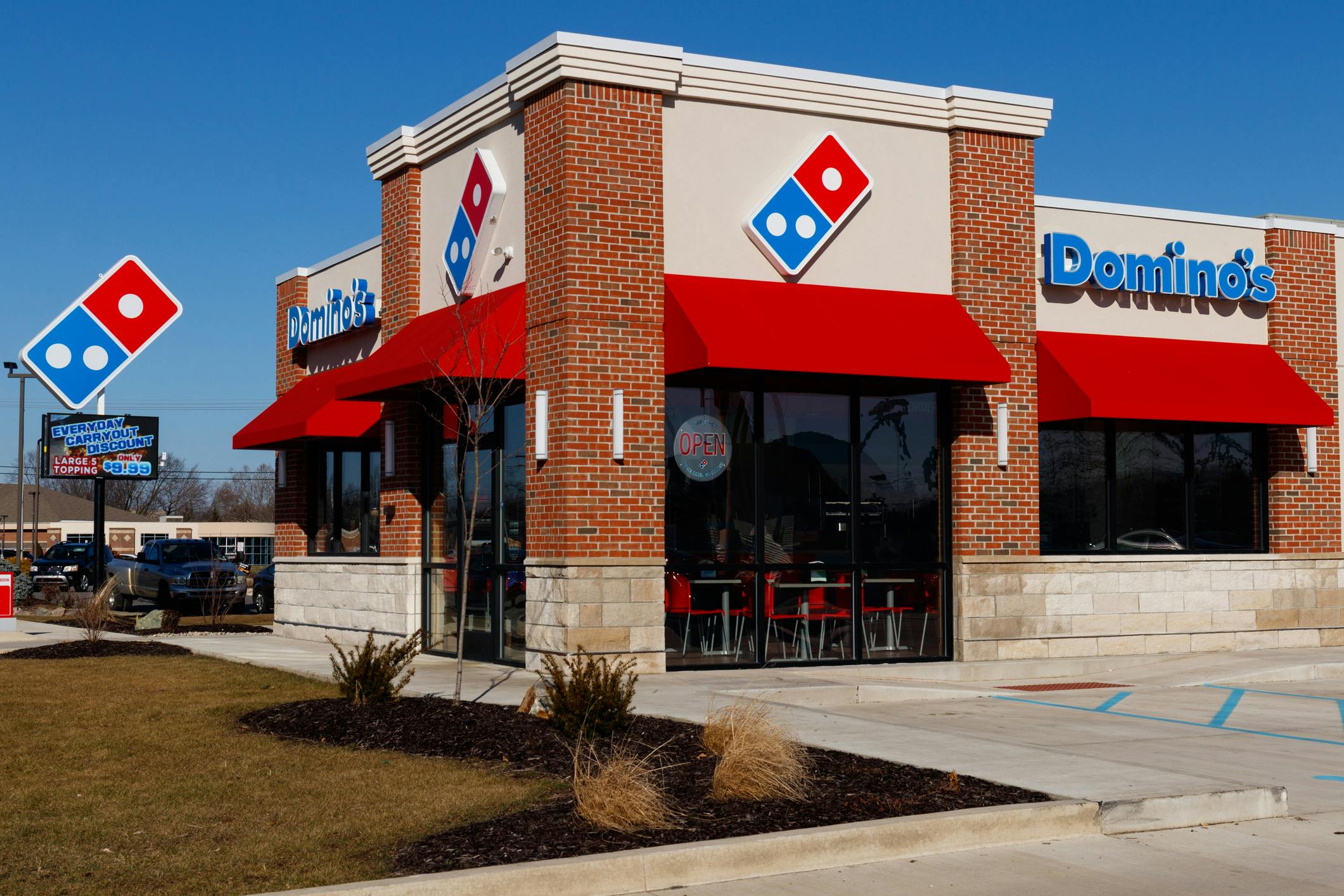
Domino's Pizza Carryout Restaurant. Dominos is consistently one of the top five companies in terms of online transactions II
Getty Images
PERMANENT PIZZA

Domino’s now has 21,000 restaurants around the world

The pizza chain didn’t close a single store in the US in Q3

David Crowther

Domino’s Pizza, Inc., just reported third quarter earnings, with US same-store sales rising 3.0%, slightly worse than expected, contributing to the company revising its forecast for sales growth this year. The company now expects global retail sales to grow 6% this year, down from 7%.

The news comes just two days after the company renewed its “Emergency Pizza” promotion to drive sales, where customers can get a free medium, two-topping pizza... if they place a qualifying order.

MORE

The company also revealed that it now has 21,002 stores across the world, as it continues to build on its ambitious global growth plans or, as Domino’s calls it, the “Hungry for MORE” strategy. A substantial slice of those — some 33% — are in the US, with the rest spread across its 90 international markets. The new additions widen the gap to its nearest rival, Pizza Hut, which had fewer than 20,000 locations at the latest count.
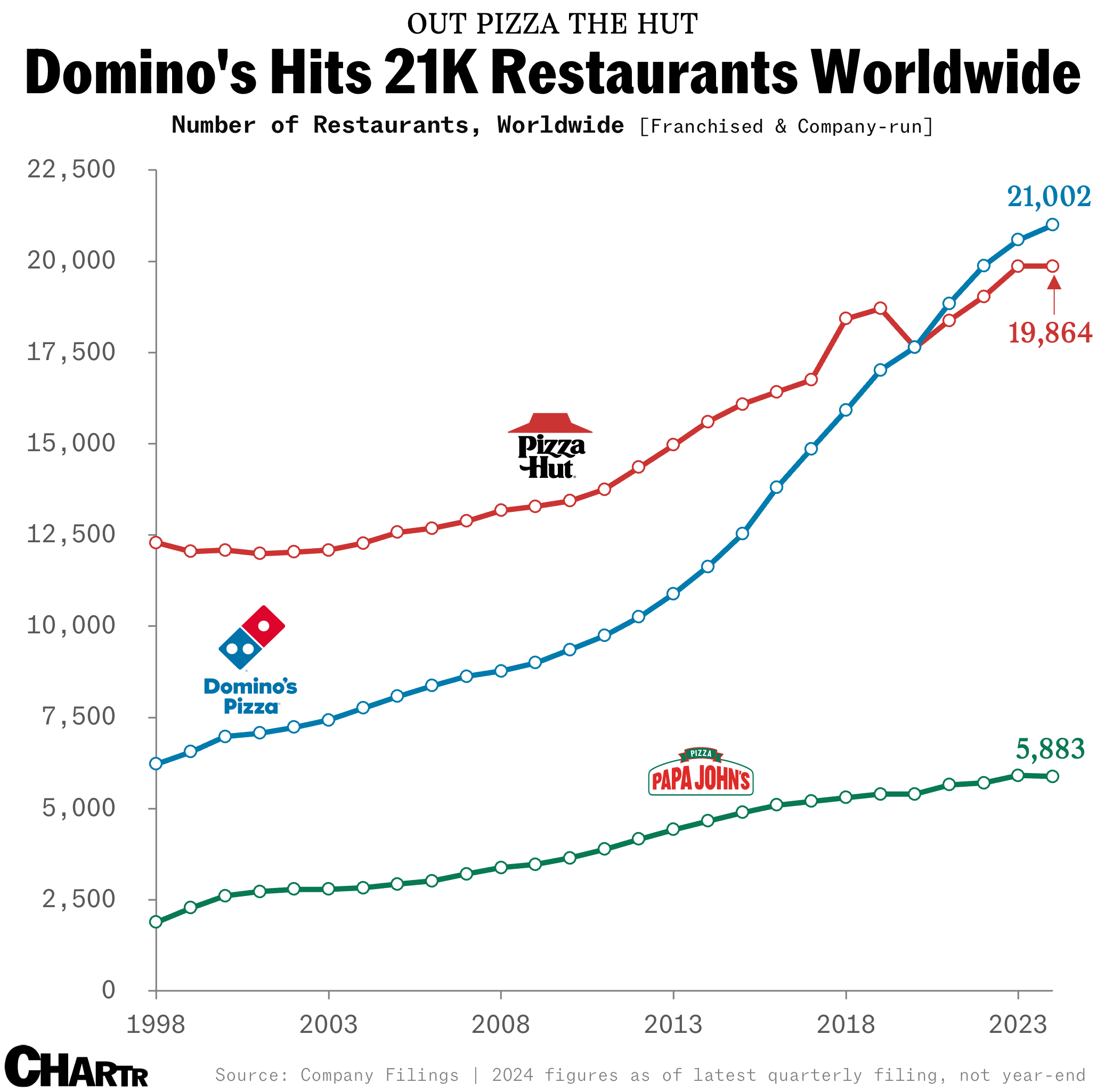
Domino’s store count
Sherwood News

Most of the store growth for Domino’s came from overseas: in Q3, the company’s international division opened 184 new stores and closed 136, for net growth of 48 stores. That feels pretty typical for most large chains. Some restaurants naturally close every quarter for a host of reasons (underperformance, franchisee change, etc.). What’s slightly odd is that — out of more than 6,900 restaurants in the US — Domino’s didn’t shut down a single store; it opened 24 with no closures. In the previous two quarters combined it closed only three stores, and in the previous year it closed only 10. Either the company is firing on literally all cylinders, or underperforming stores just don’t close down.

The takeaway? If a Domino’s opens up near you, chances are, it’s sticking around for a long time.

More Business

See all Business
business
Tom Jones

Demis Hassabis, Google DeepMind’s CEO and founder, was also an early Anthropic investor

A chess prodigy and an actual a knight of the realm in the UK, it’s perhaps no surprise that Demis Hassabis has made some strategic moves about his exposure to AI upside. According to people familiar with the matter, the influential AI architect became an angel investor in Anthropic, currently behind many of the leading AI models, per Arena AI leaderboards.

The Nobel Prize winner’s position in the Claude creator was previously undisclosed and, per the Financial Times, highlights Hassabis’ “growing influence across the AI industry.”

Google, which bought DeepMind, the company that Hassabis cofounded and heads to this day, for a reported ~$400 million in 2014, is also a key Anthropic investor. The tech giant reportedly plans to invest up to $40 billion in the AI company as part of the mutually beneficial relationship the pair have forged, with reports that Anthropic has committed to spending $200 billion in the other direction on Google’s cloud services over the next five years.

Im playing all sides, so I always come out on top

In addition to his financial support for Anthropic, Hassabis has also invested in a range of AI startups launched by colleagues, such as Inflection AI, a company set up by DeepMind cofounder Mustafa Suleyman (who is now CEO of Microsoft AI), as well as efforts from other collaborators, like David Silver’s Ineffable Intelligence.

Hassabis also emerged as a recurring figure on the fringes of the recent Elon Musk v. Sam Altman trial, cropping up repeatedly in testimonies and court documents and appearing to live, as The Verge put it, “rent-free” in Musk’s head.

Founded in 2021, Anthropic has recently raised funding at a reported $900 billion valuation, sending it soaring ahead of competitor OpenAI.

The Nobel Prize winner’s position in the Claude creator was previously undisclosed and, per the Financial Times, highlights Hassabis’ “growing influence across the AI industry.”

Google, which bought DeepMind, the company that Hassabis cofounded and heads to this day, for a reported ~$400 million in 2014, is also a key Anthropic investor. The tech giant reportedly plans to invest up to $40 billion in the AI company as part of the mutually beneficial relationship the pair have forged, with reports that Anthropic has committed to spending $200 billion in the other direction on Google’s cloud services over the next five years.

Im playing all sides, so I always come out on top

In addition to his financial support for Anthropic, Hassabis has also invested in a range of AI startups launched by colleagues, such as Inflection AI, a company set up by DeepMind cofounder Mustafa Suleyman (who is now CEO of Microsoft AI), as well as efforts from other collaborators, like David Silver’s Ineffable Intelligence.

Hassabis also emerged as a recurring figure on the fringes of the recent Elon Musk v. Sam Altman trial, cropping up repeatedly in testimonies and court documents and appearing to live, as The Verge put it, “rent-free” in Musk’s head.

Founded in 2021, Anthropic has recently raised funding at a reported $900 billion valuation, sending it soaring ahead of competitor OpenAI.

Latest Stories

Sherwood Media, LLC and Chartr Limited produce fresh and unique perspectives on topical financial news and are fully owned subsidiaries of Robinhood Markets, Inc., and any views expressed here do not necessarily reflect the views of any other Robinhood affiliate, including Robinhood Markets, Inc., Robinhood Financial LLC, Robinhood Securities, LLC, Robinhood Crypto, LLC, Robinhood Money, LLC, Robinhood U.K. Ltd, Robinhood Derivatives, LLC, Robinhood Gold, LLC, Robinhood Asset Management, LLC, Robinhood Credit, Inc., Robinhood Ventures DE, LLC and, where applicable, its managed investment vehicles.
