
Business
TechCrunch Disrupt 2022 - Day 3
Co-founder & CEO of Figma Dylan Field onstage in 2022 (Kimberly White/Getty Images)
DRAWING INTEREST

Figma just filed for IPO, revealing its financials for the first time publicly

Ignoring some one-offs, Figma is a profit machine growing at nearly 50% year on year — no wonder Adobe wanted to drop $20 billion to snap up its disruptive rival.

Silicon Valley likes the enigmatic founder who does things differently, so when Dylan Field wrote “chocolate is repulsive” in his essay for his application for the Thiel Fellowship, he was already fitting into the archetypal tech founder mold.

In the years since, Field and cofounder Evan Wallace went on to start Figma, a design software company that eschewed the collective wisdom that you couldn’t build a powerful, collaborative design tool on the open web. Now, with the stock market climbing a wall of worry to reach new heights, Figma has finally filed for an IPO — revealing its financials publicly for the first time.

So, is this the classic cash-incinerating disruptive startup with a bunch of super-founder shares, tapping the public markets for an enormous payday for early employees and investors? Sort of.

CEO Dylan Field does indeed have a vicelike grip on the company, controlling ~75% of the voting rights pre-IPO, and many employees will no doubt become liquid millionaires once the stock starts trading, but the company’s financials are remarkably mature. In its latest quarter, the company racked up $228 million in revenue (up 46% year on year), with typically tasty software gross margins and an operating profit margin of more than 17%.
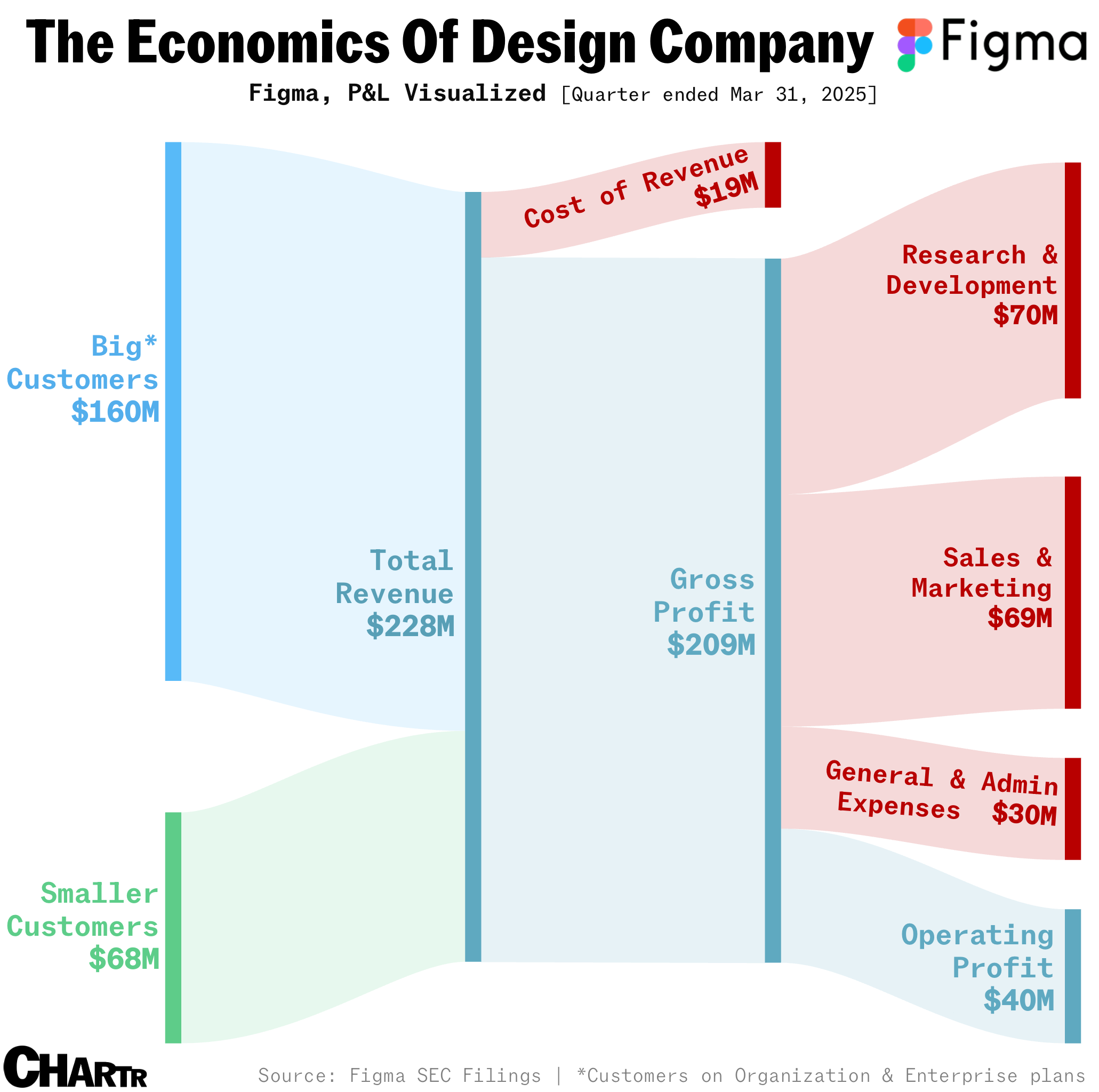
The economics of Figma
The Economics of Figma (Sherwood News)

The IPO filing also reveals that it holds nearly $70 million in bitcoin ETFs and $30 million in stablecoins for future bitcoin purchases — a corporate strategy that traders loved initially, but might be starting to sour on.

What’s particularly interesting is just how well Figma has infiltrated the design teams of America’s largest companies. According to the S-1 filing, a whopping “95% of the Fortune 500 and 78% of the Forbes Global 2000 used Figma in March 2025” — and those companies are spending big for the privilege to Draw, Design, and FigJam. Over the past two years, Figma has more than doubled the customers that pay it more than $100,000 annually.

Indeed, with the exception of a one-off stock-based compensation expense in Q2 2024, Figma has slowly but surely trudged toward consistent profitability. Its balance sheet was also bolstered by a $1 billion termination fee from its breakup with Adobe, which had tried to acquire Figma for $20 billion in 2022 — a deal that fell apart because of regulatory hurdles.
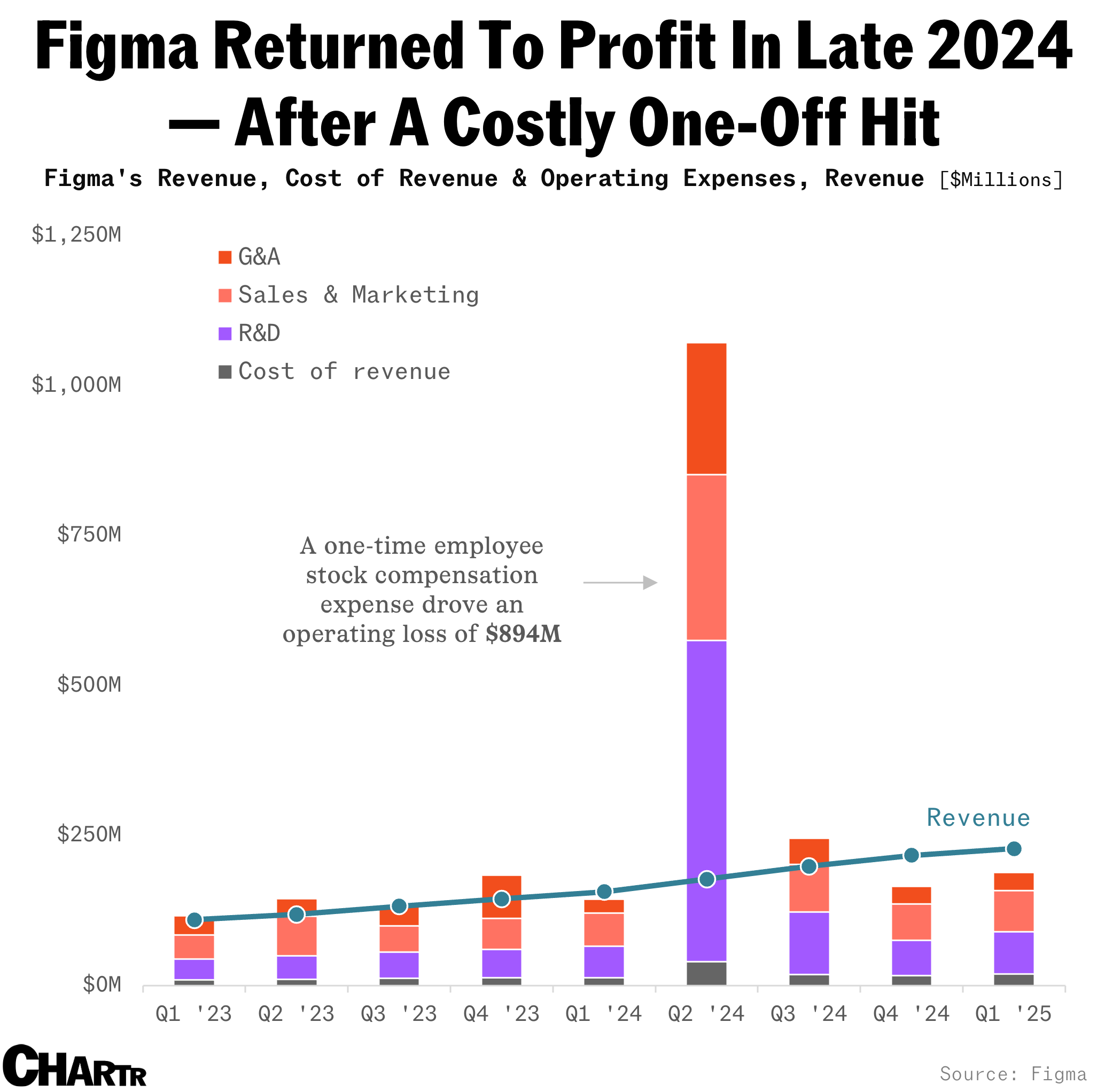
Figma 2, profitability
Sherwood News

Now, Figma will be the IPO guinea pig for a swath of still private startups — and none will be watching the Figma offering more closely than Canva, another hot design company that’s rumored to be looking at a public offering of its own, having recently been valued at $49 billion.

More Business

See all Business
Capsule Pill and Dots

Justice Department accuses telehealth Zealthy of fraud, says remedy may bankrupt it

The feds say they don’t think Zealthy has the liquidity to pay what it owes customers.

Netflix playground

Will investing in kids games finally make Netflix Games “the Netflix of games”?

Netflix is launching a game for preschoolers, its latest foray into stuff-you-play instead of stuff-you-watch.

business

American Airlines joins the flock, hiking bag fees amid higher jet fuel prices

American Airlines on Thursday announced that it, too, will be hiking the fees it charges customers to check luggage.

With the move, all four of the major US airlines, which together control about 80% of the US market, have now hiked their baggage fees in recent days amid surging jet fuel prices.

The change will go into effect on tickets bought on or after Thursday, the same day Southwest’s hike begins.

Since late March, JetBlue, Delta Air Lines, United Airlines, Canada’s WestJet, and Southwest have hiked their fees. Experts expect more major carriers to follow, and to potentially tweak the pricing of other ancillary revenue sources like seat assignments and carry-on luggage.

The change will go into effect on tickets bought on or after Thursday, the same day Southwest’s hike begins.

Since late March, JetBlue, Delta Air Lines, United Airlines, Canada’s WestJet, and Southwest have hiked their fees. Experts expect more major carriers to follow, and to potentially tweak the pricing of other ancillary revenue sources like seat assignments and carry-on luggage.

business

Less than a year after implementing them, Southwest is also hiking its bag fees

Southwest Airlines has joined the growing list of airlines opting to hike their bag fees amid sustained higher jet fuel costs.

Starting today, the first checked bag at the carrier — which implemented bag fees less than a year ago — will jump from $35 to $45, and the second from $45 to $55. Southwest quietly disclosed the change Tuesday.

Southwest assigned the decision to “part of an ongoing analysis of the business and against the evolving global backdrop.”

As of Wednesday, jet fuel prices dropped to $4.16 a gallon, per the Argus US Jet Fuel Index, down from $4.81 on Tuesday following President Trump’s ceasefire announcement, which sent travel stocks soaring. Major airlines have shed some of those gains in premarket trading Thursday.

With the move to hike bag fees, Southwest joins JetBlue, United Airlines, Delta Air Lines, and Canada’s WestJet, all of which also boosted fees this month. Experts expect more major carriers to follow, and to potentially tweak the pricing of other ancillary revenue sources like seat assignments and carry-on luggage.

Southwest assigned the decision to “part of an ongoing analysis of the business and against the evolving global backdrop.”

As of Wednesday, jet fuel prices dropped to $4.16 a gallon, per the Argus US Jet Fuel Index, down from $4.81 on Tuesday following President Trump’s ceasefire announcement, which sent travel stocks soaring. Major airlines have shed some of those gains in premarket trading Thursday.

With the move to hike bag fees, Southwest joins JetBlue, United Airlines, Delta Air Lines, and Canada’s WestJet, all of which also boosted fees this month. Experts expect more major carriers to follow, and to potentially tweak the pricing of other ancillary revenue sources like seat assignments and carry-on luggage.

Latest Stories

Sherwood Media, LLC produces fresh and unique perspectives on topical financial news and is a fully owned subsidiary of Robinhood Markets, Inc., and any views expressed here do not necessarily reflect the views of any other Robinhood affiliate, including Robinhood Markets, Inc., Robinhood Financial LLC, Robinhood Securities, LLC, Robinhood Crypto, LLC, Robinhood Derivatives, LLC, or Robinhood Money, LLC. Futures and event contracts are offered through Robinhood Derivatives, LLC.
