
Business
Seedling on dry dirt.
Getty Image
LIMITED LIFE COMPANY

Half of new US companies disappear within 5 years — and only 1 in 3 makes it to year 10

Survival depends on more than luck, from where it starts, to what it does, to when it’s born.

Hyunsoo Rim

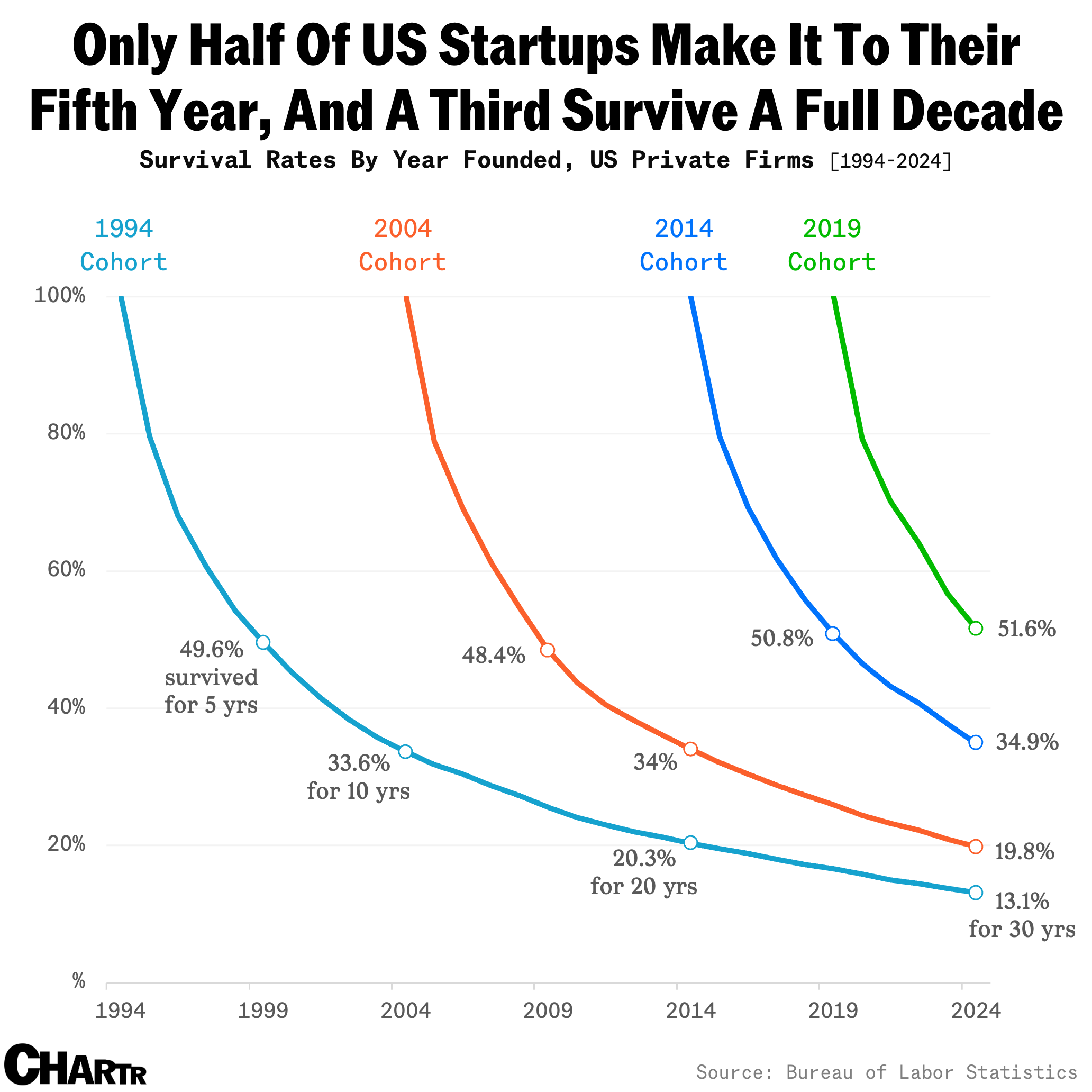
Roughly half of new US startups make it to their fifth birthday — and the most recent ones have even dodged the recession curse (so far).

According to an Axios analysis on the latest Bureau of Labor Statistics data, 51.6% of private sector firms founded in March 2019 were still operating as of March 2024. Zooming out, the typical life cycle of an American startup follows a familiar curve.
2025-11-07-firm survival
Sherwood News

Limited life company

Of those founded since 1994, about one-third survived a full decade, roughly one in five makes it to year 20, and only around 13% are still standing after three decades, per data from the BLS.

So, who manages to last — and who doesn’t? Several factors are at play, including location and industry. Axios found that West Virginia (57.6%) and Connecticut (57.5%) had the highest five-year survival rates as of 2024, while Washington (41.1%), Missouri (43.2%), and DC (44.7%) ranked lowest, well below the national average.

Meanwhile, sectors with stable, regulated demand and high entry barriers — like agriculture and utilities — tend to endure longer, while those like mining and technology see faster churn, as innovation races, winner-take-all markets, and price swings can make longevity harder to achieve.

Beyond geography and type of business, timing matters, too, as business survival tends to rise and fall with the economic cycle.

Indeed, startups born just before or during downturns, like those from 2001 and 2006-7, typically show lower five-year survival rates than those born in the subsequent recovery periods (2003, 2010), according to BLS analysis.

What’s interesting, though, is that the pandemic era might have broken that pattern, with startups launched in 2018-19 posting the highest five-year survival on record. Several tailwinds could’ve helped, such as loans for small businesses rolled out during early Covid, government stimulus that propped up consumer demand, record-low borrowing costs, and a whopping 43% surge in e-commerce sales — all of which perhaps made the early 2020s an unexpectedly fertile moment for new companies.

More Business

See all Business
business

Used car prices dip in April but remain at 2023 levels as gas prices surge

Used car prices ticked down in April, the first drop in 2026, according to fresh data from Cox Automotive.

Cox’s Manheim Used Vehicle Value Index, which tracks wholesale prices, dipped 1.6% in April from March, but remains around highs not seen since 2023 as shoppers react to surging gas prices.

“Affordability remains front and center, and that’s driving some increased demand for older vehicles... as well as changing the calculus for consumers shopping for EVs,” said Cox’s chief economist, Jeremy Robb.

As reported in March, used car retailers including CarMax have told Sherwood News that gas prices are driving more shoppers to look toward EVs. Cox’s EV index is up 7.2% from April 2025, compared to a 1.1% hike for its non-EV index.

business

Xbox CEO overhauls leadership team with Microsoft AI execs amid sales declines

Microsoft is continuing to shake up Xbox, with gaming chief Asha Sharma (who took over the division suddenly in February) announcing an executive overhaul.

According to an internal memo seen by CNBC, Sharma is bringing four leaders from her former CoreAI group into the Xbox fold, as they have “consumer and technical expertise [Xbox does] not yet have.”

“Right now, it is too hard to ship impact quickly. We spend too much time inward instead of with the community, and we lack the depth we need in some of the fundamentals,” Sharma said in the memo.

Aside from the CoreAI team, David Schloss, a former Instacart growth exec, will take over the subscription and cloud business.

Following Microsoft’s earnings report last week, in which Xbox console sales fell 33% from last year, Sharma said the division had work to do. The company forecast more sales declines for Game Pass and consoles in the current quarter.

“Right now, it is too hard to ship impact quickly. We spend too much time inward instead of with the community, and we lack the depth we need in some of the fundamentals,” Sharma said in the memo.

Aside from the CoreAI team, David Schloss, a former Instacart growth exec, will take over the subscription and cloud business.

Following Microsoft’s earnings report last week, in which Xbox console sales fell 33% from last year, Sharma said the division had work to do. The company forecast more sales declines for Game Pass and consoles in the current quarter.

Latest Stories

Sherwood Media, LLC produces fresh and unique perspectives on topical financial news and is a fully owned subsidiary of Robinhood Markets, Inc., and any views expressed here do not necessarily reflect the views of any other Robinhood affiliate, including Robinhood Markets, Inc., Robinhood Financial LLC, Robinhood Securities, LLC, Robinhood Crypto, LLC, Robinhood Derivatives, LLC, or Robinhood Money, LLC. Futures and event contracts are offered through Robinhood Derivatives, LLC.
