Business
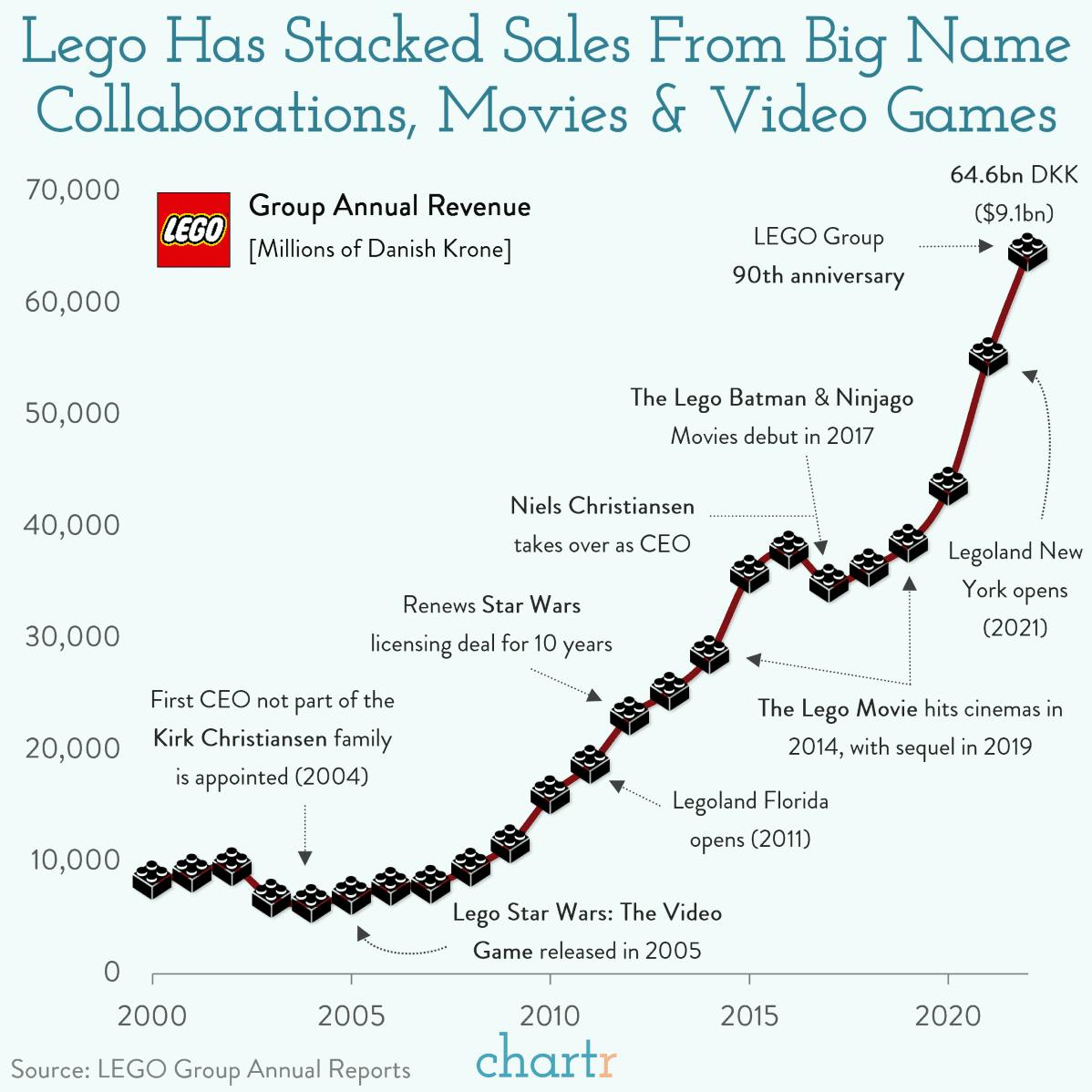
Plastic uptick: Lego's sales have stacked in recent years

Plastic uptick: Lego's sales have stacked in recent years

Through brick and thin

Even with Lego’s modern legacy of movies, games, and theme parks, most of us think of Lego in its purest form: bright plastic bricks that can be built into whatever shape your creativity takes, from cars, to condos, to the Colosseum.

Despite the playful design and imaginative spirit that Lego is known for today, its roots actually trace back to the Great Depression. Ole Kirk Christiansen, a carpenter from Billund, Denmark, noticed that the demand for home construction and furniture was waning. To sustain his livelihood, Ole Kirk pivoted to making wooden toys in the early 1930s, which he initially traded for food for him and his family. Two years later, he christened his venture Lego, a name derived from the Danish phrase "leg godt", meaning "play well".

Plastic uptick

Lego's foray into plastic — the precursor to Lego we know today, dubbed by Christiansen as ‘automated binding bricks’ —  didn’t start until 1947, when the material was still novel. However, sales stacked quickly, with plastic toys accounting for half of Lego's production by 1951. A devastating warehouse fire, which consumed the wooden toy inventory, forced the family to fully embrace their plastic future — a transition that marked the beginning of Lego’s meteoric rise. By the mid-1960s, Lego was sold in 40+ countries, and, by the 1990s, the company was one of the world’s largest toy manufacturers.

However, by the early noughties, Lego was struggling. Sales plummeted almost 30% in 2003, pushing the company close to bankruptcy. Seeking a revitalization, Lego appointed its first non-family member CEO, Jørgen Vig Knudstorp, who sold off non-essential parts of the business and went back to basics: halving the number of LEGO pieces produced, cutting jobs, and — perhaps most crucially of all — asking kids what they actually wanted to play with.

AFOLogy

While tracking playtime proved profitable for Lego — as they noticed that, rather than playing for mindless amusement, children enjoyed trying to master a skill with degrees of difficulty — more mature brick enthusiasts have also played a part in Lego’s present-day prosperity.

Indeed, Lego has an enormous legion of AFOLs (Adult Fans Of Lego). Whether driven by nostalgia, the need for stress relief, or just wanting to show people a self-completed 7,541-pieceMillenium Falcon, more adults are discovering, or rediscovering, the joy of Lego. In turn, the company has embraced the trend, designing retro-themed builds (like the $270 Pac-Man set released earlier this year) that tap into adults’ sentimental seeking of childhood favorites, with many AFOLs interested in the "displayability" of Lego sets, like Lego typewriters, Lego bonsai trees… or even a 9,090-piece Titanic model.


More Business

See all Business
business

Netflix is down amid reports it’s leading the Warner Bros. bidding war as Paramount cries foul

Netflix’s charm offensive appears to be working.

Netflix is reportedly emerging as the leader in the bidding war for Warner Bros. Discovery after second-round bids this week, edging out entertainment juggernaut rivals Comcast and Paramount Skydance.

Investors don’t appear psyched by the streaming leader’s turn of fortune: the stock is down on Thursday morning, a day after closing down nearly 5% following reports that scooping up HBO Max wouldn’t necessarily result in a big market share boost.

Paramount, which has reportedly made five bids for Warner Bros. Discovery, doesn’t love the current state of play, either. The company sent WBD a letter questioning the “fairness and adequacy” of the process, highlighting reports that WBD’s board favors Netflix and is resisting Paramount.

Any offer would be subject to regulatory approval — a fact that may have weighed against Netflix’s offer given that cofounder Reed Hastings’ politics are vocally to the left, very much at odds with the current regulatory regime. Paramount seems confident in its ability to get approval, reportedly boosting its breakup fee to $5 billion should its potential acquisition fall apart in the regulatory process.

Investors don’t appear psyched by the streaming leader’s turn of fortune: the stock is down on Thursday morning, a day after closing down nearly 5% following reports that scooping up HBO Max wouldn’t necessarily result in a big market share boost.

Paramount, which has reportedly made five bids for Warner Bros. Discovery, doesn’t love the current state of play, either. The company sent WBD a letter questioning the “fairness and adequacy” of the process, highlighting reports that WBD’s board favors Netflix and is resisting Paramount.

Any offer would be subject to regulatory approval — a fact that may have weighed against Netflix’s offer given that cofounder Reed Hastings’ politics are vocally to the left, very much at odds with the current regulatory regime. Paramount seems confident in its ability to get approval, reportedly boosting its breakup fee to $5 billion should its potential acquisition fall apart in the regulatory process.

business

Delta says the government shutdown will cost it $200 million in Q4

The 43-day government shutdown that ended last month will result in a $200 million ding for Delta Air Lines, the airline said in a filing on Wednesday.

That’s about $100,000 per shutdown-related canceled flight. (Delta previously said it canceled more than 2,000 flights due to FAA flight reductions.) When the company reports its fourth-quarter earnings, the shutdown will lop off about $0.25 per share.

Delta initially stayed calm about the shutdown, with CEO Ed Bastian stating in early October that the company was running smoothly and hadn’t seen any impacts at all. One historically long shutdown later, Delta wasn’t able to remain untouched.

The skies have since cleared, though, and Delta’s filing states that booking growth has “returned to initial expectations following a temporary softening in November.”

Delta’s shares were up over 2% as of Wednesday’s market open.

Delta initially stayed calm about the shutdown, with CEO Ed Bastian stating in early October that the company was running smoothly and hadn’t seen any impacts at all. One historically long shutdown later, Delta wasn’t able to remain untouched.

The skies have since cleared, though, and Delta’s filing states that booking growth has “returned to initial expectations following a temporary softening in November.”

Delta’s shares were up over 2% as of Wednesday’s market open.

Latest Stories

Sherwood Media, LLC produces fresh and unique perspectives on topical financial news and is a fully owned subsidiary of Robinhood Markets, Inc., and any views expressed here do not necessarily reflect the views of any other Robinhood affiliate, including Robinhood Markets, Inc., Robinhood Financial LLC, Robinhood Securities, LLC, Robinhood Crypto, LLC, or Robinhood Money, LLC.