Business
Cartoon of multiple rockets in space
(Getty Images)
Rocket-fueled

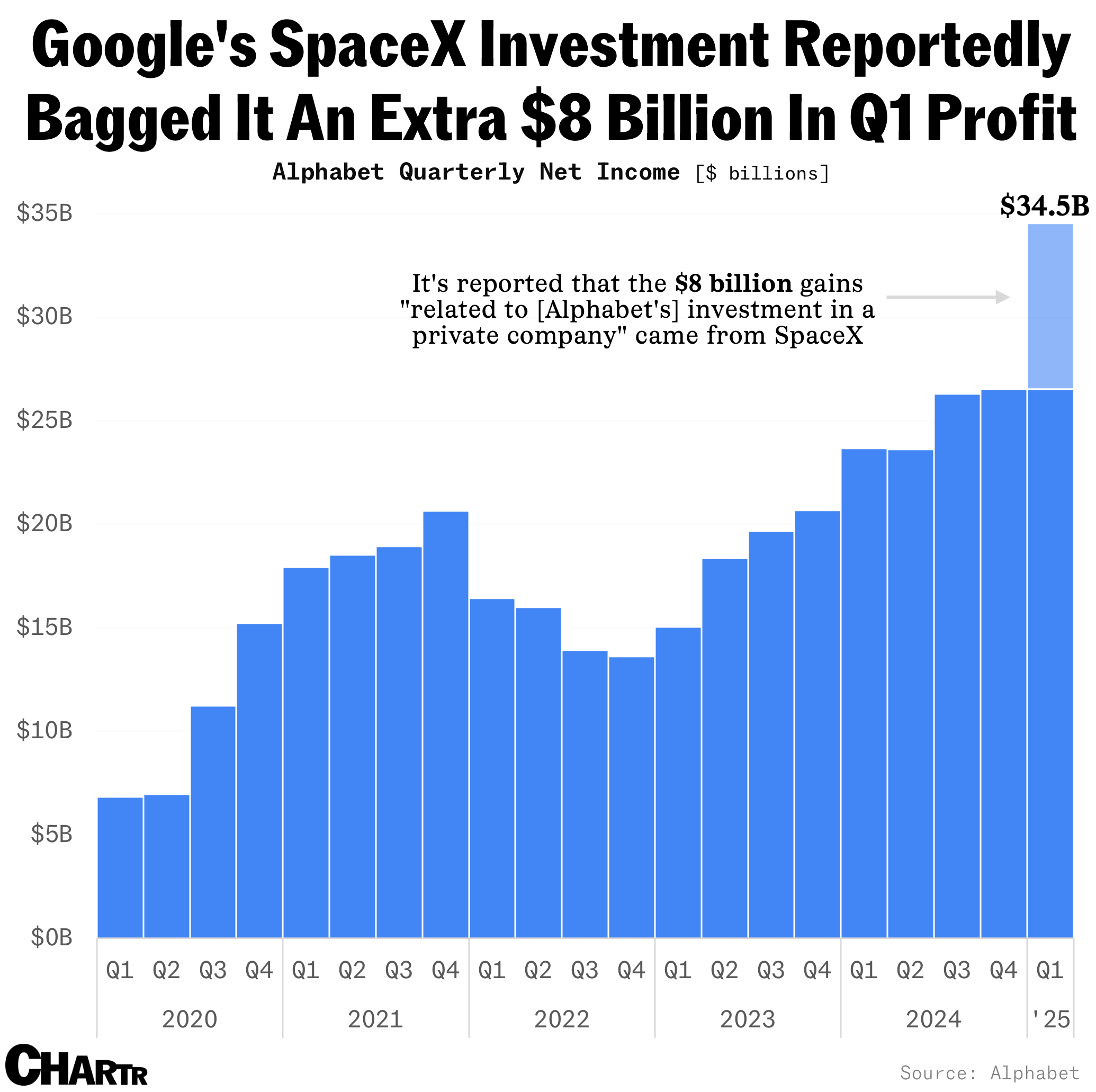
Nearly 25% of Google’s Q1 net income reportedly came from its SpaceX investment

Unrealized gains from an investment in an unnamed private company gave Alphabet an $8 billion boost.

Tom Jones

Last night and into this morning, Alphabet investors have been cheering yesterday’s big earnings beat after the tech giant posted revenue and earnings-per-share figures that surpassed Wall Street expectations for the first quarter of the year. 

While there were a handful of big numbers in the Google parent company’s earnings for shareholders to get stoked about, like Google Cloud revenue jumping 28% year over year to hit $12.3 billion, or YouTube ad revenue climbing 10% in the same period, one figure fell a little by the wayside in the excitement. From the report

Net Gain on Equity Securities

OI&E of $11.2 billion for the three months ended March 31, 2025 included an $8.0 billion unrealized gain on our non-marketable equity securities related to our investment in a private company.”

The mysterious, unnamed private company that added an extra $8 billion to the search behemoth’s bottom line in Q1? Elon Musk’s SpaceX, per Bloomberg reporting

Alphabet net income SpaceX boost
Sherwood News

We have liftoff

In December, it was reported that the valuation of Musk’s private rocket company had soared by almost $100 billion in just one month, reaching $350 billion after its latest round of employee share purchases. That was good news for Musk, certainly, whose stake in SpaceX outweighed his Tesla shares on paper in February, but also for other big investors in the 23-year-old business, not least Google.

In early 2015 — months before cofounder Larry Page had even announced the formation of Alphabet as Google’s parent company — the business made a joint $1 billion investment in SpaceX alongside Fidelity, giving the two a combined ~10% stake in Musk’s company, which was “exploring new ways to connect people to the internet” at the time. Those ambitions would be realized down the line with Starlink’s growing fleet, while Google’s 2015 investment in the rocket business is clearly still paying off a decade later.

More Business

See all Business
Family Watching Baseball On Tv

Netflix and Disney+ probably only added ad-tier subscribers this year, says Morgan Stanley

As streaming prices climb, ad-free subscribers are becoming a rarity.

Aldi Grand Opening

Discount stores are having a moment in America, drawing high- and low-income consumers alike

Everyone loves a deal in 2025 — and Aldi, Walmart, and Dollar Tree are all cashing in.

Millie Giles12/17/25
business

Report: OpenAI won’t pay a dime in cash for its 3-year licensing deal for Disney IP

More financial details behind the landmark deal that will grant OpenAI three years of access to Disney intellectual property are coming out, and they’re pretty surprising.

The deal will reportedly see OpenAI pay zero dollars in licensing fees, instead compensating Disney in stock warrants. It was previously reported that Disney would invest $1 billion into OpenAI as part of the agreement.

It’s very abnormal for Disney to grant anyone access to its massive IP library without a cash payment, and the entertainment juggernaut has been known to strike down even crocheted Etsy Yodas for infringing on its turf. In its fiscal year 2025, Disney booked more than $10 billion in revenue from licensing fees across merchandising, television, and theatrical distribution.

It’s very abnormal for Disney to grant anyone access to its massive IP library without a cash payment, and the entertainment juggernaut has been known to strike down even crocheted Etsy Yodas for infringing on its turf. In its fiscal year 2025, Disney booked more than $10 billion in revenue from licensing fees across merchandising, television, and theatrical distribution.

business

Ford says it will take $19.5 billion in charges in a massive EV write-down

The EV business has marked a long stretch of losing for Ford, and today the automaker announced it will take $19.5 billion in charges tied, for the most part, to its EV division.

Ford said it’s launching a battery energy storage business, leveraging battery plants in Kentucky and Michigan to “provide solutions for energy infrastructure and growing data center demand.”

According to Ford, the changes will drive Ford’s electrified division to profitability by 2029. The company will stop making its electric F-150, the Lightning, and instead shift to an “extended-range electric vehicle” that includes a gas-powered generator.

The Detroit automaker also raised its adjusted earnings before interest and taxes outlook to “about $7 billion” from a range of $6 billion to $6.5 billion.

Ford’s write-down is one of the largest taken by a company as legacy automakers scale back on EVs, giving EV-only automakers a market share boost.

Latest Stories

Sherwood Media, LLC produces fresh and unique perspectives on topical financial news and is a fully owned subsidiary of Robinhood Markets, Inc., and any views expressed here do not necessarily reflect the views of any other Robinhood affiliate, including Robinhood Markets, Inc., Robinhood Financial LLC, Robinhood Securities, LLC, Robinhood Crypto, LLC, or Robinhood Money, LLC.