
Business
Senate Hearing Examines Competitive Impact Of Proposed Netflix-Warner Brothers Transaction
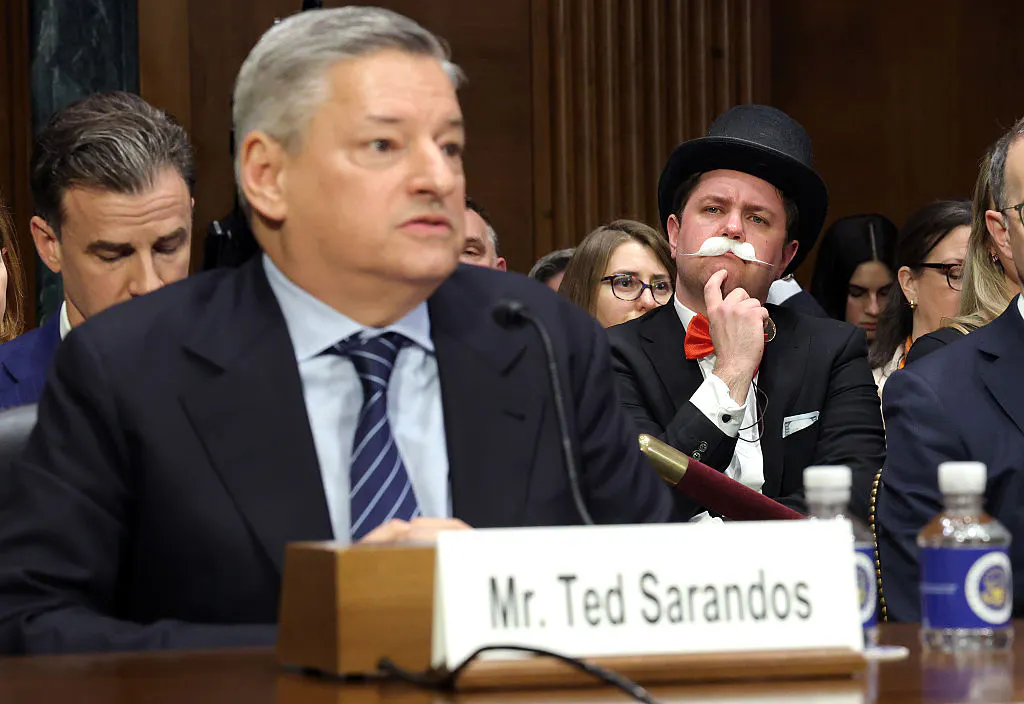
Netflix co-CEO Ted Sarandos testifies as Mr. Monopoly looks on. (Photo by Kevin Dietsch/Getty Images)

Netflix’s Sarandos: Big Tech is trying to “run away with the television business”

Netflix co-CEO Ted Sarandos addressed regulatory and industry fears around its merger plans.

Netflix co-CEO Ted Sarandos testified before the Senate antitrust subcommittee in a packed hearing room on Tuesday, reflecting the intense public and regulatory interest in the company’s efforts to acquire Warner Bros. Discovery for $83 billion.

Sarandos and Warner Bros. Discovery’s chief revenue officer, Bruce Campbell, took questions from subcommittee members around the merits of their deal. Paramount CEO David Ellison reportedly turned down an invitation to appear.

“This is not an either-or situation. With either merger, another corporation will gain significant control over what we see, what we hear, and what we consume,” Democratic Senator Cory Booker said in his opening statement.

Sarandos, in his opening statement, remarked that 80% of Netflix subscribers also subscribe to HBO Max.

“This is not a typical media merger where you end up with what’s called the Noah’s Ark problem: two of everything,” Sarandos said.

In questioning, Sarandos pointed a finger at deep-pocketed tech companies including Google, Amazon, and Apple, which he said are trying to “run away with the television business.” These companies, Sarandos said, have changed what TV is, and Netflix needs to grow in order to compete with them.

Broadly, the two executives attempted to allay fears that the proposed merger would result in entertainment industry job cuts, fewer US productions, fewer buyers of original content, and higher subscription prices for consumers.

WBD’s Campbell told Senator Adam Schiff that the proposed merger would not result in layoffs. In response to Senator Josh Hawley, Sarandos said that the combined company would increase US production in the next two years.

The executives testified that writers and content creators could sell their projects to either Netflix or HBO, rather than the entities being combined into one buyer. In recent years, media consolidation has resulted in fewer buyers of original scripts across the entertainment industry, Hollywood insiders say.

Sarandos also recommitted to a 45-day exclusive theatrical release window for Warner Bros. films, though certain windows could shift based on box office performance.

Republican senators repeatedly questioned Netflix’s “political agenda” and “woke programming,” reflecting broad conjecture that Netflix’s acquisition could run into issues beyond typical antitrust grounds with the Trump administration.

“I think the president, from my experience, has been nothing but interested in protecting and creating American jobs,” Sarandos said, following Senator Booker’s questions about President Trump’s potential involvement in the merger review.

“The larger problem that we have is that corporate power is growing in the United States of America in a staggering way, creating disparities of wealth that were unconscionable, even unimaginable just a generation ago,” Senator Booker said. “I do not trust this administration in their evaluations.”

Following Tuesday’s hearing, event contracts around the deal were largely unchanged as of 4:40 p.m. ET.

(Event contracts are offered through Robinhood Derivatives, LLC — probabilities referenced or sourced from KalshiEx LLC or ForecastEx LLC.)

More Business

See all Business
business

China’s EV startup trio have all become profitable

China’s EV startup trio, Nio, Li Auto, and XPeng, are now all profitable, following the latter’s Q4 results released Friday.

XPeng reported a quarterly net profit of about $55 million, compared to rival Nio’s Q4 net profit (also its first) of about $40 million. Li Auto posted Q4 net profit of less than $1 million.

All three companies being profitable offers a stark contrast to the EV market in the US, where Rivian quietly delayed its 2027 profitability target in a filing about its Uber robotaxi partnership yesterday. Lucid is likely further away, and last month cut 12% of its US workforce as part of its “path toward profitability.”

Still, it’s not all rosy for China’s EV startups, either. XPeng ADRs were down more than 6% in Friday morning trading as its Q1 sales forecast came in below estimates. As China rolls back subsidies, auto sales are slumping. Chinese retail EV and hybrid sales fell 32% in February from the same month last year.

9.3%

As the war with Iran produces the biggest spike in US gas prices since Hurricane Katrina, car retailer CarMax is continuing to see heightened interest in EVs, hybrids, and plug-in hybrids.

“From Feb 1st - March 1st (inclusive), compared to March 2nd to March 15th (inclusive), we saw a 9.3% lift in page views for these vehicles,” a spokesperson for the company told Sherwood News.

As industry insiders recently told us, EV interest climbs when gas prices rise. That appears to be holding true even without EV tax credits, which the Trump administration ended under its new budget package.

CarMax also saw EV searches spike in 2022, amid Russia’s invasion of Ukraine and the resulting oil price spike.

Walt Disney Chairman And CEO Bob Iger Rings Opening Bell At NY Stock Exchange

It’s the end of Disney’s Iger era (again)

Incoming CEO Josh D’Amaro is replacing Bob Iger on Wednesday, though Iger will remain a senior adviser through the end of the year.

$35.4B

The tariffs imposed by the Trump administration have cost automakers at least $35.4 billion since the start of 2025, according to a new analysis by Automotive News.

That total will continue to climb this year, since the Supreme Court’s February tariff ruling largely leaves the 25% levy on vehicles and auto parts untouched.

Toyota has taken the biggest hit, projecting more than $9 billion in tariff costs in its fiscal year ending this month, while Detroit’s big three automakers — Ford, GM, and Stellantis — were hit with a combined $6.5 billion tariff charge in 2025.

In the fourth quarter, automakers sold about 8% fewer imported vehicles in the US compared to the same period a year ago, per the Automotive News Research & Data Center.

Tariff charges come at a rough time for legacy carmakers, which are also scaling back EV plans following the Trump administration’s elimination of tax credits and fuel standard goals. According to Automotive News, the cost of EV write-downs and restructuring is, so far, nearly $70 billion.

Latest Stories

Sherwood Media, LLC produces fresh and unique perspectives on topical financial news and is a fully owned subsidiary of Robinhood Markets, Inc., and any views expressed here do not necessarily reflect the views of any other Robinhood affiliate, including Robinhood Markets, Inc., Robinhood Financial LLC, Robinhood Securities, LLC, Robinhood Crypto, LLC, Robinhood Derivatives, LLC, or Robinhood Money, LLC. Futures and event contracts are offered through Robinhood Derivatives, LLC.