
Power
Netflix WBD CEOs
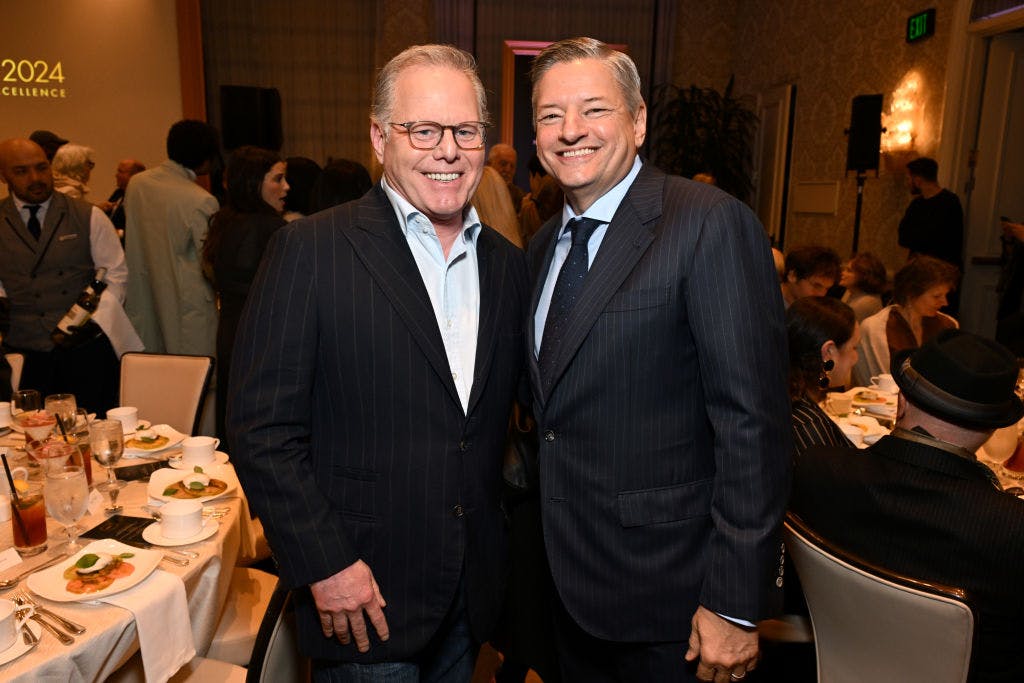
Warner Bros. CEO David Zaslav with Netflix CEO Ted Sarandos (Michael Kovac/Getty Images)

The Netflix-Warner Bros. deal now faces a wall of opposition

Netflix will owe Warner Bros. $5.8 billion in cash if the deal is terminated on antitrust grounds.

An $83 billion deal that would see the world’s No. 1 and No. 4 streamers combine has been announced, with Netflix edging out rivals Paramount Skydance and Comcast in the bidding war for Warner Bros. Discovery.

Now there’s just the matter of getting the thing approved.

Netflix appears to have convinced WBD of its ability to pass antitrust scrutiny through a combination of arguments: the deal would lower consumer costs through new bundles, there wouldn’t be a significant market share boost since most people subscribe to Netflix and HBO Max already, and nobody can hold a monopoly on “content” in the internet age anyway.

Those arguments will now face a wall of scrutiny as opponents to the merger pile on to argue against its legality to a Trump administration that reportedly already views it with “heavy skepticism.” Among the critics:

Paramount Skydance

A lot can change in a week. The newly merged Paramount Skydance appeared the runaway victor of the bidding war as recently as last month before ultimately losing out to Netflix. In hindsight, the company’s letter to the Warner Bros. board on Thursday reads like an early draft of its email to the Trump administration.

Paramount questioned the “fairness and adequacy” of the bidding process, writing:

“It has become increasingly clear, through media reporting and otherwise, that WBD appears to have abandoned the semblance and reality of a fair transaction process, thereby abdicating its duties to stockholders, and embarked on a myopic process with a predetermined outcome that favors a single bidder.”

Theater owners

Cinema United, the world’s largest movie theater trade group, representing more than 30,000 screens across the US, came out in opposition to the merger on Friday, highlighting the “unprecedented threat” the combination poses for the already embattled film industry.

The trade group warns that 25% of the US box office could be eliminated if Netflix opts to send films typically marked for wide theatrical release straight to its streaming platform. Cinema United wrote:

“The proposed acquisition of Warner Bros. by Netflix poses an unprecedented threat to the global exhibition business. The negative impact of this acquisition will impact theatres from the biggest circuits to one-screen independents in small towns in the United States and around the world. ...

Netflix’s stated business model does not support theatrical exhibition. In fact, it is the opposite. Regulators must look closely at the specifics of this proposed transaction and understand the negative impact it will have on consumers, exhibition and the entertainment industry.”

In its press release, Netflix said that it plans to “maintain Warner Bros.’ current operations,” which includes “theatrical releases for films” — so films in development will appear on the big screens through 2029.

Nevertheless, the likes of AMC and Cinemark are getting shelled on Friday.

The WGA

With union members already facing a severely contracted labor market, entertainment unions are unlikely to support any effort to further constrict the number of buyers in the industry.

Prior to Netflix’s emergence as the winner of the WBD bidding war, the Writers Guild of America — the union representing film and television writers — wrote that any major consolidation between entertainment giants would be a “disaster.” In an October statement, the union said:

“Merger after merger in the media industry has harmed workers, diminished competition and free speech, and wasted hundreds of billions of dollars better invested in organic growth. ... Combining Warner Bros. with Paramount or another major studio or streamer would be a disaster for writers, for consumers, and for competition. The WGAW will work with regulators to block the merger.”

Film producers

An anonymous collective of “concerned feature film producers” reportedly sent an unsigned letter to members of Congress on Thursday, arguing that the merger would allow Netflix to “effectively hold a noose around the theatrical marketplace.”

According to Variety reporting, Netflix’s proposal could have WBD films in theaters for as little as two weeks before dropping on the combined streaming services, though another insider denied the report.

The letter is said to have included a 2023 earnings call quote from Netflix CEO Ted Sarandos in which the exec said, “Driving folks to a theater is just not our business.”

Congress

Members of Congress on both sides of the political spectrum have already expressed heavy skepticism about the megamerger.

Republican Senator Mike Lee said the deal raises more competition questions than any transaction in a decade.

Democratic Senator Elizabeth Warren referred to it as an “anti-monopoly nightmare.”

Republican Congressman Darrell Issa, who represents California’s 48th district, also penned a letter critical of the proposed tie-up addressed to Attorney General Pam Bondi and Gail Slater, head of the Department of Justice’s antitrust division, urging them to “continue to protect a critical American industry.”

According to antitrust expert and Cornell law school professor George Hay, this deal presents an unusual regulation scenario — one in which regulators may have more tools to effectively break up a deal on antitrust grounds.

“Often the DOJ is shooting blind,” Hay told Sherwood News’ Rani Molla. “They have help this time from parties who know the numbers, know where bodies are buried. You have very interested parties like Paramount delighted to tell the DOJ everything they know.”

Whether Netflix will be able to successfully overcome all of these arguments is anyone’s guess. If the deal is squashed in court, though, the streamer will owe Warner Bros. a $5.8 billion breakup fee.

More Power

See all Power
power
Jake Lahut

Lori Chavez-DeRemer out at Department of Labor

Lori Chavez-DeRemer resigned as President Donald Trump's labor secretary on Monday, sources familiar with the matter told NOTUS.

Her tenure at the department was mired in scandal, including her husband being barred from headquarters after women employees reported he had touched them inappropriately. Chavez-DeRemer and a top aide reportedly texted women on staff to "pay attention" to the secretary's husband and her father around the office, according to the New York Times.

The department's inspector general had been investigating those messages and personal requests made of staff members.

power
Jon Keegan

Report: Anthropic’s Amodei headed to White House to settle dispute

In February, President Trump called Anthropic “A RADICAL LEFT, WOKE COMPANY,” and said of the company’s Claude AI technology: “We don’t need it, we don’t want it, and will not do business with them again!”

Now, less than two months later, Anthropic CEO Dario Amodei is scheduled to meet with White House Chief of Staff Susie Wiles today, according to a report from Axios.

After being declared a supply chain risk to national security by the Pentagon, and then suing the government to block the action, Anthropic finds itself in a powerful position: it has announced that its new Mythos AI model is capable of planning and executing offensive cyberattacks, and therefore would be shared only with a close group of trusted partners for testing before wider release, leading the US Treasury to try to get its hands on the new model.

The White House meeting is expected to result in some sort of deal that settles the dispute with the company, per the report.

After being declared a supply chain risk to national security by the Pentagon, and then suing the government to block the action, Anthropic finds itself in a powerful position: it has announced that its new Mythos AI model is capable of planning and executing offensive cyberattacks, and therefore would be shared only with a close group of trusted partners for testing before wider release, leading the US Treasury to try to get its hands on the new model.

The White House meeting is expected to result in some sort of deal that settles the dispute with the company, per the report.

power
Jon Keegan

Maine is the first to pass a statewide ban on large data centers

The tide is turning against big AI data centers.

In addition to many cities and towns that have passed outright bans on data centers, lawmakers in at least 11 states have introduced legislation to pause their construction, citing the need to carefully study power and water usage of the facilities.

But Maine just became the first state to successfully pass a ban on large data centers. If Maine Governor Janet Mills signs the bill into law, new data centers that draw more than 20 gigawatts of power would be banned until late 2027, and the state would set up a mechanism to study the impact of data center energy usage.

Last month, a federal bill was introduced to block new data centers until AI regulation has been passed. The issue has been getting more attention in this election year, as voters in data center hubs like Virginia have soured on the facilities.

Look at the crumbling support among Virginians (America's first data center hot spot) for data centers:

But Maine just became the first state to successfully pass a ban on large data centers. If Maine Governor Janet Mills signs the bill into law, new data centers that draw more than 20 gigawatts of power would be banned until late 2027, and the state would set up a mechanism to study the impact of data center energy usage.

Last month, a federal bill was introduced to block new data centers until AI regulation has been passed. The issue has been getting more attention in this election year, as voters in data center hubs like Virginia have soured on the facilities.

Look at the crumbling support among Virginians (America's first data center hot spot) for data centers:

power
Jon Keegan

Trump pulls tech execs even closer, adding Zuckerberg, Huang, Ellison, and others to tech council

President Trump has had a close relationship with America’s biggest tech leaders. They have flown across the world for investment announcements, attended intimate dinners at the White House, donned tuxedos and white ties for royal banquets, and have been known to bring golden gifts to him in the Oval Office.

Today he brings them in even closer. The White House announced that Nvidia CEO Jensen Huang, Meta CEO Mark Zuckerberg, and close pal and Oracle cofounder Larry Ellison will join a new President’s Council of Advisors on Science and Technology, along with 10 other tech leaders including Dell founder Michael Dell and Google cofounder Sergey Brin.

According to the White House, the group will “focus on topics related to the opportunities and challenges that emerging technologies present to the American workforce, and ensuring all Americans thrive in the Golden Age of Innovation.”

The full list of appointees:

Today he brings them in even closer. The White House announced that Nvidia CEO Jensen Huang, Meta CEO Mark Zuckerberg, and close pal and Oracle cofounder Larry Ellison will join a new President’s Council of Advisors on Science and Technology, along with 10 other tech leaders including Dell founder Michael Dell and Google cofounder Sergey Brin.

According to the White House, the group will “focus on topics related to the opportunities and challenges that emerging technologies present to the American workforce, and ensuring all Americans thrive in the Golden Age of Innovation.”

The full list of appointees:

power
Saleah Blancaflor

Prediction markets show a tight (and tightening) Illinois Democratic Senate primary

It’s primary election time in Illinois, and as voters in the state head to the polls on March 17, there are a few races to watch closely across both parties.

While polls show that Darren Bailey is leading in the Republican race for governor, the primary election for a rare seat in the Democratic Senate to replace Sen. Dick Durbin is proving to be a tight one.

Loading...
 

At the top of the 10-candidate race are Raja Krishnamoorthi, Lt. Gov. Juliana Stratton, and Robin Kelly. Krishnamoorthi, a lawmaker from Chicago’s 8th Congressional District, was an early front-runner, received funding and support from several Congress members for the seat. Kelly, who represented the South Side’s 2nd Congressional District, has support from the Congressional Black Caucus and South Carolina Rep. Jim Clyburn. Meanwhile, Stratton has been endorsed by Gov. JB Pritzker, whose administration she used to work for, as well as Sen. Elizabeth Warren.

While polls suggested that Krishnamoorthi was favored to win, Stratton has seen a boost and late surge, though Krishnamoorthi still remains close behind. Capitol News Illinois reports that Illinois Future PAC, funded by Pritzker, has spent more than $10 million on ads elevating Stratton. Meanwhile, two PACs affiliated with the crypto industry have attempted to attack Stratton and promote Kelly. Indian American Impact, which endorsed Krishnamoorthi, reportedly employed similar tactics against Stratton.

Political insiders tell Capitol News Illinois the race could go either way, but they still expect Krishnamoorthi to come out on top. Prediction markets currently show that Stratton narrowly leading Krishnamoorthi.

(Event contracts are offered through Robinhood Derivatives, LLC — probabilities referenced or sourced from KalshiEx LLC or ForecastEx LLC.)

Loading...
 

At the top of the 10-candidate race are Raja Krishnamoorthi, Lt. Gov. Juliana Stratton, and Robin Kelly. Krishnamoorthi, a lawmaker from Chicago’s 8th Congressional District, was an early front-runner, received funding and support from several Congress members for the seat. Kelly, who represented the South Side’s 2nd Congressional District, has support from the Congressional Black Caucus and South Carolina Rep. Jim Clyburn. Meanwhile, Stratton has been endorsed by Gov. JB Pritzker, whose administration she used to work for, as well as Sen. Elizabeth Warren.

While polls suggested that Krishnamoorthi was favored to win, Stratton has seen a boost and late surge, though Krishnamoorthi still remains close behind. Capitol News Illinois reports that Illinois Future PAC, funded by Pritzker, has spent more than $10 million on ads elevating Stratton. Meanwhile, two PACs affiliated with the crypto industry have attempted to attack Stratton and promote Kelly. Indian American Impact, which endorsed Krishnamoorthi, reportedly employed similar tactics against Stratton.

Political insiders tell Capitol News Illinois the race could go either way, but they still expect Krishnamoorthi to come out on top. Prediction markets currently show that Stratton narrowly leading Krishnamoorthi.

(Event contracts are offered through Robinhood Derivatives, LLC — probabilities referenced or sourced from KalshiEx LLC or ForecastEx LLC.)

Latest Stories

Sherwood Media, LLC produces fresh and unique perspectives on topical financial news and is a fully owned subsidiary of Robinhood Markets, Inc., and any views expressed here do not necessarily reflect the views of any other Robinhood affiliate, including Robinhood Markets, Inc., Robinhood Financial LLC, Robinhood Securities, LLC, Robinhood Crypto, LLC, Robinhood Derivatives, LLC, or Robinhood Money, LLC. Futures and event contracts are offered through Robinhood Derivatives, LLC.