
Business
The decline of print: Read all about it

The decline of print: Read all about it

The decline of print: read all about it

Can you remember the last time you strolled up to a newsstand and picked up your daily? It's probably been a while — or perhaps more likely... you’ve never done that in your entire life.

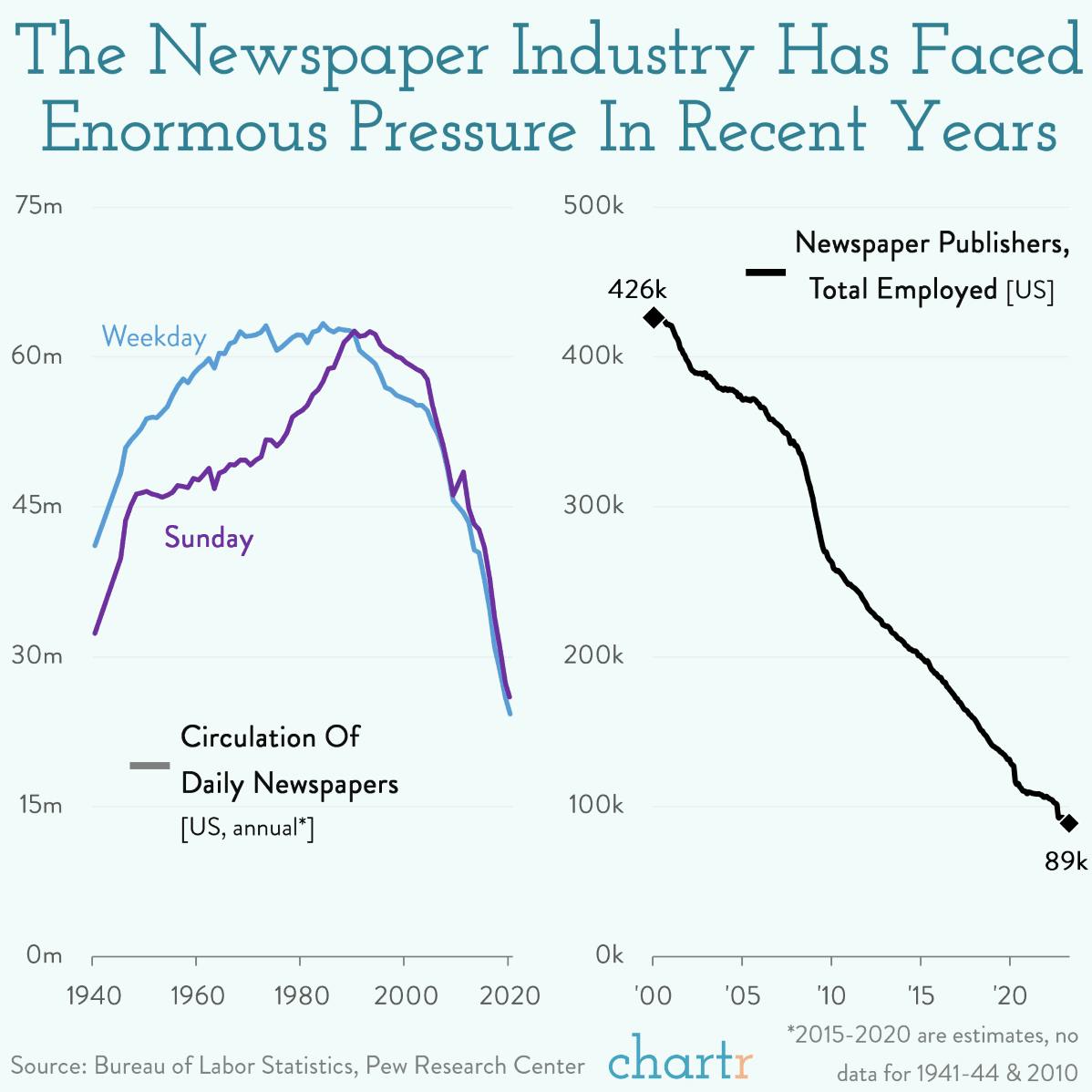
In the last 3 decades, the information diet of a typical citizen has changed dramatically. Physical newspaper circulation, both on weekdays and Sundays, has collapsed since the mid-1990s, as the friction of distributing information plummeted to nearly zero with the internet.

In its heyday, weekday editions would routinely reach more than 60 million readers, before beginning a slippery slope of decline in the early 1990s.

Interestingly, the Sunday papers — perhaps because they were filled with fewer "breaking stories", as this very Sunday edition itself is — staved off their eventual demise a little longer. Data compiled by Pew Research Center shows Sunday newspaper circulation holding on until almost the turn of the millennium, before plummeting in the early 2000s.

With declining circulation, job cuts were inevitable. In the last 20 years, thousands of journalists, editors and those involved in the physical production of millions of newspapers were laid off. America's newspaper industry shrunk from over 400,000 employed at the turn of the century to less than 90,000 as of April this year, as reported by the Bureau of Labor Statistics. Scores of newspapers have shut down, and the shrinkage is ongoing, with 360 local newspapers shutting down during the pandemic alone.

Even more nimble, digitally-native brands have struggled. Each burning brightly for a time, media companies like BuzzFeed, Vice, and Vox carved out a niche on the internet before the harsh reality caught up with them, with all 3 either closing divisions, laying off staff or going bankrupt entirely (Vice) this year.

But amidst this challenging landscape, the 170-year-old New York Times has survived, and even strangely thrived, retaining the title of largest daily print circulation, as reported by the Alliance for Audited Media.

More Business

See all Business
business

Netflix is down amid reports it’s leading the Warner Bros. bidding war as Paramount cries foul

Netflix’s charm offensive appears to be working.

Netflix is reportedly emerging as the leader in the bidding war for Warner Bros. Discovery after second-round bids this week, edging out entertainment juggernaut rivals Comcast and Paramount Skydance.

Investors don’t appear psyched by the streaming leader’s turn of fortune: the stock is down on Thursday morning, a day after closing down nearly 5% following reports that scooping up HBO Max wouldn’t necessarily result in a big market share boost.

Paramount, which has reportedly made five bids for Warner Bros. Discovery, doesn’t love the current state of play, either. The company sent WBD a letter questioning the “fairness and adequacy” of the process, highlighting reports that WBD’s board favors Netflix and is resisting Paramount.

Any offer would be subject to regulatory approval — a fact that may have weighed against Netflix’s offer given that cofounder Reed Hastings’ politics are vocally to the left, very much at odds with the current regulatory regime. Paramount seems confident in its ability to get approval, reportedly boosting its breakup fee to $5 billion should its potential acquisition fall apart in the regulatory process.

Investors don’t appear psyched by the streaming leader’s turn of fortune: the stock is down on Thursday morning, a day after closing down nearly 5% following reports that scooping up HBO Max wouldn’t necessarily result in a big market share boost.

Paramount, which has reportedly made five bids for Warner Bros. Discovery, doesn’t love the current state of play, either. The company sent WBD a letter questioning the “fairness and adequacy” of the process, highlighting reports that WBD’s board favors Netflix and is resisting Paramount.

Any offer would be subject to regulatory approval — a fact that may have weighed against Netflix’s offer given that cofounder Reed Hastings’ politics are vocally to the left, very much at odds with the current regulatory regime. Paramount seems confident in its ability to get approval, reportedly boosting its breakup fee to $5 billion should its potential acquisition fall apart in the regulatory process.

business

Delta says the government shutdown will cost it $200 million in Q4

The 43-day government shutdown that ended last month will result in a $200 million ding for Delta Air Lines, the airline said in a filing on Wednesday.

That’s about $100,000 per shutdown-related canceled flight. (Delta previously said it canceled more than 2,000 flights due to FAA flight reductions.) When the company reports its fourth-quarter earnings, the shutdown will lop off about $0.25 per share.

Delta initially stayed calm about the shutdown, with CEO Ed Bastian stating in early October that the company was running smoothly and hadn’t seen any impacts at all. One historically long shutdown later, Delta wasn’t able to remain untouched.

The skies have since cleared, though, and Delta’s filing states that booking growth has “returned to initial expectations following a temporary softening in November.”

Delta’s shares were up over 2% as of Wednesday’s market open.

Delta initially stayed calm about the shutdown, with CEO Ed Bastian stating in early October that the company was running smoothly and hadn’t seen any impacts at all. One historically long shutdown later, Delta wasn’t able to remain untouched.

The skies have since cleared, though, and Delta’s filing states that booking growth has “returned to initial expectations following a temporary softening in November.”

Delta’s shares were up over 2% as of Wednesday’s market open.

Latest Stories

Sherwood Media, LLC produces fresh and unique perspectives on topical financial news and is a fully owned subsidiary of Robinhood Markets, Inc., and any views expressed here do not necessarily reflect the views of any other Robinhood affiliate, including Robinhood Markets, Inc., Robinhood Financial LLC, Robinhood Securities, LLC, Robinhood Crypto, LLC, or Robinhood Money, LLC.
