Business
Male athletes running in big graphic space
(Getty Images)
sell your soles

On Running is widening its lead over rival shoe brand Hoka

On just reported sales up 38% on a constant currency basis, as the Swiss brand eyes Nike-level numbers.

Tom Jones, David Crowther

For those in the business of Reading Things Online, it felt like you couldn’t go more than a few weeks last summer without seeing a new piece on how upstart running shoe brands like On and Hoka had industry behemoths like Adidas, Nike, and New Balance quaking in their sneakers.

Media (and investor) hype for the two athletic shoe sellers might have subsided a little, but both brands continue to make huge strides forward as runners around the world add Clifton 10s and Cloudsurfers to their collections and workers adopt the comfort-first sneakers to return to the office in style.

Build phase

With strikingly similar origin stories — Hoka was founded in the French Alps by two athletes in 2009, while On Holding was launched by three a year later in Zurich, Switzerland — the brands’ tracks have barely diverged in the years since. In 2012, American footwear giant Deckers snapped up Hoka One One, as it was at the time, for a reported $1.1 million. On, meanwhile, signed Swiss tennis legend Roger Federer as a brand representative in 2019, giving him a 3% stake in the company, and went public two years later.
Hoka and On annual sales chart
Sherwood News

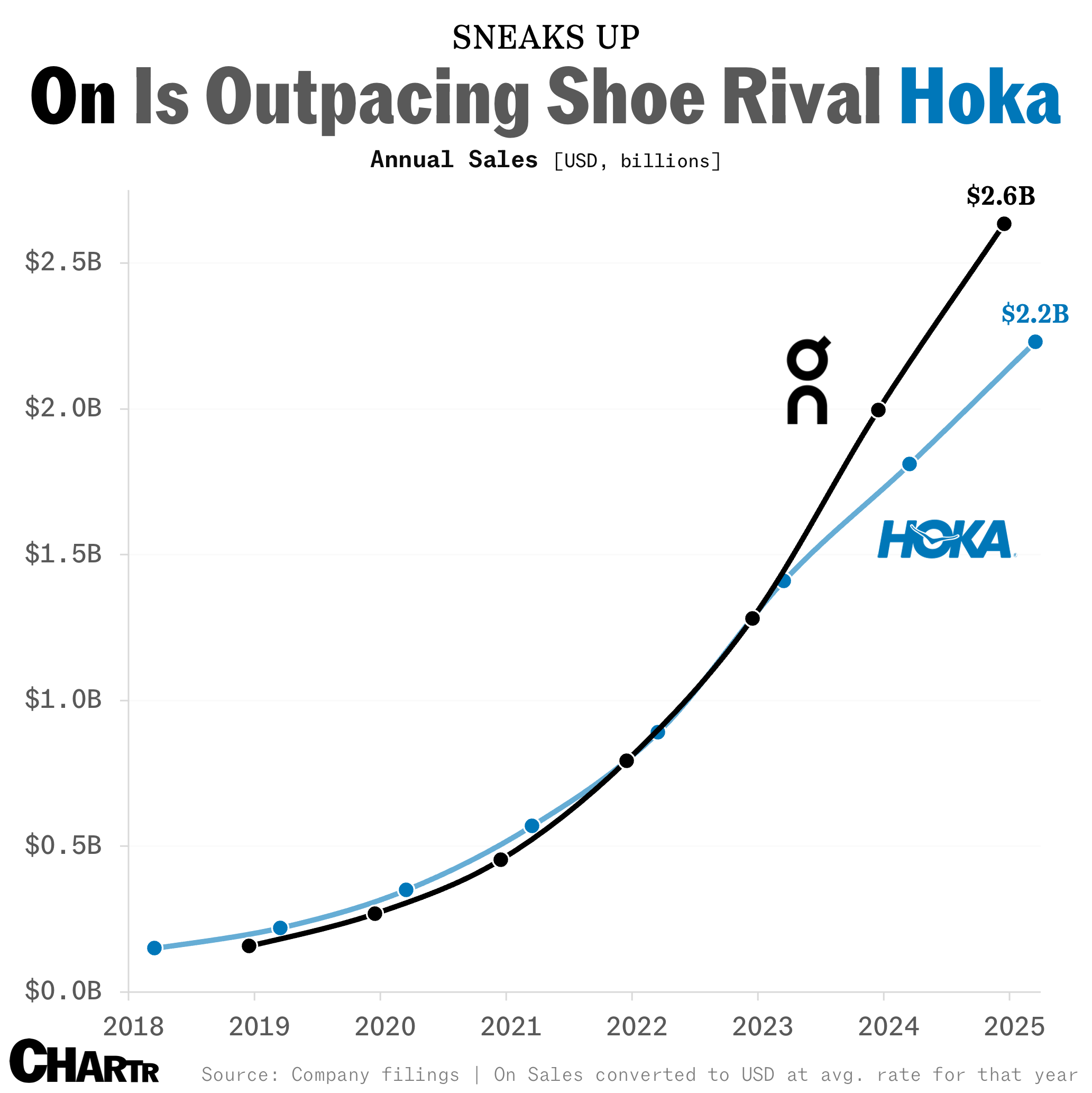
For most of the past six or so years, On and Hoka’s sales had broadly run neck and neck, with not much to split the two Europe-birthed brands. However, the former has really started to kick on in recent years, with the Swiss company reporting ~$2.6 billion in sales last year and announcing another impressive quarter yesterday, in which sales jumped 38% (currency adjusted).

The Hoka brand isn’t exactly a slouch, posting $2.2 billion in revenue for the last fiscal year, but investors’ expectations maybe got ahead of reality. Hoka notched just ~20% sales growth in its latest quarter, and Deckers’ stock has been crushed this year, dropping nearly 50%, as Hoka sales slow down in the all-important US market.

More Business

See all Business
business
Tom Jones

Demis Hassabis, Google DeepMind’s CEO and founder, was also an early Anthropic investor

A chess prodigy and an actual a knight of the realm in the UK, it’s perhaps no surprise that Demis Hassabis has made some strategic moves about his exposure to AI upside. According to people familiar with the matter, the influential AI architect became an angel investor in Anthropic, currently behind many of the leading AI models, per Arena AI leaderboards.

The Nobel Prize winner’s position in the Claude creator was previously undisclosed and, per the Financial Times, highlights Hassabis’ “growing influence across the AI industry.”

Google, which bought DeepMind, the company that Hassabis cofounded and heads to this day, for a reported ~$400 million in 2014, is also a key Anthropic investor. The tech giant reportedly plans to invest up to $40 billion in the AI company as part of the mutually beneficial relationship the pair have forged, with reports that Anthropic has committed to spending $200 billion in the other direction on Google’s cloud services over the next five years.

Im playing all sides, so I always come out on top

In addition to his financial support for Anthropic, Hassabis has also invested in a range of AI startups launched by colleagues, such as Inflection AI, a company set up by DeepMind cofounder Mustafa Suleyman (who is now CEO of Microsoft AI), as well as efforts from other collaborators, like David Silver’s Ineffable Intelligence.

Hassabis also emerged as a recurring figure on the fringes of the recent Elon Musk v. Sam Altman trial, cropping up repeatedly in testimonies and court documents and appearing to live, as The Verge put it, “rent-free” in Musk’s head.

Founded in 2021, Anthropic has recently raised funding at a reported $900 billion valuation, sending it soaring ahead of competitor OpenAI.

The Nobel Prize winner’s position in the Claude creator was previously undisclosed and, per the Financial Times, highlights Hassabis’ “growing influence across the AI industry.”

Google, which bought DeepMind, the company that Hassabis cofounded and heads to this day, for a reported ~$400 million in 2014, is also a key Anthropic investor. The tech giant reportedly plans to invest up to $40 billion in the AI company as part of the mutually beneficial relationship the pair have forged, with reports that Anthropic has committed to spending $200 billion in the other direction on Google’s cloud services over the next five years.

Im playing all sides, so I always come out on top

In addition to his financial support for Anthropic, Hassabis has also invested in a range of AI startups launched by colleagues, such as Inflection AI, a company set up by DeepMind cofounder Mustafa Suleyman (who is now CEO of Microsoft AI), as well as efforts from other collaborators, like David Silver’s Ineffable Intelligence.

Hassabis also emerged as a recurring figure on the fringes of the recent Elon Musk v. Sam Altman trial, cropping up repeatedly in testimonies and court documents and appearing to live, as The Verge put it, “rent-free” in Musk’s head.

Founded in 2021, Anthropic has recently raised funding at a reported $900 billion valuation, sending it soaring ahead of competitor OpenAI.

Latest Stories

Sherwood Media, LLC and Chartr Limited produce fresh and unique perspectives on topical financial news and are fully owned subsidiaries of Robinhood Markets, Inc., and any views expressed here do not necessarily reflect the views of any other Robinhood affiliate, including Robinhood Markets, Inc., Robinhood Financial LLC, Robinhood Securities, LLC, Robinhood Crypto, LLC, Robinhood Money, LLC, Robinhood U.K. Ltd, Robinhood Derivatives, LLC, Robinhood Gold, LLC, Robinhood Asset Management, LLC, Robinhood Credit, Inc., Robinhood Ventures DE, LLC and, where applicable, its managed investment vehicles.