
Business
USPS worker in a Santa hat operating a forklift
(Frederic J. Brown/Getty Images)

Parcels make up over 40% of USPS revenues, but account for just 6% of what the agency actually sends

The Postmaster General is stepping away as the (mostly) mail service tries to work out where it stands in 2025.

After being appointed by President Trump in 2020, at the height of the agency’s financial and logistical chaos, America’s 75th postmaster general, Louis DeJoy, declared his immediate resignation from the top role at the United States Postal Service on Monday.

The move follows DeJoy first announcing his retirement in February, when he asked the USPS Board of Governors to start searching for his successor. That same month, Trump contemplated privatizing the service

Package deal

DeJoy’s five-year tenure has been eventful. Besides overseeing two elections where mail-in voting took an unprecedented role, DeJoy rolled out a modernization plan in 2021 to reverse USPS’s losses — amounting to a cumulative ~$87 billion across the 14 years to August — in the hopes of saving the agency from insolvency.

However, since then, the plan has hit several obstacles, causing delays, backlogs, and mounting expenses. In FY24, revenues reached $79.5 billion, up 2% year over year, but net losses still clocked in at $9.5 billion, up 47% from 2023, as inflation weighed on operating costs.
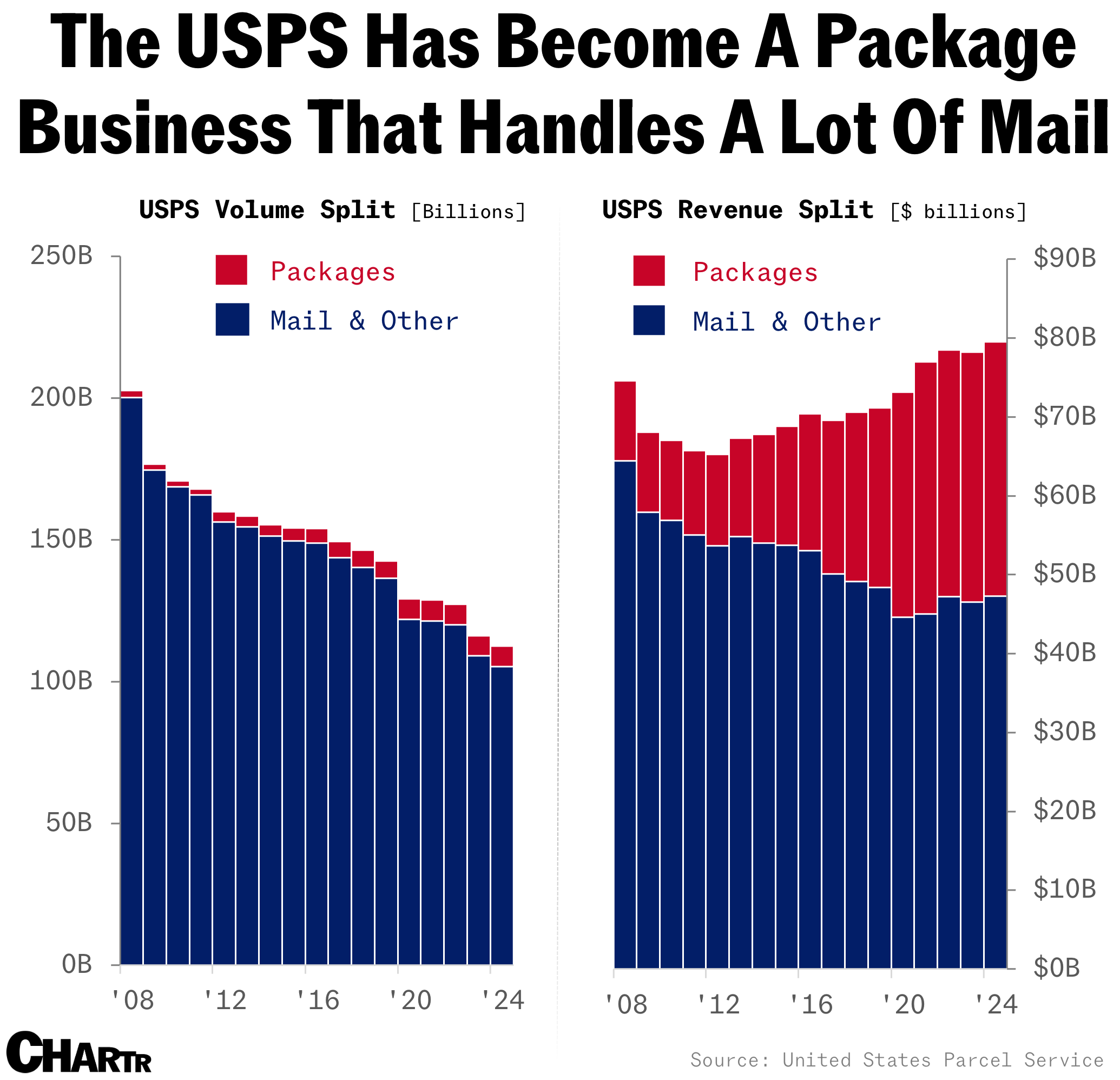
USPS volume and revenue splits chart
Sherwood News

As mail’s fallen out of favor — the volume of mail handled by the service has almost halved since 2008 — USPS has become more dependent on its lucrative package business. Indeed, packages accounted for over 40% of its revenue last year, despite making up only 6% of total volumes

Trying to gain ground in the package space by competing with big names like UPS, FedEx, and Amazon, the latter of which delivered over 9 billion parcels the same or next day alone last year, was always going to be tricky for USPS to deliver. Now, though, it’ll be someone else’s problem.

More Business

See all Business
business
Tom Jones

Demis Hassabis, Google DeepMind’s CEO and founder, was also an early Anthropic investor

A chess prodigy and an actual a knight of the realm in the UK, it’s perhaps no surprise that Demis Hassabis has made some strategic moves about his exposure to AI upside. According to people familiar with the matter, the influential AI architect became an angel investor in Anthropic, currently behind many of the leading AI models, per Arena AI leaderboards.

The Nobel Prize winner’s position in the Claude creator was previously undisclosed and, per the Financial Times, highlights Hassabis’ “growing influence across the AI industry.”

Google, which bought DeepMind, the company that Hassabis cofounded and heads to this day, for a reported ~$400 million in 2014, is also a key Anthropic investor. The tech giant reportedly plans to invest up to $40 billion in the AI company as part of the mutually beneficial relationship the pair have forged, with reports that Anthropic has committed to spending $200 billion in the other direction on Google’s cloud services over the next five years.

Im playing all sides, so I always come out on top

In addition to his financial support for Anthropic, Hassabis has also invested in a range of AI startups launched by colleagues, such as Inflection AI, a company set up by DeepMind cofounder Mustafa Suleyman (who is now CEO of Microsoft AI), as well as efforts from other collaborators, like David Silver’s Ineffable Intelligence.

Hassabis also emerged as a recurring figure on the fringes of the recent Elon Musk v. Sam Altman trial, cropping up repeatedly in testimonies and court documents and appearing to live, as The Verge put it, “rent-free” in Musk’s head.

Founded in 2021, Anthropic has recently raised funding at a reported $900 billion valuation, sending it soaring ahead of competitor OpenAI.

The Nobel Prize winner’s position in the Claude creator was previously undisclosed and, per the Financial Times, highlights Hassabis’ “growing influence across the AI industry.”

Google, which bought DeepMind, the company that Hassabis cofounded and heads to this day, for a reported ~$400 million in 2014, is also a key Anthropic investor. The tech giant reportedly plans to invest up to $40 billion in the AI company as part of the mutually beneficial relationship the pair have forged, with reports that Anthropic has committed to spending $200 billion in the other direction on Google’s cloud services over the next five years.

Im playing all sides, so I always come out on top

In addition to his financial support for Anthropic, Hassabis has also invested in a range of AI startups launched by colleagues, such as Inflection AI, a company set up by DeepMind cofounder Mustafa Suleyman (who is now CEO of Microsoft AI), as well as efforts from other collaborators, like David Silver’s Ineffable Intelligence.

Hassabis also emerged as a recurring figure on the fringes of the recent Elon Musk v. Sam Altman trial, cropping up repeatedly in testimonies and court documents and appearing to live, as The Verge put it, “rent-free” in Musk’s head.

Founded in 2021, Anthropic has recently raised funding at a reported $900 billion valuation, sending it soaring ahead of competitor OpenAI.

Latest Stories

Sherwood Media, LLC and Chartr Limited produce fresh and unique perspectives on topical financial news and are fully owned subsidiaries of Robinhood Markets, Inc., and any views expressed here do not necessarily reflect the views of any other Robinhood affiliate, including Robinhood Markets, Inc., Robinhood Financial LLC, Robinhood Securities, LLC, Robinhood Crypto, LLC, Robinhood Money, LLC, Robinhood U.K. Ltd, Robinhood Derivatives, LLC, Robinhood Gold, LLC, Robinhood Asset Management, LLC, Robinhood Credit, Inc., Robinhood Ventures DE, LLC and, where applicable, its managed investment vehicles.
