
Business
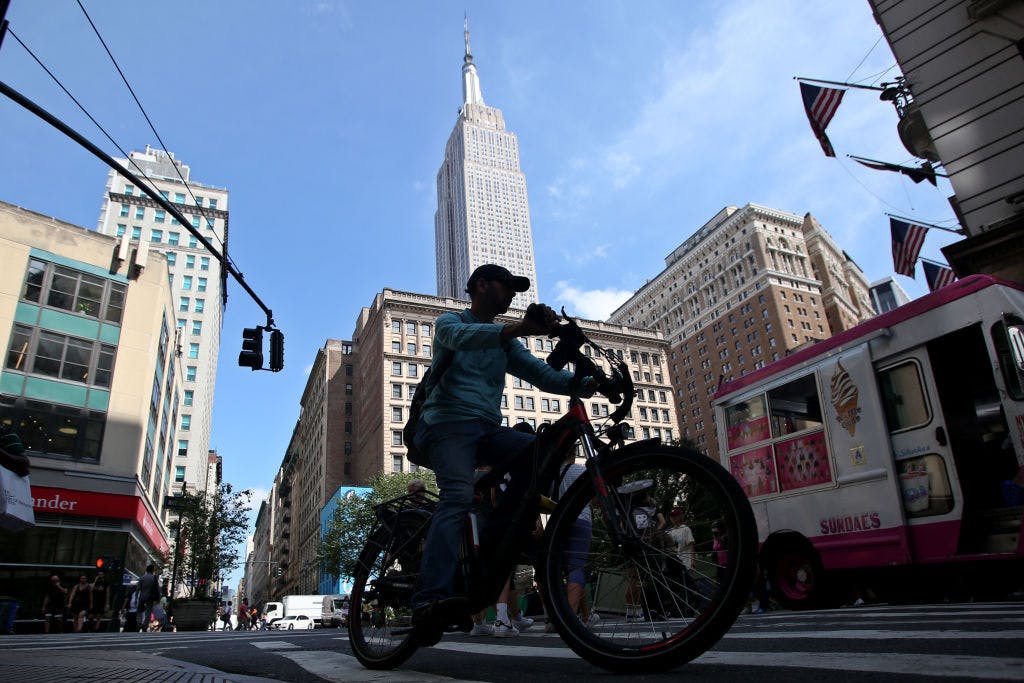
A delivery worker in New York City.
(Getty images)

Pay is way up and tipping is down after NYC's delivery wage hike. Takeout prices are flat.

Food-delivery workers took home $19.26 an hour, including tips, during the first quarter of 2024. That’s up from $11.72 a year earlier.

J. Edward Moreno

Requiring food delivery apps to pay their drivers a minimum wage doesn't dramatically change the cost of takeout, according to data released by New York City. 

New York raised the minimum wage for app-based food delivery workers last year. Uber, DoorDash and Grubhub launched a fierce legal battle challenging the switch, but a judge ruled in favor of the city, allowing it begin enforcing the law in December.

The initial phase-in rate was $18.96 an hour, which was raised by 3.15% in April to adjust for inflation, and it now sits at $19.56.

According to the city’s data, a delivery driver made $19.26 an hour on average in the first quarter of this year including tips, up from $11.72 an hour during the same period last year.

That’s a 64% increase in hourly wages in one year. Workers relied significantly less on tips, with the vast majority of their wages now coming from the apps.

Delivery-app have long argued that paying their drivers (which they consider contractors) a set wage would require them to pass costs onto consumers and merchants.

The apps did in fact start charging higher fees. On average, consumers spent 46% more on fees compared to a year ago. But they tipped 68% less, bringing the total average cost of a delivery order up only 2%, or 76 cents.

The apps also charged merchants 13% more in fees since last year, the city found.

New York may serve as a test study for other cities or states exploring minimum wages for app-based workers. Seattle started enforcing its own this year as well.

Ravi Inukonda, DoorDash's chief financial officer, told analysts in May that the company "did absorb a meaningful amount of cost" in the first quarter of this year due minimum wage laws in New York and Seattle. DoorDash has never been consistently profitable.

"We did pass on some fees to consumers," he said. "I do expect that every market that we operate in over time will have sustainable unit economics."

More Business

See all Business
The entrance of Allbirds seen from Hayes St. in San Francisco, Calif.

Allbirds, the once buzzy multibillion-dollar sneaker startup, is selling up for $39 million

That’s less than 1% of its peak market cap about four years ago.

Tom Jones3/31/26
business

JetBlue is raising its bag fees as fuel costs squeeze airlines

JetBlue will reportedly hike its bag fees, as the cost of jet fuel continues to climb amid the war in Iran. It’s the latest example of carriers finding ways to push rising costs onto travelers.

Last week, United Airlines CEO Scott Kirby said that if fuel prices remain elevated, fares would need to rise another 20% for his airline to break even this year.

As CNBC reported, when one airline raises fees, others tend to follow.

Earlier this month, JetBlue hiked its first-quarter outlook for operating revenue per seat mile to between 5% and 7%, saying that strong Q1 demand helped “partially offset additional expenses realized from operational disruptions and rising fuel costs.” Now, the carrier appears to be making moves to further boost revenue to offset those costs.

Earlier on Monday, JetBlue rival Alaska Air lowered its Q1 profit forecast. The refining margins for the carrier’s cheapest fuel option — sourced from Singapore and representing about 20% of Alaska’s overall supply — have spiked 400% since February.

JetBlue did not immediately respond to a request for comment.

As CNBC reported, when one airline raises fees, others tend to follow.

Earlier this month, JetBlue hiked its first-quarter outlook for operating revenue per seat mile to between 5% and 7%, saying that strong Q1 demand helped “partially offset additional expenses realized from operational disruptions and rising fuel costs.” Now, the carrier appears to be making moves to further boost revenue to offset those costs.

Earlier on Monday, JetBlue rival Alaska Air lowered its Q1 profit forecast. The refining margins for the carrier’s cheapest fuel option — sourced from Singapore and representing about 20% of Alaska’s overall supply — have spiked 400% since February.

JetBlue did not immediately respond to a request for comment.

Latest Stories

Sherwood Media, LLC produces fresh and unique perspectives on topical financial news and is a fully owned subsidiary of Robinhood Markets, Inc., and any views expressed here do not necessarily reflect the views of any other Robinhood affiliate, including Robinhood Markets, Inc., Robinhood Financial LLC, Robinhood Securities, LLC, Robinhood Crypto, LLC, Robinhood Derivatives, LLC, or Robinhood Money, LLC. Futures and event contracts are offered through Robinhood Derivatives, LLC.
