
Business
Break the cycle: Peloton is pedaling uphill

Break the cycle: Peloton is pedaling uphill

Uphill struggle

If you’ve ever wanted to buy a Peloton bike, but never wanted to part ways with the ~$2,000 required to get one, you might be able to justify the expense to yourself knowing that the company likely won’t be making any money from your equipment purchase.

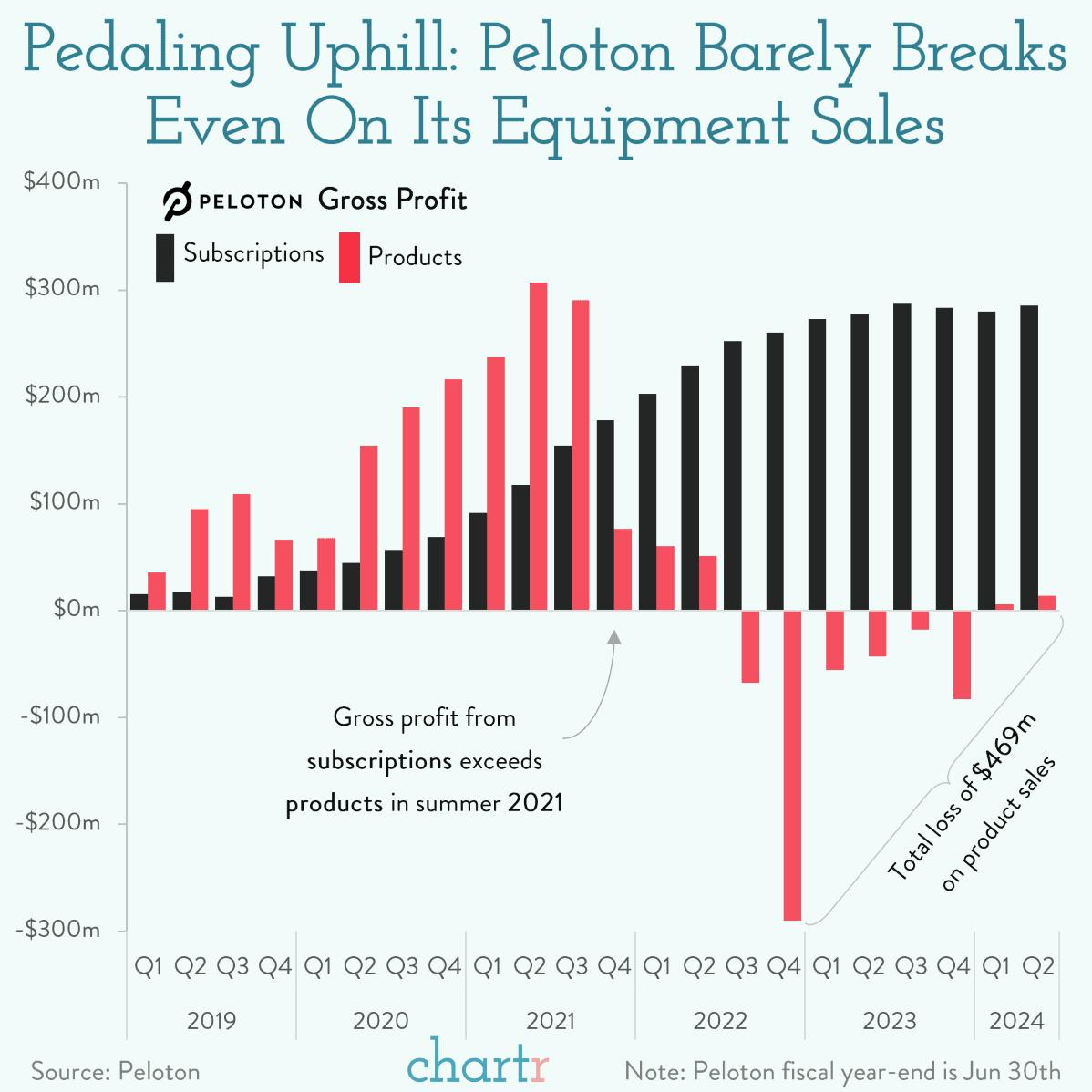
Indeed, yesterday Peloton reported another strained set of earnings, slashing its outlook for the coming year and sending its shares down 25%: an all-time low for the company once hailed as the pandemic’s fitness savior. The high-end bike and treadmill maker reported that, in its latest quarter, it made just a sliver of gross profit ($13.8m) on actual product sales — that’s profit only derived from the sale of the item itself. Once sales and marketing expenses, general & administrative expenses, research and development costs, or any other “overheads” were accounted for, Peloton remained deeply in the red.

Shifting gears

Current CEO Barry McCarthy took the reins in February 2022, when gyms were fully reopened and product issues were shaking Peloton. Cutting prices helped stem the losses, but it left the subscription business as Peloton’s financial backbone, relying on the famously energetic live online classes to pedal the company forward. However, despite deals with Lululemon and TikTok — as well as new distribution channels through third-party retailers like Dick’s Sporting Goods and Amazon — Peloton just hasn’t been able to grow subscriptions meaningfully in recent months.

On paper, the business model isn’t inherently flawed: Costco, for example, has a wildly successful subscription-based service, selling a wide array of products for close to cost but profiting enormously on the membership needed to shop there.

More Business

See all Business
The entrance of Allbirds seen from Hayes St. in San Francisco, Calif.

Allbirds, the once buzzy multibillion-dollar sneaker startup, is selling up for $39 million

That’s less than 1% of its peak market cap about four years ago.

Tom Jones3/31/26
business

JetBlue is raising its bag fees as fuel costs squeeze airlines

JetBlue will reportedly hike its bag fees, as the cost of jet fuel continues to climb amid the war in Iran. It’s the latest example of carriers finding ways to push rising costs onto travelers.

Last week, United Airlines CEO Scott Kirby said that if fuel prices remain elevated, fares would need to rise another 20% for his airline to break even this year.

As CNBC reported, when one airline raises fees, others tend to follow.

Earlier this month, JetBlue hiked its first-quarter outlook for operating revenue per seat mile to between 5% and 7%, saying that strong Q1 demand helped “partially offset additional expenses realized from operational disruptions and rising fuel costs.” Now, the carrier appears to be making moves to further boost revenue to offset those costs.

Earlier on Monday, JetBlue rival Alaska Air lowered its Q1 profit forecast. The refining margins for the carrier’s cheapest fuel option — sourced from Singapore and representing about 20% of Alaska’s overall supply — have spiked 400% since February.

JetBlue did not immediately respond to a request for comment.

As CNBC reported, when one airline raises fees, others tend to follow.

Earlier this month, JetBlue hiked its first-quarter outlook for operating revenue per seat mile to between 5% and 7%, saying that strong Q1 demand helped “partially offset additional expenses realized from operational disruptions and rising fuel costs.” Now, the carrier appears to be making moves to further boost revenue to offset those costs.

Earlier on Monday, JetBlue rival Alaska Air lowered its Q1 profit forecast. The refining margins for the carrier’s cheapest fuel option — sourced from Singapore and representing about 20% of Alaska’s overall supply — have spiked 400% since February.

JetBlue did not immediately respond to a request for comment.

Latest Stories

Sherwood Media, LLC produces fresh and unique perspectives on topical financial news and is a fully owned subsidiary of Robinhood Markets, Inc., and any views expressed here do not necessarily reflect the views of any other Robinhood affiliate, including Robinhood Markets, Inc., Robinhood Financial LLC, Robinhood Securities, LLC, Robinhood Crypto, LLC, Robinhood Derivatives, LLC, or Robinhood Money, LLC. Futures and event contracts are offered through Robinhood Derivatives, LLC.
