
Business
Democratic National Convention (DNC) 2024 - Day One
US Vice President Kamala Harris speaks during the 2024 Democratic National Convention in Chicago (Jacek Boczarski/Anadolu via Getty Images)
Election Coherence

Companies are talking about this election way more than they talked about 2016 or 2020

Politics is front-of-mind for the corporate leaders who say they’ll do well no matter who’s in the White House.

Rani Molla

The policies of the next president can always affect companies’ financial future, but this upcoming election seems to be more pressing than usual for leaders at S&P 500 companies.

The number of times “election” or “elections” were mentioned on Q2 earnings calls — measured from Jun 15-Aug 15 — this year was nearly double what it was during the last two presidential election years, according to data from FactSet.

Many of those companies this year cited energy and carbon emissions policies, which vary greatly between Kamala Harris and Donald Trump. A second Trump presidency would be more supportive of domestic oil drilling, at least rhetorically, while the price backdrop will play a bigger role in actual production. It would also include rolling back the Inflation Reduction Act, a policy Harris helped implement and incentivizes electric cars as well as green energy projects.

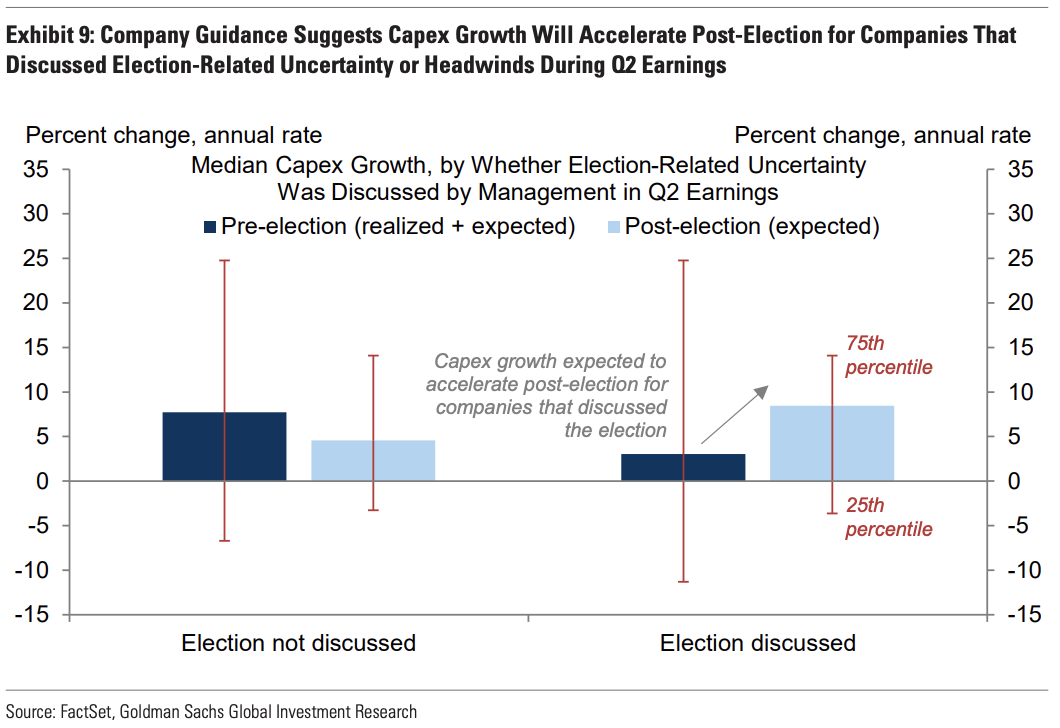
In fact, this uncertainty over the policy environment appears to be weighing on businesses’ investment spending.

“Some companies—mostly financials, government contractors, and those with exposure to the Inflation Reduction Act—noted this earnings season that either they or their customers are postponing some investment decisions until after the election,” writes Ronnie Walker, senior economist at Goldman Sachs, who flagged that capital expenditures have been lower among firms that have discussed the election. He expects that trend to reverse thereafter.
CapEx and election uncertainty
Goldman Sachs

Of course, many of those executives tried to make the case that they’re positioned to succeed, regardless of who wins.

“Ford has had a lot of history — a lot of experience and wisdom after 120 years of elections,” CEO James Farley told investors, saying that the car company wouldn’t alter its electric vehicle push over “short-term” compliance changes. “It is not a strategy where we handicap the presidential election for the next one and the next one and see what we can get away with the EPA. That is not how we run Ford.”

History suggests that collectively, they’re right. The stock market and earnings usually go up no matter who’s in the White House. But the very fact that companies are talking about this election so much this time around also suggests it might be a bigger deal than they’re letting on.

Updated with comments from Goldman Sachs analyst.

More Business

See all Business
Family Watching Baseball On Tv

Netflix and Disney+ probably only added ad-tier subscribers this year, says Morgan Stanley

As streaming prices climb, ad-free subscribers are becoming a rarity.

Aldi Grand Opening

Discount stores are having a moment in America, drawing high- and low-income consumers alike

Everyone loves a deal in 2025 — and Aldi, Walmart, and Dollar Tree are all cashing in.

Millie Giles12/17/25
business

Report: OpenAI won’t pay a dime in cash for its 3-year licensing deal for Disney IP

More financial details behind the landmark deal that will grant OpenAI three years of access to Disney intellectual property are coming out, and they’re pretty surprising.

The deal will reportedly see OpenAI pay zero dollars in licensing fees, instead compensating Disney in stock warrants. It was previously reported that Disney would invest $1 billion into OpenAI as part of the agreement.

It’s very abnormal for Disney to grant anyone access to its massive IP library without a cash payment, and the entertainment juggernaut has been known to strike down even crocheted Etsy Yodas for infringing on its turf. In its fiscal year 2025, Disney booked more than $10 billion in revenue from licensing fees across merchandising, television, and theatrical distribution.

It’s very abnormal for Disney to grant anyone access to its massive IP library without a cash payment, and the entertainment juggernaut has been known to strike down even crocheted Etsy Yodas for infringing on its turf. In its fiscal year 2025, Disney booked more than $10 billion in revenue from licensing fees across merchandising, television, and theatrical distribution.

business

Ford says it will take $19.5 billion in charges in a massive EV write-down

The EV business has marked a long stretch of losing for Ford, and today the automaker announced it will take $19.5 billion in charges tied, for the most part, to its EV division.

Ford said it’s launching a battery energy storage business, leveraging battery plants in Kentucky and Michigan to “provide solutions for energy infrastructure and growing data center demand.”

According to Ford, the changes will drive Ford’s electrified division to profitability by 2029. The company will stop making its electric F-150, the Lightning, and instead shift to an “extended-range electric vehicle” that includes a gas-powered generator.

The Detroit automaker also raised its adjusted earnings before interest and taxes outlook to “about $7 billion” from a range of $6 billion to $6.5 billion.

Ford’s write-down is one of the largest taken by a company as legacy automakers scale back on EVs, giving EV-only automakers a market share boost.

Latest Stories

Sherwood Media, LLC produces fresh and unique perspectives on topical financial news and is a fully owned subsidiary of Robinhood Markets, Inc., and any views expressed here do not necessarily reflect the views of any other Robinhood affiliate, including Robinhood Markets, Inc., Robinhood Financial LLC, Robinhood Securities, LLC, Robinhood Crypto, LLC, or Robinhood Money, LLC.