Business
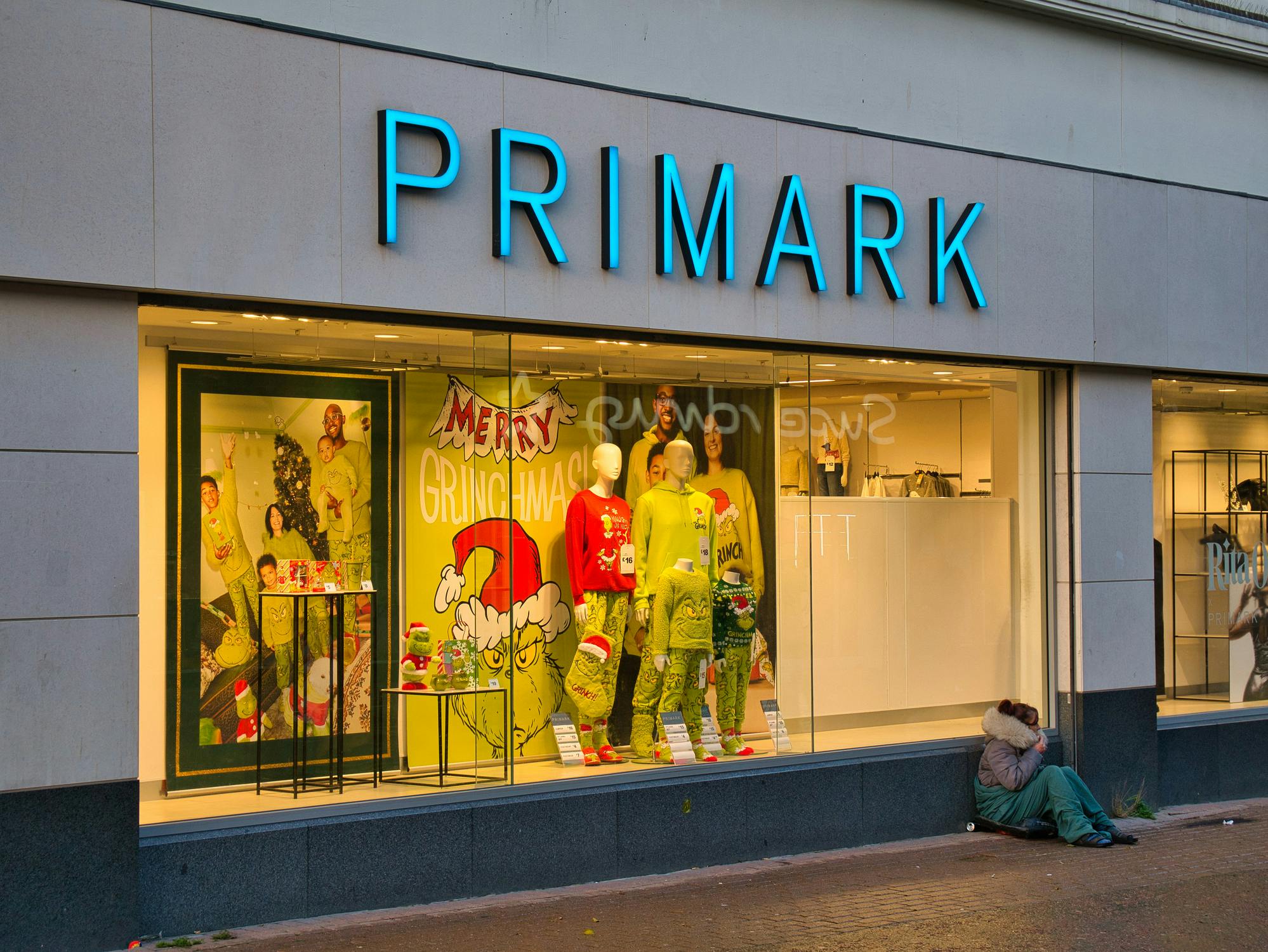
The frontage of a branch of discount clothing retailer Primark.
Getty Images

Primark owner AB Foods’ shares slump because of sugar and sentiment

As its sugar business fails, fast-fashion retailer Primark is hoping a stateside push can unlock more sweet growth.

Millie Giles

The owner of bargain fashion retailer Primark has had a rough week.

But for once, the value clothing chain — which has seen its fair share of controversy in recent years, from unethical labor practices and sustainability concerns to “errors of judgement” leading to its CEO resigning last month — wasn’t the primary source of parent company Associated British Foods’ pain.

Sweet, sours

AB Foods shares slumped more than 9% on Tuesday after reporting interim results for the first half of 2025. The group warned that its sugar business — yes, Primark’s parent company is deep in the sugar game... and the bread game... and the enzyme game... and the animal feed game — will struggle to get back to profitability anytime soon, and that its commercial viability is being undermined.

Indeed, AB Foods now expects to report a loss of up to £40 million in its sugar segment for FY25, owing to restrictions put on its sugar-derived biofuel business, Vivergo, as well as declining market conditions for comestible sugar in Europe. But while the sweet sector weighed heavily on the company’s outlook, the forecast for its retail division (which is just Primark), wasn’t too bright either.

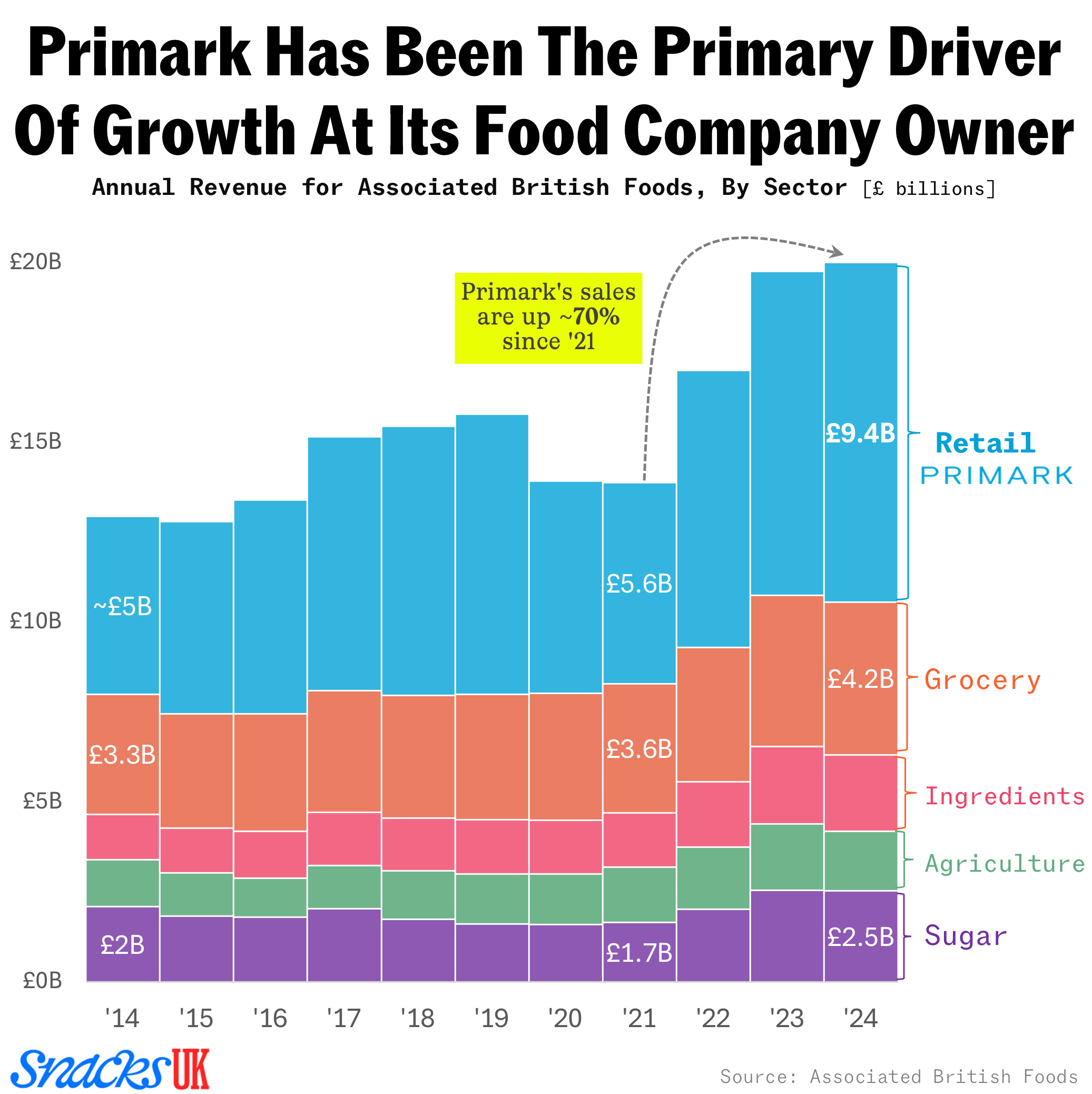
For the past decade, Primark has been the primary growth driver for AB Foods. Retail revenues at the company increased by 57% in the five years to 2019 (as sugar contracted by 40%) before the budget Irish retailer had a particularly strong postpandemic rebound. Since 2021, Primark’s sales have boomed almost 70% to a whopping £9.4 billion last year.
Primark chart
Sherwood News

However, the latest interim results showed that the company’s meal ticket posted a 4% decline in comparable sales in the UK and Ireland in the 24 weeks to March 1.

The company pointed to weakening consumer confidence, job cuts, and a “lack of seasonal purchasing” due to “mild weather” (companies love blaming the weather for their woes, but rarely credit it for their wins) as reasons why Primark has lost market share in the UK.

To get growth back on track, the group is betting on its stateside push. Though tariffs affecting its clothes production have complicated its supply chain somewhat, Primark is planning to expand its 29 US stores to 60 by the end of 2026, in the hopes that the brand’s low-priced offerings will attract de minimis-affected customers away from Shein and Temu.

Besides its international expansion, Primark still mentioned some “early signs of improvement” in the brand’s UK sales as the weather begins to warm up again — which often means Brits panic-buying cheap shorts, flip flops, and swimwear at a moment’s notice.


More Business

See all Business
business

OpenAI’s ARR reached over $20 billion in 2025, CFO says

Sam Altman’s $500 billion artificial intelligence behemoth hit a major financial milestone last year, according to a new blog post over the weekend from OpenAI CFO Sarah Friar, as the company confirmed it had hit a more than $20 billion annual revenue run rate at the end of 2025.

Elsewhere in the blog post, Friar spent time addressing the company’s shifting goals, referencing plans to “close the distance between where intelligence is advancing and how individuals, companies, and countries actually adopt and use it.” As has become customary in the AI company press release genre, the CFO was also keen to tout the unending growth of the business, writing:

  • Both our Weekly Active User (WAU) and Daily Active User (DAU) figures continue to produce all-time highs. This growth is driven by a flywheel across compute, frontier research, products, and monetization.

  • Compute grew 3X year over year or 9.5X from 2023 to 2025: 0.2 GW in 2023, 0.6 GW in 2024, and ~1.9 GW in 2025.

And, perhaps most importantly for current backers and those keeping an eye on the private company before its rumored mega IPO:

  • Revenue followed the same curve growing 3X year over year, or 10X from 2023 to 2025: $2B ARR in 2023, $6B in 2024, and $20B+ in 2025. This is never-before-seen growth at such scale.

That latest figure has certainly set tongues in the tech world wagging, just as the company announced it would begin rolling out ads to free and ChatGPT Go users. It also puts the chatbot giant a fair way ahead of competitors like Anthropic, the company behind Claude.

OpenAI Anthropic ARR race
Sherwood News

Elsewhere in the blog post, Friar spent time addressing the company’s shifting goals, referencing plans to “close the distance between where intelligence is advancing and how individuals, companies, and countries actually adopt and use it.” As has become customary in the AI company press release genre, the CFO was also keen to tout the unending growth of the business, writing:

  • Both our Weekly Active User (WAU) and Daily Active User (DAU) figures continue to produce all-time highs. This growth is driven by a flywheel across compute, frontier research, products, and monetization.

  • Compute grew 3X year over year or 9.5X from 2023 to 2025: 0.2 GW in 2023, 0.6 GW in 2024, and ~1.9 GW in 2025.

And, perhaps most importantly for current backers and those keeping an eye on the private company before its rumored mega IPO:

  • Revenue followed the same curve growing 3X year over year, or 10X from 2023 to 2025: $2B ARR in 2023, $6B in 2024, and $20B+ in 2025. This is never-before-seen growth at such scale.

That latest figure has certainly set tongues in the tech world wagging, just as the company announced it would begin rolling out ads to free and ChatGPT Go users. It also puts the chatbot giant a fair way ahead of competitors like Anthropic, the company behind Claude.

OpenAI Anthropic ARR race
Sherwood News
The Sphere In Las Vegas

Washington, DC, looks set to get America’s second Sphere

Revenue for the Las Vegas version of the big orb has soared, but the Sphere is still a money pit.

business

Ford reportedly in talks to buy hybrid vehicle batteries from Chinese auto giant BYD

Detroit’s Ford and China’s BYD are said to be in ongoing talks to partner on an agreement that would see Ford buy hybrid vehicle batteries from BYD, according to reporting from The Wall Street Journal.

The report comes just days after President Trump toured a Ford factory in Michigan and implied openness to Chinese automakers coming to the US.

“If they want to come in and build a plant... that’s great, I love that,” Trump said on January 13. “Let China come in, let Japan come in.”

Last week, China’s Geely Automobile Holdings said it expects to make an announcement about expanding into the US within the next three years. Chinese carmakers currently face huge tariffs and software restrictions, effectively barring their vehicles from the US.

Ford has doubled down on hybrid vehicles amid high EV costs and the end of federal EV tax credits. The automaker is currently building a battery plant in Michigan where it plans to use tech from Chinese battery maker CATL.

“If they want to come in and build a plant... that’s great, I love that,” Trump said on January 13. “Let China come in, let Japan come in.”

Last week, China’s Geely Automobile Holdings said it expects to make an announcement about expanding into the US within the next three years. Chinese carmakers currently face huge tariffs and software restrictions, effectively barring their vehicles from the US.

Ford has doubled down on hybrid vehicles amid high EV costs and the end of federal EV tax credits. The automaker is currently building a battery plant in Michigan where it plans to use tech from Chinese battery maker CATL.

Still life of Ozempic and Wegovy with weight scale.

Lawsuit alleges Lilly, Novo locked up telehealth to kill compounded GLP-1s

Novo Nordisk CEO Mike Doustdar estimated that around 1.5 million US patients are using compounded versions of the company’s drugs.

Latest Stories

Sherwood Media, LLC produces fresh and unique perspectives on topical financial news and is a fully owned subsidiary of Robinhood Markets, Inc., and any views expressed here do not necessarily reflect the views of any other Robinhood affiliate, including Robinhood Markets, Inc., Robinhood Financial LLC, Robinhood Securities, LLC, Robinhood Crypto, LLC, or Robinhood Money, LLC.