
Business
Six Flags

Six Flags and Cedar Fair have merged

The deal creates a theme park behemoth, which is seeking to improve its core economics as it manages more than $4 billion in net debt

Rollercoaster tycoon

This week, the merger of theme park operators Six Flags and Cedar Fair was completed, creating a new giant in the industry, with annual revenues north of $3 billion, that spans 27 amusement parks and 15 water parks. Calling itself the “Six Flags Entertainment Corporation”, the combined entity, which is trading under Cedar Fair's ticker, FUN, will likely see close to 50 million people roll through its regional parks this year (last year would have seen 48 million).

Even at its combined scale, FUN won’t threaten the dominance of Disney or Universal, which continue to dominate the top spots for attendance. But, by joining forces, the company will be looking for that which consultants and investment bankers often promise in such deals: the rewards of greater scale. 

In this case that’s important because the new company is set to be saddled with more than $4 billion of net debt. So, despite all the corporate jargon of offering “a more engaging and immersive guest experience”, a primary focus of the merger will be managing that debt load… which means getting more out of each guest.
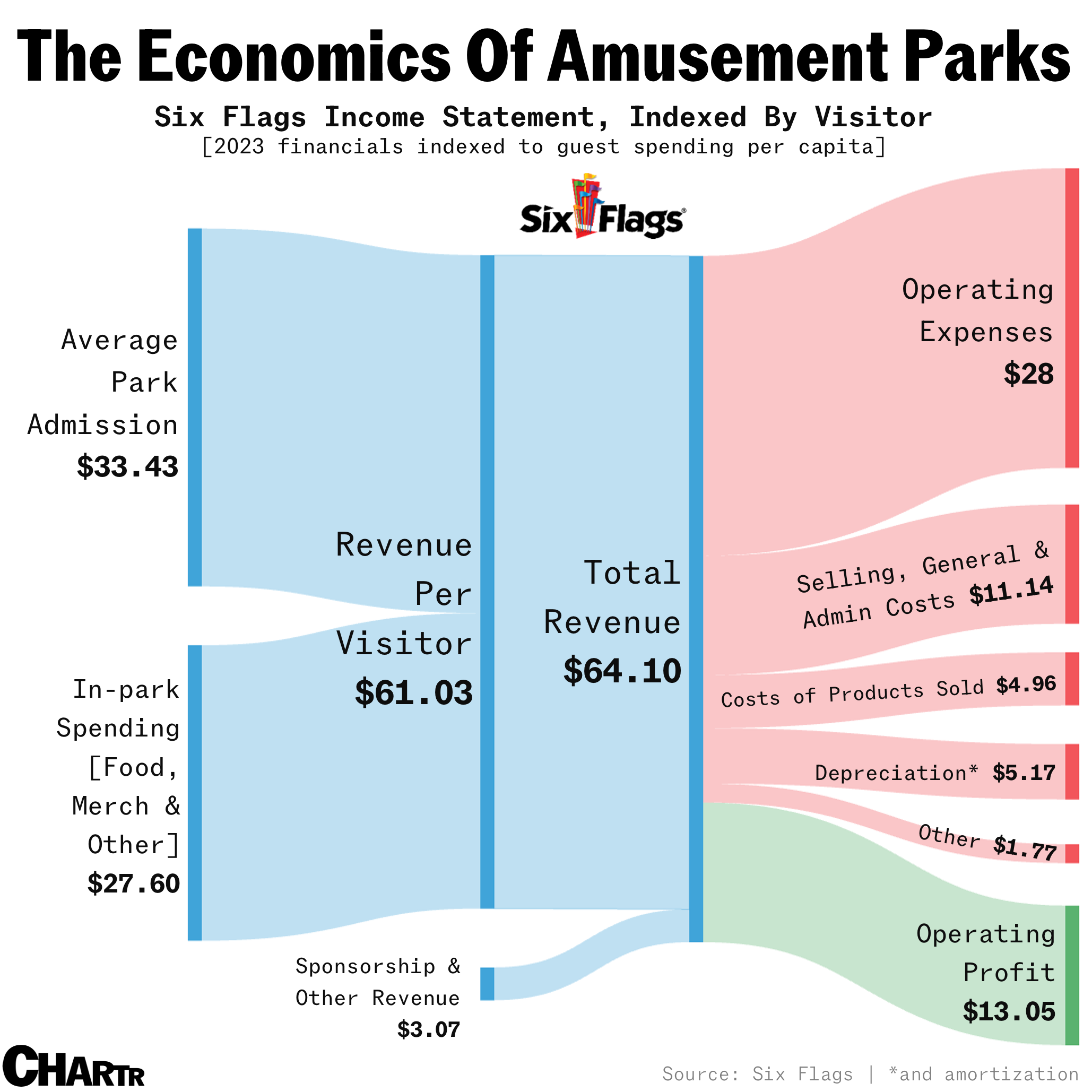
Six Flags

In 2023, Six Flags (the standalone company) filings revealed that an average guest was worth about ~$61 in revenue to the park, ~$33 from admission and another ~$28 for theme park necessities like nachos, dirty fries, funnel cakes, merchandise, and extras like fast-passes. Six Flags also generated an extra ~$3 per guest through sponsorships and international agreements, helping take its operating profit margins to about 20%, or ~$13 in our example.

After the merger, however, the company believes it can make more. Indeed, an investor presentation reveals that FUN is hoping to realize significant synergies — every consultant's favorite word — from the deal. Some $120M a year is expected to be saved in costs, and an additional $80M of incremental profits (EBITDA) due to an “improved guest experience” are expected to be realized within 3 years of the deal’s close.

More Business

See all Business
The entrance of Allbirds seen from Hayes St. in San Francisco, Calif.

Allbirds, the once buzzy multibillion-dollar sneaker startup, is selling up for $39 million

That’s less than 1% of its peak market cap about four years ago.

Tom Jones3/31/26
business

JetBlue is raising its bag fees as fuel costs squeeze airlines

JetBlue will reportedly hike its bag fees, as the cost of jet fuel continues to climb amid the war in Iran. It’s the latest example of carriers finding ways to push rising costs onto travelers.

Last week, United Airlines CEO Scott Kirby said that if fuel prices remain elevated, fares would need to rise another 20% for his airline to break even this year.

As CNBC reported, when one airline raises fees, others tend to follow.

Earlier this month, JetBlue hiked its first-quarter outlook for operating revenue per seat mile to between 5% and 7%, saying that strong Q1 demand helped “partially offset additional expenses realized from operational disruptions and rising fuel costs.” Now, the carrier appears to be making moves to further boost revenue to offset those costs.

Earlier on Monday, JetBlue rival Alaska Air lowered its Q1 profit forecast. The refining margins for the carrier’s cheapest fuel option — sourced from Singapore and representing about 20% of Alaska’s overall supply — have spiked 400% since February.

JetBlue did not immediately respond to a request for comment.

As CNBC reported, when one airline raises fees, others tend to follow.

Earlier this month, JetBlue hiked its first-quarter outlook for operating revenue per seat mile to between 5% and 7%, saying that strong Q1 demand helped “partially offset additional expenses realized from operational disruptions and rising fuel costs.” Now, the carrier appears to be making moves to further boost revenue to offset those costs.

Earlier on Monday, JetBlue rival Alaska Air lowered its Q1 profit forecast. The refining margins for the carrier’s cheapest fuel option — sourced from Singapore and representing about 20% of Alaska’s overall supply — have spiked 400% since February.

JetBlue did not immediately respond to a request for comment.

Latest Stories

Sherwood Media, LLC produces fresh and unique perspectives on topical financial news and is a fully owned subsidiary of Robinhood Markets, Inc., and any views expressed here do not necessarily reflect the views of any other Robinhood affiliate, including Robinhood Markets, Inc., Robinhood Financial LLC, Robinhood Securities, LLC, Robinhood Crypto, LLC, Robinhood Derivatives, LLC, or Robinhood Money, LLC. Futures and event contracts are offered through Robinhood Derivatives, LLC.
