
Business
Bowling Alley
(Getty Images)

The economics of bowling kingpin Lucky Strike are pretty solid

Food and drinks make up 37% of Lucky Strike’s revenue. Premium options like birria and bao buns could bolster it even further.

Lucky Strike Entertainment, which is the world’s largest operator of bowling alleys and changed its name from Bowlero in December, wants you to know that there’s a lot more to the business than people paying to knock down pins. Judging by its latest quarterly report, it’s got a point: the company’s basically a fast-casual restaurant, too.

Bowling for... buns?

According to the company’s CFO, Bobby Lavan, who spoke to The Wall Street Journal, its focus on premium gastronomy offerings (think bao buns and beef birria tacos) means that food now brings in more money than alcohol at Lucky Strike.

When discussing how its winter rebrand repositions the company as “a versatile entertainment platform” in the December announcement, recent acquisitions like the Raging Waves waterpark and other family parks stole a lot of focus. However, there’s no denying that the simple task of keeping people fed and watered while they bowl has become a big contributor to the company’s top and bottom lines.
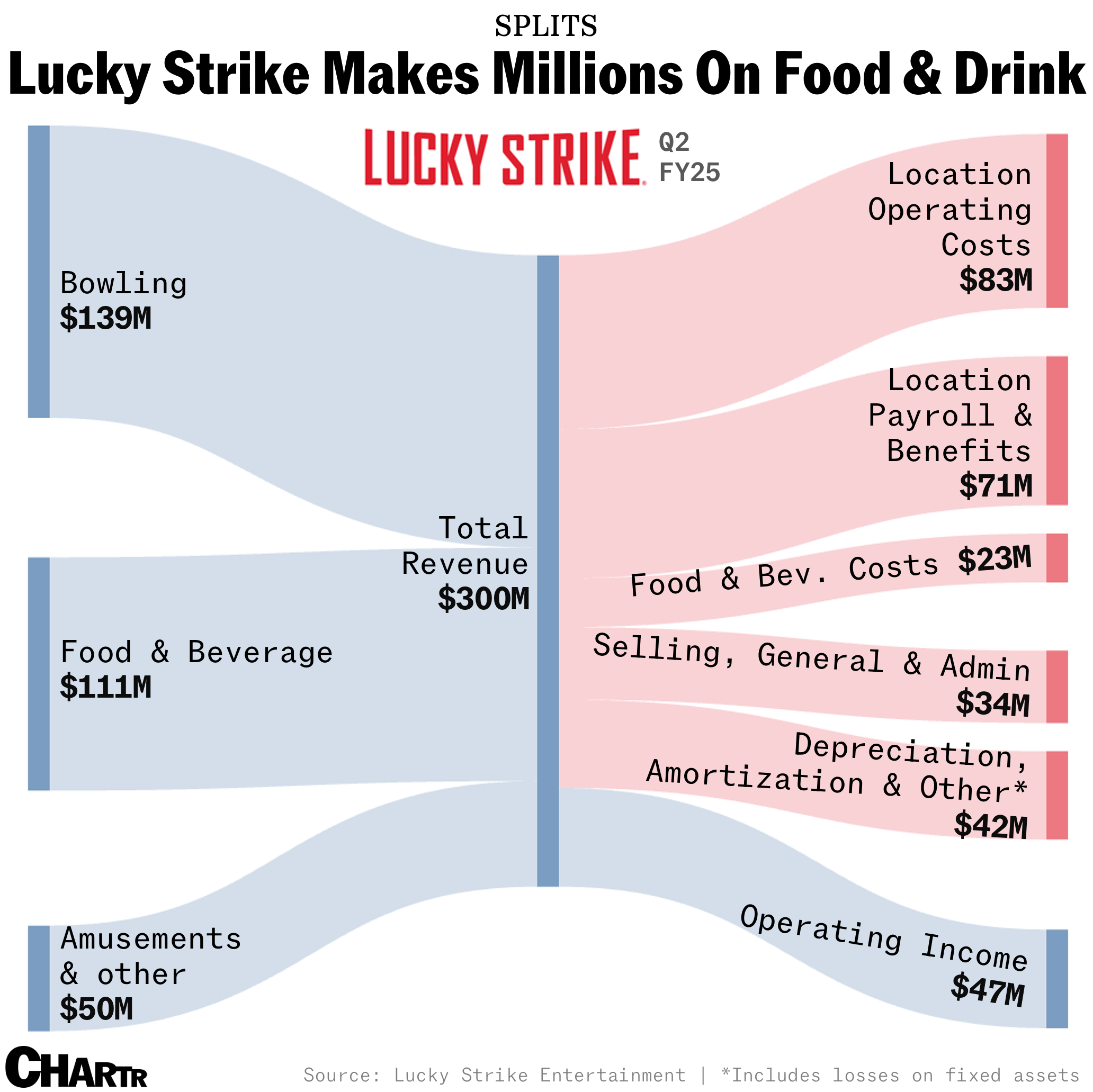
Lucky Strike revenue chart
Sherwood News

In the most recent quarter, Lucky Strike Entertainment took ~$111 million in food and beverage sales, as first dates downed mid-game cocktails and gaggles of work friends tucked into office party finger food like Buffalo wings and Bavarian pretzels. The markups — maybe predictably, if you’re not a huge fan of the lane-based fare — are also not to be sniffed at, with direct food and beverage costs coming in at just $23.2 million. Those are cinema-level margins.

Despite its burgeoning culinary prowess, the company’s revenue in Q2 of its 2025 fiscal year fell 1.8% overall, though shares are still up almost 10% so far this year.

More Business

See all Business
Capsule Pill and Dots

Justice Department accuses telehealth Zealthy of fraud, says remedy may bankrupt it

The feds say they don’t think Zealthy has the liquidity to pay what it owes customers.

Netflix playground

Will investing in kids games finally make Netflix Games “the Netflix of games”?

Netflix is launching a game for preschoolers, its latest foray into stuff-you-play instead of stuff-you-watch.

business

American Airlines joins the flock, hiking bag fees amid higher jet fuel prices

American Airlines on Thursday announced that it, too, will be hiking the fees it charges customers to check luggage.

With the move, all four of the major US airlines, which together control about 80% of the US market, have now hiked their baggage fees in recent days amid surging jet fuel prices.

The change will go into effect on tickets bought on or after Thursday, the same day Southwest’s hike begins.

Since late March, JetBlue, Delta Air Lines, United Airlines, Canada’s WestJet, and Southwest have hiked their fees. Experts expect more major carriers to follow, and to potentially tweak the pricing of other ancillary revenue sources like seat assignments and carry-on luggage.

The change will go into effect on tickets bought on or after Thursday, the same day Southwest’s hike begins.

Since late March, JetBlue, Delta Air Lines, United Airlines, Canada’s WestJet, and Southwest have hiked their fees. Experts expect more major carriers to follow, and to potentially tweak the pricing of other ancillary revenue sources like seat assignments and carry-on luggage.

business

Less than a year after implementing them, Southwest is also hiking its bag fees

Southwest Airlines has joined the growing list of airlines opting to hike their bag fees amid sustained higher jet fuel costs.

Starting today, the first checked bag at the carrier — which implemented bag fees less than a year ago — will jump from $35 to $45, and the second from $45 to $55. Southwest quietly disclosed the change Tuesday.

Southwest assigned the decision to “part of an ongoing analysis of the business and against the evolving global backdrop.”

As of Wednesday, jet fuel prices dropped to $4.16 a gallon, per the Argus US Jet Fuel Index, down from $4.81 on Tuesday following President Trump’s ceasefire announcement, which sent travel stocks soaring. Major airlines have shed some of those gains in premarket trading Thursday.

With the move to hike bag fees, Southwest joins JetBlue, United Airlines, Delta Air Lines, and Canada’s WestJet, all of which also boosted fees this month. Experts expect more major carriers to follow, and to potentially tweak the pricing of other ancillary revenue sources like seat assignments and carry-on luggage.

Southwest assigned the decision to “part of an ongoing analysis of the business and against the evolving global backdrop.”

As of Wednesday, jet fuel prices dropped to $4.16 a gallon, per the Argus US Jet Fuel Index, down from $4.81 on Tuesday following President Trump’s ceasefire announcement, which sent travel stocks soaring. Major airlines have shed some of those gains in premarket trading Thursday.

With the move to hike bag fees, Southwest joins JetBlue, United Airlines, Delta Air Lines, and Canada’s WestJet, all of which also boosted fees this month. Experts expect more major carriers to follow, and to potentially tweak the pricing of other ancillary revenue sources like seat assignments and carry-on luggage.

Latest Stories

Sherwood Media, LLC produces fresh and unique perspectives on topical financial news and is a fully owned subsidiary of Robinhood Markets, Inc., and any views expressed here do not necessarily reflect the views of any other Robinhood affiliate, including Robinhood Markets, Inc., Robinhood Financial LLC, Robinhood Securities, LLC, Robinhood Crypto, LLC, Robinhood Derivatives, LLC, or Robinhood Money, LLC. Futures and event contracts are offered through Robinhood Derivatives, LLC.
