

WECAN’TCARRYONLIKETHIS
We can't carry on like this
With jet fuel prices surging, carriers are trying to protect their profits, and that may not stop at bag fees. One analyst told us: “There’s nothing that they haven’t thought about monetizing.”
Your bag didn’t get any heavier, but the fees you’ll have to pay to check it just did.
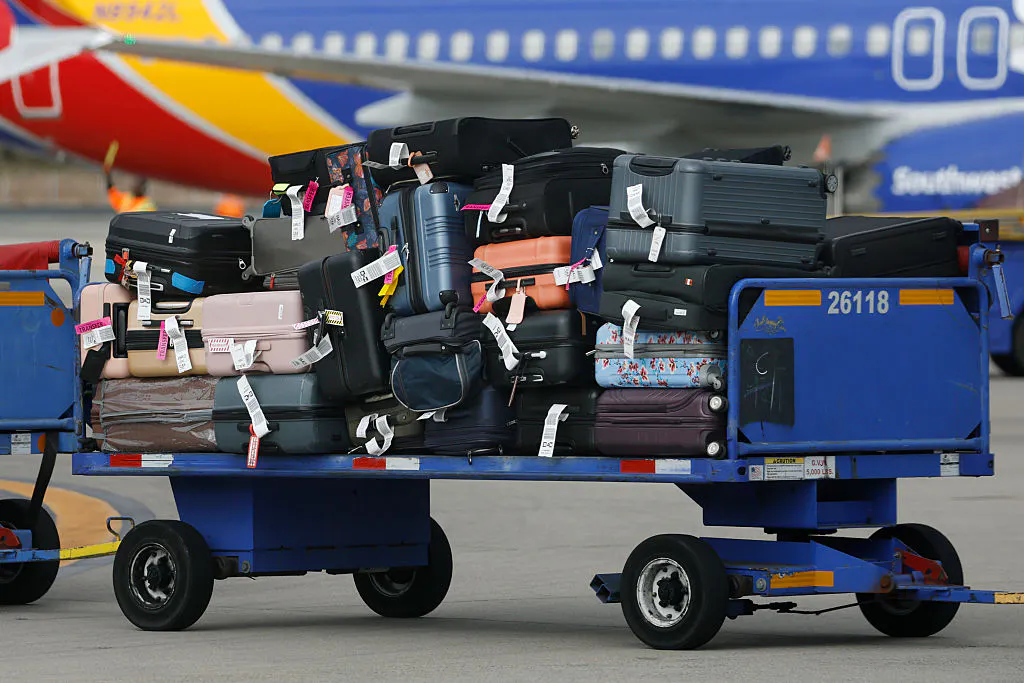
With Delta’s move to hike its bag fees by $10 on domestic flights beginning Wednesday, three of America’s six largest airlines have now raised the prices customers must pay to check their luggage in recent days. (JetBlue and United Airlines made the move last week.)
If history is any indicator, more airlines are likely to follow. Delta last hiked bag fees in March 2024, after United, JetBlue, American Airlines, and Alaska Air all chose to do so.
Bag fees are benefiting the aviation industry more every year. Through the first three quarters of 2025, checked luggage charges generated $5.47 billion in revenue for the country’s largest airlines — up about 12% from the industry’s full-year total in 2018.
The soaring price of jet fuel is largely to blame for the recent fee hikes. According to a Tuesday research note from Deutsche Bank, if jet fuel costs remain at their present level — they reached $4.69 a gallon on Monday, per the Argus US Jet Fuel Index, more than doubling from early February amid the war in Iran — the industry could be looking at a fuel cost headwind of roughly $40 billion this year. With the cost of inputs (i.e. fuel) significantly higher, airlines — which tend to operate on tight margins and rely on fees and credit card partnerships for profits — are increasingly tweaking the pricing of their services (transporting bags, humans, etc.).
Given the cost of fuel this time, airlines may not stop at checked bags.
Carriers have already hiked airfares in recent weeks, and United CEO Scott Kirby last month said they’d need to rise another 20% for the airline to “break even.” Deutsche Bank puts the industrywide figure at 17%, should fuel prices remain where they are. But, given the discretionary nature of air travel and the potential for demand to drop rapidly, airlines may look elsewhere to make up for the higher costs.
“Airlines have never seen a significant jet fuel price increase that they haven’t in some way, shape, or form passed along to consumers. And this will not be the exception,” said Bill McGee, the senior fellow for aviation at the American Economic Liberties Project. “But at the same time, they’re also scared as hell, because between the war and the TSA issues, the hassle factor of flying right now is extremely high.”
Messing with fares too much could risk a significant drop in demand. Still, shareholders will expect airlines to try everything they can to curb potential losses. As McGee put it, “These are the times that try airline executives’ souls.”
Per McGee, ancillary fees — also called junk fees — come in two varieties: those that genuinely reflect a cost for airlines (like handling baggage), and those that don’t (boarding group order, the price of a window seat vs. an aisle seat, etc.). In a crisis, airlines are more likely to hike or institute fees where there is a back-end cost, given that passengers are less likely to give those services up. This, McGee said, is why passengers shouldn’t expect Delta to be the last major carrier to hike baggage fees.
Fees were designed to generate revenue without taking the risk of hiking base fares. Should fuel costs remain elevated, airlines may look to boost the price of other ancillary revenue streams like seat assignments, boarding group numbers, and even carry-on luggage.
In considering what could come next, McGee typically looks to Ryanair — Europe’s ultra low-cost powerhouse, which first normalized bag fees in the early 2000s.
“[Ryanair CEO Michael] O’Leary is, in many ways, the id of airline executives,” McGee said. Among other choice revenue-boosting ideas, O’Leary has suggested charging passengers to use the bathroom, charging travelers to print boarding passes, and creating a standing-only section on planes. “US airline execs don’t exactly have the guts to say the things he says, but they listen. There’s nothing that they haven’t thought about monetizing.”
“These are the times when airlines are looking at introducing fees that they may not have introduced otherwise. These meetings are happening in real time, in Atlanta, in Dallas, in Chicago,” McGee said. “It becomes easier to do during a crisis.”
So, could more US airlines begin charging for carry-ons?
“Let’s put it this way,” said McGee: “It’s on the table in a way that it wasn’t two months ago, right?”



