Business
shopper
(Jaydee Lee Serrano/Getty Images)

The Federal Reserve’s economic vibe check shows businesses are spooked by tariffs

Notably, many of the businesses reportedly feeling the crunch are manufacturers, which the administration has proclaimed would benefit from tariffs.

J. Edward Moreno

The Federal Reserves economic vibe check, also known as the Beige Book, painted a picture of business and community organizations rattled by uncertainty over President Trumps chaotic tariff policies.

The most recent edition, released Wednesday, spanned most of March and April. During that short time, the Trump administration has flip-flopped on its tariff policy many times, and according to businesses surveyed by the central banks 24 branches, the pain has already started to be felt.

The report mentioned tariffs and uncertainty 105 and 80 times, respectively, the most since it started being collected in 1970, an analysis from Bespoke Investment Groups George Pearkes found. References to “cuts” and “layoffs” are also rising to levels that have coincided with either recessions or serious growth scares, like the shale bust or high-inflation episode that followed the pandemic.
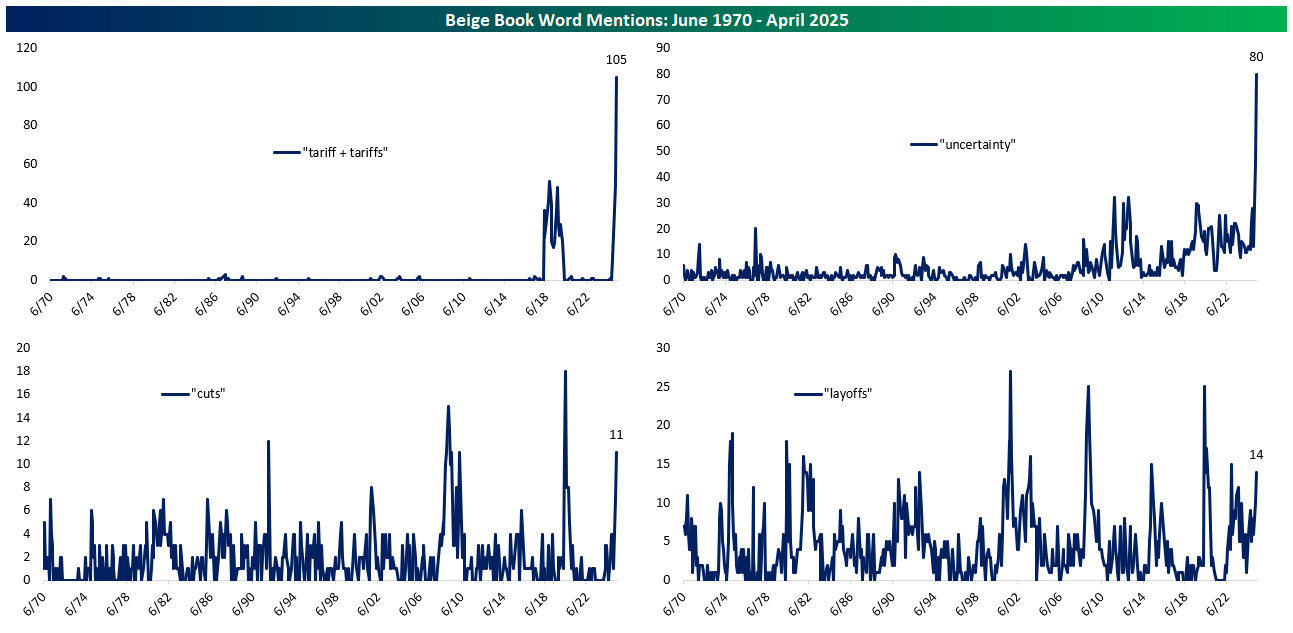
image (5)
(Bespoke Investment Group analyst George Pearkes)

Notably, many of the businesses reportedly feeling the crunch are manufacturers, which the administration has proclaimed would benefit from tariffs but so far are seeing rising costs that they hope to be able to pass along to their customers. Many companies also reported adopting a wait-and-see approach to hiring and more are now considering layoffs. Meanwhile, community organizations like food banks are grappling with increased demand coupled with cuts in federal grants and subsidies. Some highlights:

Port contacts were particularly concerned about the proposed port call tax on Chinese vessels which, by their estimates, could quadruple cargo handling costs. Some ports received multi-million-dollar tariff bills on Chinese cranes that were already ordered and enroute as tariffs were enacted and are now subject to the tariff. Rail saw record volumes this period with high storage levels; contacts attributed the extra cargo to tariff front-loading and extended gate hours to accommodate the extra freight. — Richmond Fed

Firms broadly expressed trepidation about the effect of tariffs on demand and costs, with some contacts indicating they will not be able to pass on the increases to clients. — Dallas Fed

A manufacturer reported that what initially looked to be a mild impact had worsened and was forcing them to evaluate sourcing options. — St. Louis Fed

Many firms raised prices amid higher costs resulting from tariffed inputs, and even some firms not directly impacted cited tariffs and less foreign competition as a trigger for price increases. — Atlanta Fed

More Business

See all Business
The entrance of Allbirds seen from Hayes St. in San Francisco, Calif.

Allbirds, the once buzzy multibillion-dollar sneaker startup, is selling up for $39 million

That’s less than 1% of its peak market cap about four years ago.

Tom Jones3/31/26
business

JetBlue is raising its bag fees as fuel costs squeeze airlines

JetBlue will reportedly hike its bag fees, as the cost of jet fuel continues to climb amid the war in Iran. It’s the latest example of carriers finding ways to push rising costs onto travelers.

Last week, United Airlines CEO Scott Kirby said that if fuel prices remain elevated, fares would need to rise another 20% for his airline to break even this year.

As CNBC reported, when one airline raises fees, others tend to follow.

Earlier this month, JetBlue hiked its first-quarter outlook for operating revenue per seat mile to between 5% and 7%, saying that strong Q1 demand helped “partially offset additional expenses realized from operational disruptions and rising fuel costs.” Now, the carrier appears to be making moves to further boost revenue to offset those costs.

Earlier on Monday, JetBlue rival Alaska Air lowered its Q1 profit forecast. The refining margins for the carrier’s cheapest fuel option — sourced from Singapore and representing about 20% of Alaska’s overall supply — have spiked 400% since February.

JetBlue did not immediately respond to a request for comment.

As CNBC reported, when one airline raises fees, others tend to follow.

Earlier this month, JetBlue hiked its first-quarter outlook for operating revenue per seat mile to between 5% and 7%, saying that strong Q1 demand helped “partially offset additional expenses realized from operational disruptions and rising fuel costs.” Now, the carrier appears to be making moves to further boost revenue to offset those costs.

Earlier on Monday, JetBlue rival Alaska Air lowered its Q1 profit forecast. The refining margins for the carrier’s cheapest fuel option — sourced from Singapore and representing about 20% of Alaska’s overall supply — have spiked 400% since February.

JetBlue did not immediately respond to a request for comment.

Latest Stories

Sherwood Media, LLC produces fresh and unique perspectives on topical financial news and is a fully owned subsidiary of Robinhood Markets, Inc., and any views expressed here do not necessarily reflect the views of any other Robinhood affiliate, including Robinhood Markets, Inc., Robinhood Financial LLC, Robinhood Securities, LLC, Robinhood Crypto, LLC, Robinhood Derivatives, LLC, or Robinhood Money, LLC. Futures and event contracts are offered through Robinhood Derivatives, LLC.